
After a law firm interview or callback, thank the recruiting contact or the attorneys you spoke with through the channel the firm or your law school recommends. A useful email names the position or summer associate opportunity, recalls one practice-related conversation, and confirms interest only if true. Keep the note short and professional; never share client information, internal matter details, or promises you cannot make. Law-school career offices vary: some favor individual personalized notes, while others allow a coordinator-routed note, and recommendations on handwritten cards versus email differ. Check the actual recruiting instructions rather than treating one practice as universal.
Use the recruiting structure to choose recipients
A screening interview, a callback and a substantive meeting with a practice-group attorney are different events. For a callback with several lawyers, take private notes about who covered which practice topics. Georgetown Law’s callback guidance encourages thoughtful, individualized follow-up, while another Georgetown resource notes that a recruiting coordinator can receive a consolidated note when individual personalization is not practical. These approaches are not contradictions to conceal: they are options depending on the employer process and the type of interaction. Ask your law school’s career office when a firm or recruiting program has its own expectation.
If you have professional addresses from the firm, direct a note to the attorney whose discussion you can genuinely reference. If only the recruiting coordinator communicated with you, thank them and ask that your appreciation be passed on. Do not infer an attorney’s personal email address from a firm pattern or contact associates through social media. Distinguish the person who arranged lunch and travel from the attorneys evaluating your work. Administrative thanks should be warm but should not carry detailed claims about client matters or legal judgment.
Mention a practice interest without implying a case assignment
Suppose you spoke with an associate about how new lawyers receive feedback on legal research. You might write, ‘I appreciated your explanation of how junior associates receive research feedback on the litigation team.’ This is a hypothetical illustration, not a report of a real firm. The statement is about professional development, not a particular client dispute. If the conversation concerned public practice areas or the firm’s published training program, reference those accurately. Do not imply that an attorney promised you a seat in a practice group when the conversation was exploratory.
Avoid an email full of case speculation. The interviewer may have discussed a confidential client or a hypothetical legal scenario. Your thank-you is not a legal memorandum and should not reveal sensitive factual details or continue arguing the legal merits. You can say ‘I enjoyed learning how the team approaches complex research questions’ rather than naming confidential facts. Honesty also applies to your own background: a moot-court exercise or clinic simulation can be described as academic experience, not actual representation of a private client.
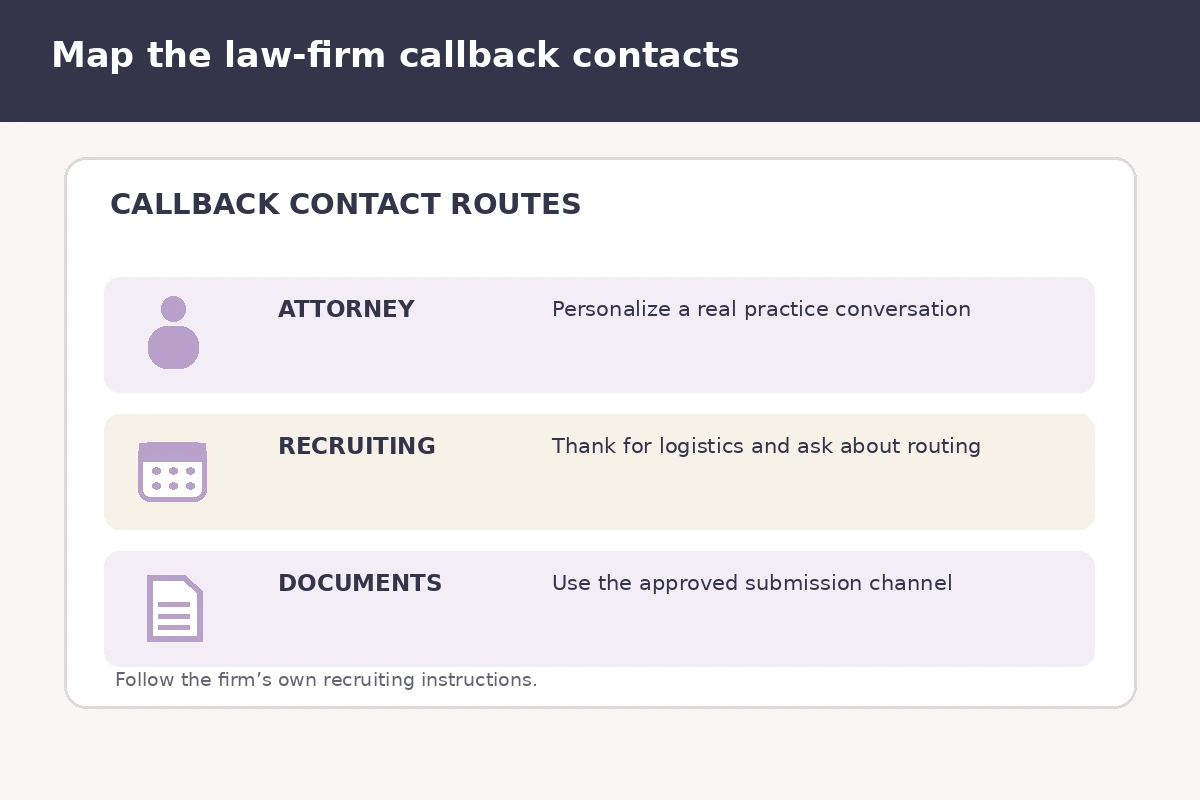
| Situation | Good evidence to mention | Boundary to check |
|---|---|---|
| Screening interview | One substantive conversation | Personalized short note |
| Multi-attorney callback | Several distinct discussions | Individual notes or approved coordinator |
| Recruiting coordinator | Schedules and materials | Logistics thanks, correct upload route |
Write a professional callback email without mass copying
Hypothetical message: Subject: Thank you — [Firm] callback, [Your Name]. Dear [Attorney Name], thank you for taking the time to meet with me during my callback for the [position]. I appreciated our conversation about [public practice or training topic actually discussed], particularly your explanation of [specific point]. It helped me understand the team’s approach to developing junior attorneys. I remain interested in the opportunity and appreciate the chance to learn more about the firm. Sincerely, [Your Name]. Adjust for the attorney, position and conversation; never send unreplaced brackets or invented compliments.
For a coordinator instead, write: ‘Thank you for coordinating yesterday’s callback. I appreciated meeting the team and learning more about the [actual role]. Please pass my thanks to the attorneys who met with me.’ There is no need to claim that all interviewers were equally involved or that you know the internal hiring decision. If sending multiple notes, vary the one genuinely remembered discussion rather than swapping names in an identical paragraph. Keep correspondence polished because recruiting teams may share messages internally.

Check different guidance on handwritten notes and timing
Some law-school career resources favor handwritten notes; others accept or suggest email for speed. Saint Louis University’s law career guidance describes practice-specific preferences, and Georgetown Law’s callback guide recognizes email as acceptable. A firm that expressly requests communication through an applicant portal should be handled differently from a small practice that supplied a contact card. No one format guarantees a callback or offer. If your school participates in a structured on-campus interviewing program, check that program’s current rules and deadlines first.
Prompt delivery is useful because memories are fresh. If you cannot send a high-quality note the same day, verify names and topics before rushing. A typo in the lawyer’s practice group or a misidentified office can be more distracting than a slightly later message. Do not use the thank-you email to push for a decision before the recruiting timeline. If another employer gave a real offer deadline, tell the recruiting contact factually in a separate scheduling email rather than blending it with praise.
Keep professional boundaries and shared documents clear
A firm may request a writing sample, transcript, or references through its recruiting system. Do not attach work product that belongs to a client, a former firm or a clinical placement without explicit authorization and suitable redaction. Even a document with names covered can expose strategy, proprietary facts or metadata. Use a school-approved writing sample or a document you have rights to share, and follow the employer’s required channel. The thank-you can simply offer to provide the requested materials through recruiting when ready.
Do not overstate legal credentials. If you are a law student, do not sign as an attorney. If admission to the bar is pending, state your real status in application materials rather than implying it is complete. A callback note is not an appropriate place to make promises about legal outcomes, revenue, or client contacts. It can demonstrate discretion, attention to detail and a genuine understanding of the training and practice area. Those professional traits are far clearer than inflated claims about influence inside the firm.

Audit the final message before sending
Check the firm name, office location, attorney name, role, practice group, and whether the conversation actually happened. Remove internal hiring information and any identifying client details. If the firm operates in several markets, don’t mix locations because its careers page has similar language. Confirm the chosen channel; a note through the coordinator may be correct if that is how the callback was organized. Ask your career adviser to review uncertain etiquette rather than assuming what is required everywhere.
Save a record of the note without recording private client information. Continue evaluating the position and the interviewers’ answers about training, workload and mentorship; a thank-you does not bind you to accept an offer. If you later need a status update, use the contact and schedule provided by the recruiter. A well-written law firm follow-up is brief, specific and trustworthy, and it preserves the same confidentiality you would be expected to honor when practicing law.
How We Research This Interview Email Guide
We reviewed the following university, professional and occupational sources on November 16, 2026: Georgetown Law career guidance on callback interviews and personalized thank-you notes. Georgetown Law guidance offering coordinator routing as an alternative to individual notes. Saint Louis University Law guidance on prompt thanks and practice-specific email or handwritten preferences. ABA Student Lawyer discussion of professional legal recruiting follow-up. We also reviewed the supplied WordPress list, including drafts, to avoid repeating existing article titles and search intents. Guidance from different career offices can vary; where it differs, follow the employer’s actual process. All sample emails are hypothetical and require personalization. No paid services are recommended here. See the JobAsk affiliate disclosure.
More Interview Preparation Guides
Not always. Law-school resources offer different approaches; use a firm’s instructions and individualize notes when you can genuinely do so.
Career-center guidance varies by law-school and firm culture. Choose the permitted, timely and polished method.
Avoid repeating nonpublic client details or strategy. Refer to the broader public practice area or training discussion instead.
Only if requested and authorized; use the firm’s required route and a sample that you are permitted to share.
A short note asking the coordinator to convey thanks may be appropriate when the firm’s preferences allow it.