
Law office jobs with no experience often begin in reception, records, scanning, scheduling or administrative support—not in giving legal advice. A new employee may help route calls, maintain a file index or track a document’s status while a lawyer or trained legal professional owns its substance and approval. Before applying, read the title and tasks closely: “legal receptionist” and “paralegal” can imply very different preparation. You can show useful entry-level skills through accuracy, confidentiality and careful handoffs without pretending to know litigation procedure or to advise a client.
Search for clerical support instead of assuming every legal title is entry level
Possible search terms include legal receptionist, office assistant, records clerk, file clerk, administrative support and intake coordinator. Compare them with listings for legal secretary and paralegal. The BLS notes that legal secretaries may need additional training in terminology and office procedures, while paralegals have specialized duties and education pathways. Do not treat “no law degree” as equivalent to “no experience.” Some offices want a trained professional for calendar deadlines, client correspondence or document preparation. An honest applicant should target roles where the employer explains training and supervision, and flag postings that expect independent legal judgment under an entry-level label.
Understand client intake without promising legal advice
A front-desk employee may collect contact details, route inquiries, check appointments and note which staff member should respond. That does not authorize the employee to tell a caller whether they have a case, promise that the firm will represent them, interpret a filing deadline or discuss confidential matters with the wrong person. In an interview scenario, say you would use the firm’s script, limit questions to approved fields and pass legal questions to the responsible attorney or designated trained team member. If someone is upset, remain calm and record the request accurately rather than making an unsupported promise. The quality of a handoff can matter more than knowing an obscure legal term.

Keep a reliable document trail and version history
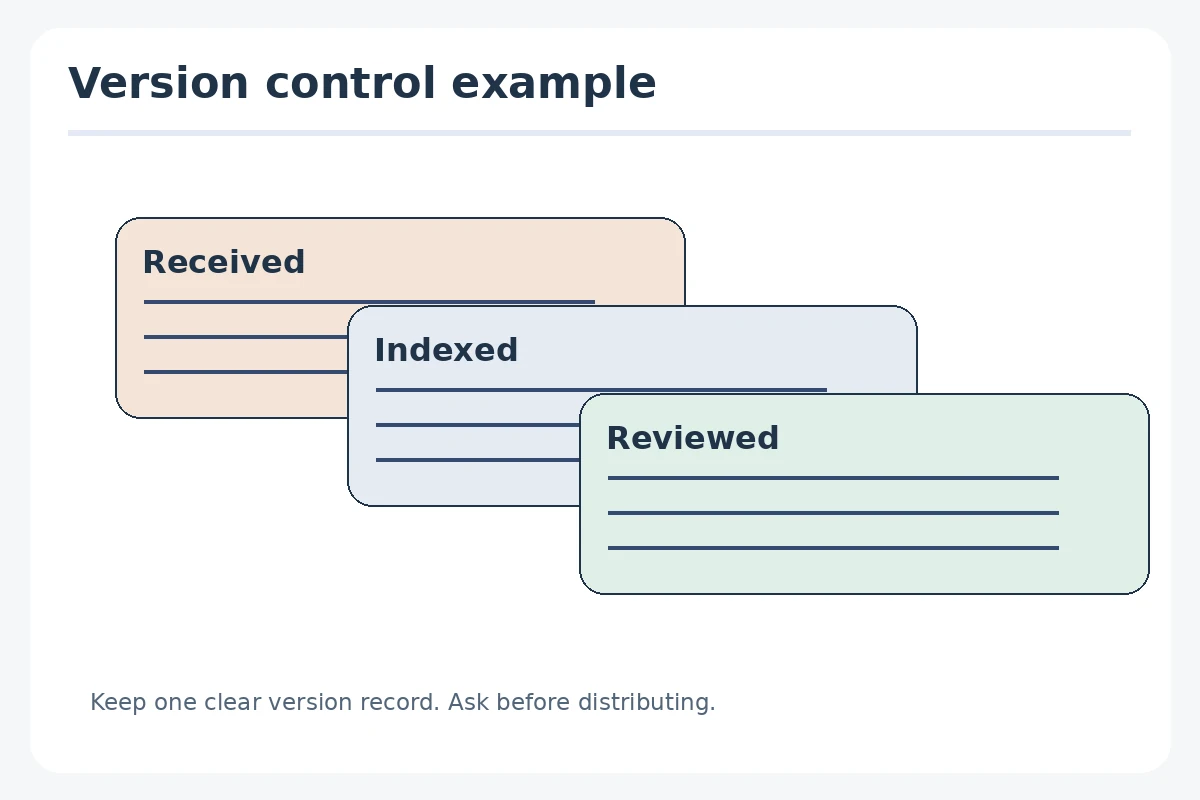
Legal offices handle files whose correct version and destination matter. A trainee may scan, name, index or file documents using the office’s established conventions. A simple method records the document type, date, matter ID as provided by the employer and current status without inventing facts. Before sending anything, verify recipient and authorization under firm procedure. If two attachments share a name but differ, do not guess which is final: ask the designated reviewer. Avoid learning this skill through actual client documents outside authorized systems. You can demonstrate the same habit with fictional file names and a small document index in a sample exercise.
Respect confidentiality even in a job interview
You may be asked how you handle sensitive information. Explain a method, not a real client story. For example: use approved access controls, do not discuss matters in public areas, verify recipients and report accidental disclosure according to policy. Never bring a previous employer’s client list, case excerpts or internal communications as portfolio proof. If you have customer service experience, describe how you protected names or orders without revealing a person’s details. Also recognize that legal offices may have specific retention and conflict-check processes that trainees must learn. Privacy consciousness is not proof of being qualified to interpret law.
Compare the job’s schedule and training expectations
Some offices need reception during fixed business hours; others have litigation or transaction deadlines. Ask about telephone coverage, document processing peaks, calendars and which tasks are time sensitive. A role mentioning court filings or deadlines requires especially clear instructions and review ownership. Do not assume you will calculate legal deadlines yourself. Confirm whether training includes document management software, legal terminology, intake scripts and error reporting. If the position combines receptionist duties and paralegal tasks, request details before accepting. The label is less important than the work you will actually be authorized to do.
Use school and ordinary office examples carefully
A candidate who organized club registrations, scheduled meetings or reconciled filenames can show relevant discipline. One honest resume example is: “Maintained a shared event sign-up sheet, verified required fields, and referred unclear entries to the coordinator.” That is transferable administrative experience; it is not “managed legal intake.” If you practiced a case-file index using fictional data, label it as a practice exercise. Familiarity with word processing, calendars and spreadsheets may be useful, but do not list specialist case-management software unless you have used it. Keep your bullets concrete and your role boundaries visible.

Prepare for common accuracy and confidentiality questions
An interviewer might ask what you would do when a caller demands an immediate answer or a document arrives without identifying details. Begin by confirming what is known, keeping private information secure and routing the question to the proper person. Explain how you would record the uncertainty so the next employee can act. If you notice a mislabeled document, pause the distribution step and ask for review rather than making a silent correction. A good entry-level answer shows reliable judgment and escalation. It does not claim that you would decide legal strategy, grant exceptions to policy or guarantee a case outcome.
Check for a trustworthy first workplace and apply precisely
Use the firm’s official contact information to confirm that the opening is real. Look for a clear position description, named hiring channel and realistic request for credentials. Do not send sensitive IDs or payment details simply because a message claims to be from a law firm. Tailor the application to the exact administrative duties: phone routing, file organization, schedule accuracy and confidentiality. Keep a copy of the materials you submitted and note the contact person. The most valuable first legal-office position is one where you can learn the firm’s process under supervision, not one that expects untrained staff to perform attorney work.
How We Research Beginner Job Routes
We compared U.S. government occupational descriptions, official worker-protection guidance and role-specific evidence rather than treating any one advertisement as a promise of a vacancy. Requirements can differ by employer, location, task authorization and date. The hypothetical examples above are learning exercises, not fabricated job offers, credentials, or guarantees of hiring. Always confirm the final scope and terms directly with the employer and the relevant authority where applicable.
Sources checked November 10, 2026: www.bls.gov; www.bls.gov; consumer.ftc.gov. Our editorial and affiliate policy is described in the affiliate disclosure. This informational article does not promise placement, income or hiring outcomes.
Related Job Search Guides
Some clerical and receptionist roles do not require a law degree. Paralegal and legal secretary roles may have different training or education expectations.
Do not interpret legal deadlines or provide legal advice outside your role. Route the question to the authorized legal professional.
Use fictional file indexes, a generic intake checklist or other practice materials—never real confidential client records.
No. Duties overlap in some workplaces, but specialized legal support and clerical administration are not interchangeable titles.
Yes, through general practices such as access control and recipient checks, not through identifiable past-client details.