
A law student resume for a U.S. legal internship or entry-level legal position normally starts with education and then shows the most relevant experience, research, activities and writing evidence. Yale Law School recommends a clear, honest student resume with choices guided by relevance and recency; Harvard Law’s public-interest advising similarly emphasizes education and specific legal work. The resume should not imply that a student is licensed, represented clients independently or performed tasks beyond clinic supervision.
Clarify the target legal opportunity before choosing sections
A judicial internship, nonprofit legal program, firm summer role and research assistantship can value different evidence. Read what the application asks for: writing, client support, legal research, service, or an academic record. Then select experiences that document those abilities. Do not assume a class topic qualifies someone to practice in that field or that a prestigious-sounding organization name outweighs a detailed account of work actually performed.
A useful preparation step is to place the job description beside the resume and underline every requirement you can support honestly. If an employer requests a transcript, writing sample or cover letter, treat those as separate materials. The resume does not have to reproduce an entire writing sample or journal article, but it can identify a supervised research memorandum, a documented publication or a clinic project that the reader could ask you to discuss.
Build an education section that identifies your stage
List the law school, expected or completed J.D. or LL.M. degree, graduation date and relevant distinctions you have actually earned. An academic appointment, journal membership, clinic participation or competitive award may belong in Education or an Activities subsection depending on its role. Harvard Law and Yale Law guidance differ in some stylistic details, so regard their examples as school-specific advice and follow the conventions of your own career office and target employer.
Do not put a completed J.D. or bar admission in the header if you are still studying. “J.D. candidate, expected May 2027” is an illustrative date format, not a claim about any real applicant. Similarly, an application to a clinic is not clinic experience until accepted and undertaken. Pending courses or future commitments can be labeled appropriately, but a resume should never convert an intention into a completed credential or case assignment.

Show clinic participation with supervisor boundaries
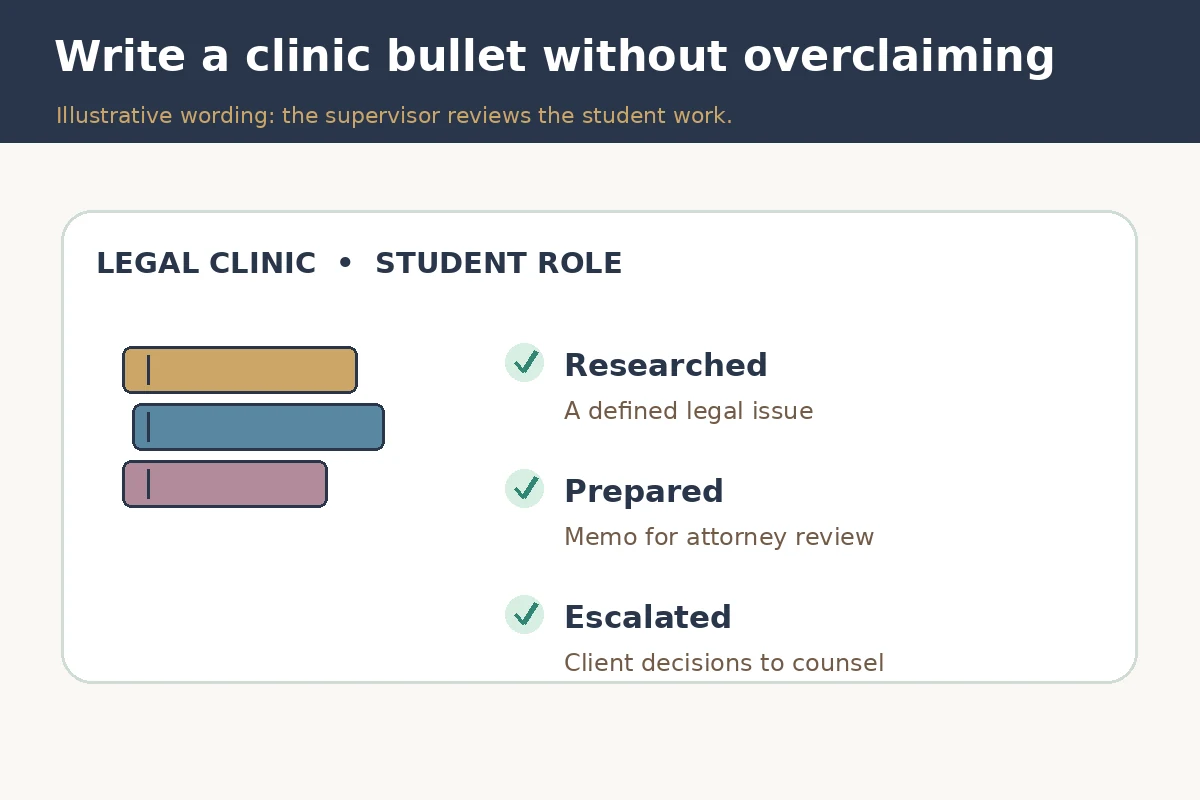
Clinic descriptions should identify the actual task, the clinic or supervising context, and what work product the student prepared. Examples could include researching an issue, organizing a case file under instruction, drafting an internal memorandum for review, or participating in authorized community outreach. Avoid stating that you independently advised a client, negotiated a settlement, appeared in court or signed filings unless that precisely describes an authorized activity and your role is accurately represented.
A hypothetical bullet might read: “Researched tenant notice requirements and prepared an issue summary for supervising clinic counsel to review.” That is a safe structural example, not an assertion about the rules of any jurisdiction. Replace it with the actual subject and work, omitting confidential names or privileged details. An employer learns more from a clear supervised research task than from a vague claim to have “handled cases.”
Choose research and writing evidence rather than long course lists
Legal employers may value the quality of your writing and analysis. A journal note, approved class research paper, externship writing assignment, or faculty research assistantship can supply evidence, but describe each accurately. If a writing sample was edited substantially by another person, do not conceal that fact when the employer asks about authorship. Your resume can mention a project without attaching any protected or unpublished material.
Use a compact line that identifies the setting and type of work product. For example, “Prepared a comparative case-law memo for a seminar project; revised analysis after faculty feedback” is an illustrative academic activity. Avoid turning the word “analysis” into an implied legal opinion offered to a client. If you have a journal position, note the actual role and dates rather than assuming a member and editor have the same responsibilities.
Keep experience chronology and nonlegal work visible
Yale Law School recommends listing experience in reverse chronological order and including paid or unpaid work when it is relevant. A law student may also have prior retail, teaching or administrative work demonstrating deadlines, writing or public-facing communication. It is reasonable to compress less relevant jobs without deleting all evidence of a sustained employment history. For public-interest roles, volunteer and community work can provide especially useful context.
For a student who worked before law school, divide the section only when doing so helps the reader. “Legal and Research Experience” followed by “Additional Experience” can make sense if the split is truthful and does not conceal dates. Keep employer, place, role and time period together. Using a smaller font to fit every college club often weakens the document more than selecting the few activities that show service, research or leadership.
Apply plain, consistent formatting
Yale Law School favors a visually clean student resume, usually one page, with a readable standard font and consistent emphasis. Its particular font and margin suggestions are guidance for its applicants, not a legal requirement. A single-column layout with clear section headings and aligned dates is easier to edit and audit than a design packed with icons and decorative sidebars. Emphasize the applicant’s work product, not visual novelty.
Export the format requested by the employer, and inspect the final PDF if a PDF is requested. Confirm that tabs and spacing survive and a second page was not accidentally created. Cross-check every date and honor. When a law school or clerkship program supplies a local format or sample, use that official direction even if a generic resume tutorial recommends a different style.
Prepare separate writing samples without breaching confidentiality
If the employer requests a writing sample, follow its length and editing rules. Do not attach client records, privileged drafts or an employer’s internal memo simply because the writing is strong. Ask the relevant supervisor or career office about permissible redaction and permission. A resume bullet can indicate “drafted research memorandum under attorney supervision” without revealing a client identity or protected fact pattern.
Yale Law’s application materials guidance explains that samples should show current analysis and writing skills; specific placements may have additional rules. Keep a private list of examples you can discuss in interviews, with the actual extent of independent work and review. If an assignment was primarily team work, name your part. Ethical restraint is evidence of professional judgment, not a lost opportunity to embellish.

Use a final relevance and integrity checklist
Before submission, read each entry as if you were the hiring attorney. Can the reader tell what you did, when, and under whose supervision? Can you discuss every line without disclosing confidential information? Does each description refer to a completed task rather than an aspirational plan? Does the legal research section explain more than a list of course titles? These checks make the resume credible even when you have limited legal work experience.
Ask your law school career office to review the document for its specific employer conventions and verify the actual application packet. Double-check current school email access, journal or clinic title, correct spelling of judges and organizations, transcripts, deadlines and file naming. Keep the version you sent so your interview answers are aligned. Never let a format change create a false bar-admission or legal-authority claim.
How We Research Resume Format Guidance
This guide compares firsthand university career-center advice and occupational or medical education sources with a reader-facing layout and factual-claim audit. University samples are examples for their audiences, not binding employer requirements. All resume lines and portfolio descriptions above are hypothetical and must be replaced with the applicant’s real credentials, dates and duties. We do not infer hiring decisions, universal applicant-tracking-system outcomes, licensing rules or work authorization from a resume template. Confirm the current application requirements with the employer, school or relevant authority.
Sources reviewed November 10, 2026: law.yale.edu (Yale Law School explains student legal resume section ordering, research evidence, activities, and concise presentation.) hls.harvard.edu (Harvard Law School public-interest advising describes legal resume header, education, legal activities, and section layout.) law.yale.edu (Yale Law explains writing sample choice, author contribution, and confidential materials.). These sources explain the recommended format and occupational scope, not an individual employer’s application process or result. Review our affiliate disclosure. This informational guide does not imply paid endorsement or approved affiliate partnerships.
More Resume and Cover Letter Guides
Often yes for current law students seeking legal positions. Yale and Harvard Law guidance emphasizes the education section, but the target employer and relevant experience can affect placement.
It can be relevant experience when clearly identified as supervised clinical education. State tasks and supervision accurately, and never imply independent licensed practice.
Yes if it is genuinely your academic work and the description identifies its context. Do not present coursework as a client-facing legal opinion or share confidential content.
Not necessarily. Relevant transferable work may demonstrate accountability and dates; condense it if legal experience needs more space.
No universal rule applies. Yale generally advises one page for its students, while specific applications and career stages can justify different lengths. Follow employer instructions.