
Mailroom jobs with no experience: Mailroom jobs with no experience can involve receiving envelopes and parcels, verifying destinations, sorting items, keeping handoff records and preparing outgoing mail. Focus on corporate or institutional mailroom vacancies, which are different from postal-service carrier or sorting jobs with their own hiring processes. Careful routing and privacy matter more than claiming you know every shipping machine. Read the employer’s actual equipment, lifting, access and training expectations before applying.
Distinguish a nonpostal mailroom from other shipping work
O*NET describes nonpostal mail clerks as workers who prepare incoming or outgoing items for distribution, check addresses and postage, sort by route, and keep necessary records. That is not identical to a U.S. Postal Service vacancy, a delivery driver job or a warehouse order-picker role. Corporate mailrooms may receive packages for offices, process return shipments and maintain secure internal handoffs. A small employer might combine mail and reception duties, while a large facility might separate mail sorting from courier access.
Before applying, write down the exact employer and environment. A hospital mailroom, university distribution room and office tower may have different restrictions around visitors, personal information and restricted packages. Compare three job features: what you handle, how you know the destination and who signs for receipt. A title such as “mailroom associate” does not prove you will operate heavy machinery or interact with the public. Check the posted role description instead of assuming a generic set of tasks.
Follow a traceable incoming-mail process
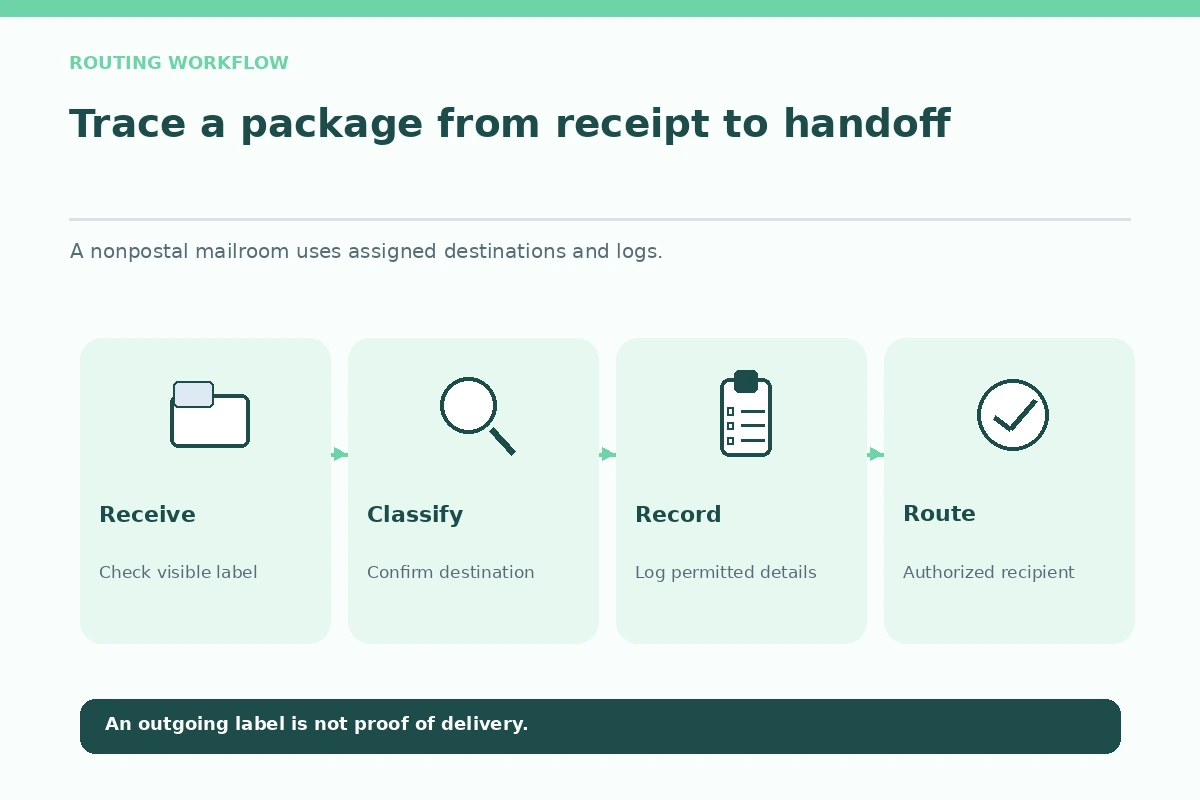
A basic workflow may be receive, inspect visible label information, classify by destination, record an identifier when required, stage securely and deliver through an approved route. The exact order varies by employer and may include scanning or chain-of-custody steps. Avoid opening or reading mail that you are not authorized to access. O*NET includes opening mail among occupational tasks, but that describes the broader occupation; it does not grant every new worker permission to open every item.
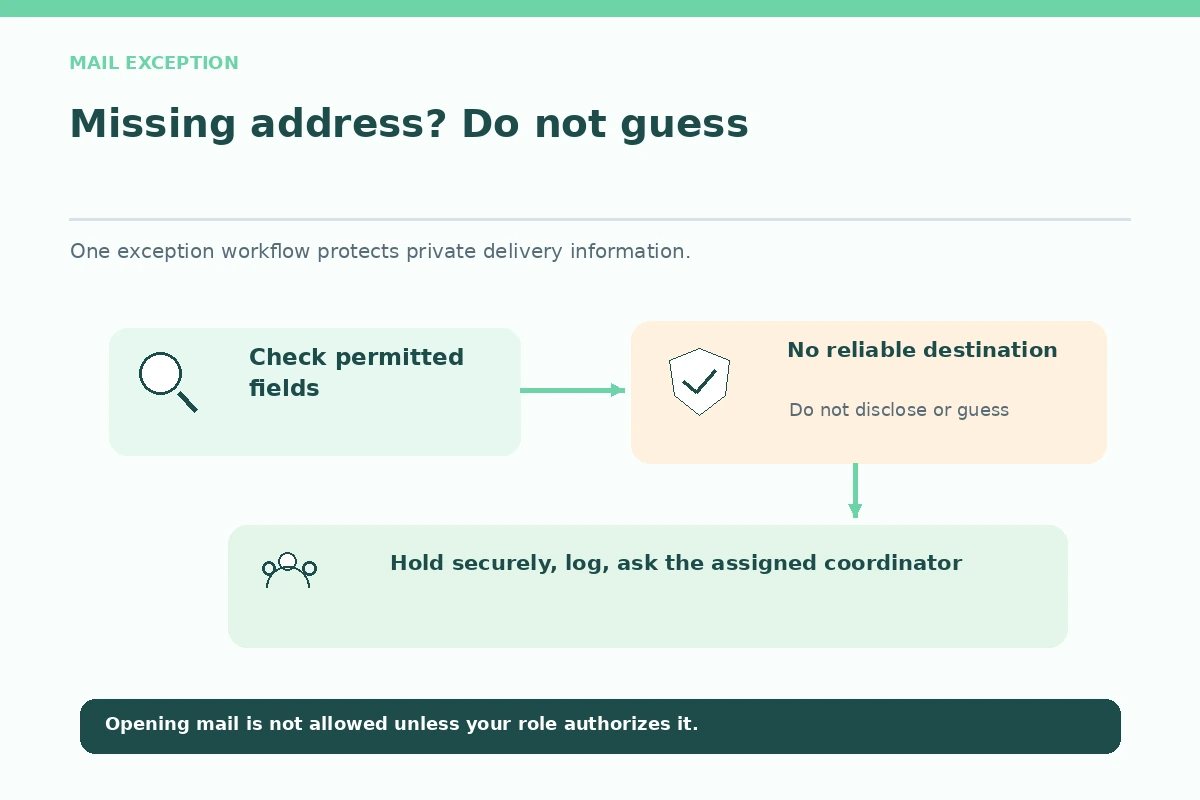
Think about a hypothetical package with an unreadable office number. The safe response is not to guess or search private records without access. Set it aside using the approved exception process, document what you are allowed to document, and ask the authorized coordinator to determine the next step. If a recipient is not available, follow the employer’s handoff or storage rule rather than leaving a sensitive item unattended. Accuracy includes the right person, location and record, not merely speed.
Handle outgoing mail and equipment within training limits
Outgoing work may involve verifying recipient information, packaging, labeling, measuring or weighing, applying postage, and arranging courier pickup. Some mailrooms use postage meters, automated sorters, conveyors or specialized mailing software. Ask what duties are taught to beginners and who is permitted to clear a machine fault. Do not reach into running equipment, bypass guards, alter postage settings or operate powered equipment without the employer’s instruction and authorization. A desire to learn is a legitimate application strength; invented machine familiarity is not.
A useful question to ask the supervisor is what “processed” means in their tracking system: label prepared, item collected by courier, or confirmed delivered. Those statuses are not interchangeable. Record your work at the correct stage and do not claim a package arrived merely because you printed a label. Where the company sets handling limits or security procedures, follow them even when a coworker asks for an informal shortcut.
Translate basic accuracy into a first-job application
Relevant proof may come from school materials distribution, library volunteering, club-event supplies, or any activity where you handled labeled items and checked lists. For example, a person who sorted event materials by room and confirmed quantities with a coordinator might describe those precise actions. This is an illustrative possibility, not a claim about an actual worker. Do not rename volunteer sorting “mailroom operations,” claim confidential-document access, or invent courier volume and error-rate metrics.
Create a four-column worksheet: task from posting, similar action you truly performed, evidence available, and training gap. If you have never handled a shipment tracking tool, state that you can follow an assigned record process and ask about training. If your only experience is preparing packages for family, label it as a personal activity, not a commercial logistics job. Honest, modest examples make it easier to answer interview follow-up questions without exaggeration.
Prepare for exceptions and protect access to records
Mailrooms may encounter damaged packaging, missing recipient information, suspicious contents, an item requiring a signature or a visitor asking for someone else’s package. Follow the company’s documented reporting and security process; avoid independently investigating or disclosing recipient details. A possible interview scenario is, “What would you do if the package label and internal destination disagree?” State that you would hold the item under approved controls, check permitted information and escalate, rather than assume delivery.
Check confidentiality expectations before accepting the position. Some workplaces restrict photographing labels or discussing what employees receive. Do not put real tracking numbers, addresses or personal information into a public portfolio. Ask which software log fields you may use, whether signatures are mandatory for certain deliveries and where exceptions are stored. A record can be accurate without exposing more information than your role needs.

Compare shifts, lifting, and real employers before applying
Mailroom positions may begin around courier arrivals and may involve repeated standing, carrying bins, carts or parcel sorting. Confirm the actual lifting and movement tasks and how the employer provides training and assistance. If a listing includes driving a vehicle or entering restricted facilities, check the distinct qualifications needed. A job that combines reception, shipping and stockroom work may be a poor fit if you only prepared for sorting envelopes; use the posting to prevent a mismatch.
Apply through a verifiable employer site and keep the job reference. Do not pay a recruiter for the promise of employment or send sensitive financial details because an unsolicited message claims a mailroom opening. The FTC advises confirming employers and watching for early requests for personal data. After an interview, compare evidence of training, security rules, actual schedule and duties before accepting. The practical goal is a truthful first position and safe, traceable handling, not an unrealistic promise of immediate independence.
How We Research First-Job Duties and Requirements
JobAsk reviewed original occupational and safety guidance on November 4, 2026: O*NET Nonpostal Mail Clerks (O*NET describes nonpostal incoming and outgoing mail sorting, labeling, routing, and records). O*NET Stockers and Order Fillers (O*NET provides comparison duties for stock and order handling, distinct from corporate mail routing). FTC Employment Scam Warning (FTC describes verification and personal-information checks for suspicious recruiters). These references describe occupational duties and general safety principles; they do not establish a vacancy, opening, state rule, personal qualification, or employer-specific policy.
All illustrated role examples, resume lines and practice scenarios on this page are hypothetical. Verify the actual hiring employer, department requirements, local rules, training, and authorized decisions before acting. We do not claim guaranteed placement, earnings, job access, or an employer relationship. Review the site’s affiliate disclosure for editorial and commercial transparency.
Related Job Search Guides
No. Nonpostal office mailrooms have separate employers and workflows from USPS hiring and operational rules.
Some openings provide training. State transferable accuracy skills and verify the employer’s software and experience requirements.
Only when the employer’s procedures and your authorization explicitly allow it. Otherwise use the exception process.
Hold it according to procedure, log permitted information and refer the discrepancy to the designated person.
It may involve bins, parcels and carts. Confirm the real physical demands and available safe-handling training.