
Quick answer: In a manager interview, pick a true leadership skill you are improving—such as giving timely coaching, adjusting how you delegate, or explaining priorities across shifts—and show what you already do to protect team clarity while you improve. Name the impact without blaming employees, disclosing private performance details, or pretending the problem has disappeared. These are hypothetical examples, not claims about an actual manager.
Choose a Leadership Weakness With Defined Boundaries
A manager’s decisions can affect more than personal efficiency. The O*NET profile for general and operations managers describes activities including coaching, monitoring work, developing teams, assigning responsibilities, and resolving conflicts. Use the actual vacancy to narrow this list. A frontline supervisor will not necessarily have the authority of a multi-site manager; the title by itself does not establish control over budgets, hiring, or disciplinary decisions.
An appropriate weakness might concern the timing of routine feedback or documenting what was agreed in a one-on-one. Avoid claiming an inability to handle essential compliance, safety, discrimination concerns, or critical supervision as though it were a harmless growth area. If you lack a required qualification, this is not a branding issue; represent your experience and authority accurately.
Separate the Habit From Its Effect on Others
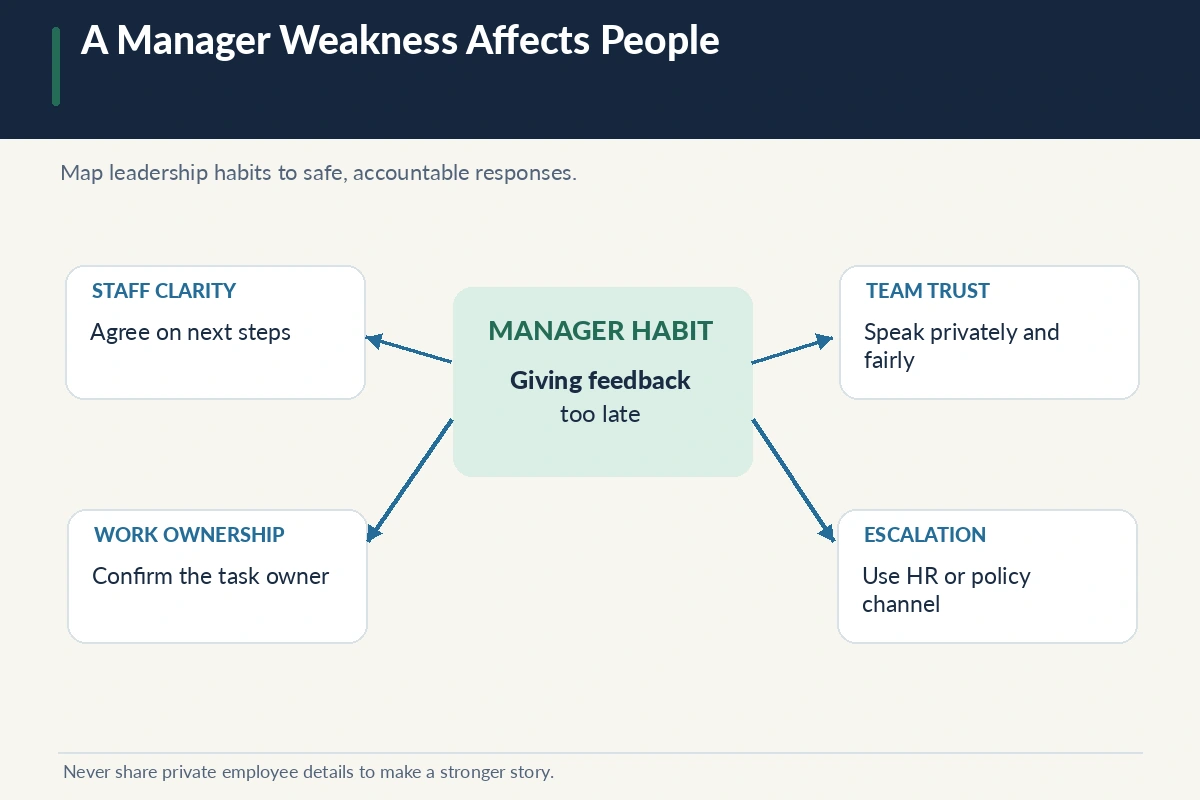
For each candidate weakness, write two columns: “What I did or missed” and “Who needed clarity.” Suppose, hypothetically, that a supervisor used to give instructions verbally without confirming ownership. The limitation is the missing confirmation; the potential effect is duplicate work or unattended tasks. Do not state that such harm actually occurred unless it did.
A defensible answer describes a behavior you control: “I learned that I needed to confirm task owners in writing after our handoffs. I now close planning meetings with owner and deadline checks.” If the speaker has not yet observed improvement, they should not add “This eliminated every delay.” Clear boundaries also matter when a more senior manager, HR, or another function owns a decision.
Discuss Coaching and Feedback Carefully
A manager may be developing a better cadence for coaching. A fictional example is: “Earlier in my role, I sometimes saved useful suggestions for a monthly check-in. I now make room for brief, private follow-ups closer to the work and document agreed next steps. I am learning to make those conversations more consistent during busy weeks.” This describes a growth practice without implying employee misconduct.
Keep disciplinary or personnel examples anonymous and appropriately generalized. Do not share employee medical details, complaints, ratings, or protected information to impress an interviewer. The NACE leadership definition emphasizes developing people and using their strengths. It is a helpful lens for preparation, not a substitute for the employer’s human-resources procedures.
Avoid Fake Delegation Stories and Authority Claims
“I care too much and take over everyone’s work” often sounds like a disguised boast. It can also suggest the candidate does not trust or support colleagues. If delegation is genuinely developing, distinguish defining the outcome, agreeing on authority, and scheduling review points. Example: “I am learning to give a clearer completion standard instead of prescribing every step; I check progress at agreed milestones.”
Do not claim that you gave an employee authority to approve purchases, access restricted systems, or change regulated procedures unless you could actually delegate those decisions. An improvement plan may involve coaching, not transfer of approval rights. Verify who can approve what, and say how you escalate exceptions. Relevant accountability is a stronger management signal than heroic solo problem-solving.

Answer a Behavioral Probe With an Honest Sequence
When asked to illustrate the weakness, set a concise scene, state your specific action, and describe the observable result or remaining gap. OPM explains that structured interviews focus on job-related experiences. Your story should reflect the type of team and authority you actually held; do not inflate a volunteer coordinator position into line-management responsibility.
A hypothetical project lead might say, “During a volunteer event, I gave two teams overlapping setup instructions. After clarifying the assignments, I began sending a single owner list after planning calls. For the next event I still needed to check that everyone had read it.” This is about coordination, not evidence that the speaker formally managed employees. Call it a volunteer leadership example rather than a staffed department.
Use a Coaching-Impact Worksheet Before Rehearsal
Write the role requirement, leadership habit, potential team consequence, safeguard already used, and what you are still evaluating. If one row names a serious business risk you cannot manage, reconsider whether the example is appropriate and whether you actually meet the role criteria. Do not invent a “team satisfaction score” to make a modest process change appear scientific.
Check your verbs. “Recommended” is different from “approved”; “supported onboarding” is not “hired”; “asked HR to review” is not “resolved an employee complaint.” This language keeps the answer within demonstrated authority. Managers who are changing industries should identify transferable team activities and be specific about any missing domain experience instead of claiming identical responsibility.

Prepare for Questions About Team Trust
A hiring manager may ask, “How did people respond?” Attribute feedback only if someone actually gave it, and do not report imagined endorsements. Explain whether you created opportunities for questions, agreed on ownership, or adjusted the frequency of check-ins. The interviewer can evaluate your judgment without a dramatized story in which everyone applauds the change.
A second probe may be about balancing support and accountability. Explain the practical standard, review point, and proper escalation channel without revealing private staff information. For a general answer about a single weakness, review JobAsk’s existing interview guide. This article deals specifically with the responsibility that managers carry for other people’s work and access.
How We Research and Check Examples
We reviewed O*NET role requirements NACE career-readiness framework OPM structured interview guidance on October 28, 2026 and compared this focused question with existing JobAsk strengths-and-weaknesses coverage. The interview examples are original and hypothetical; the sources support general competencies and occupation descriptions, not any invented applicant story or hiring prediction. Career advice is not a substitute for role-specific requirements. Our informational links do not establish paid relationships; see the affiliate disclosure.
Related Guides
- Positive Weakness for an Interview: Be Honest Without a Humblebrag
- Manager Performance Evaluation Examples: Coaching and Accountability
- First Job Interview Weaknesses: Use School and Volunteer Evidence Honestly
- Project Manager Interview Strengths and Weaknesses: Risks and Ownership
- Manager Interview Questions About Decisions, Teams and Accountability
Only when it is genuinely a development area and you can explain real steps to clarify ownership, authority and review points. Avoid a disguised claim that you do everything better.
Yes, if the description is accurate and protects staff privacy. Explain what you changed in your coaching process, not confidential details about employees.
Describe your project coordination honestly. Do not turn that experience into formal hiring, evaluation, or disciplinary authority.
Only if you have a factual basis for that result. Otherwise say what you implemented and what you are monitoring.
No. Match the actual responsibilities and decision rights of the position, whether frontline, operational, project-based or strategic.