
Quick answer. For questions about marketing campaigns, prepare to explain who a campaign was meant to reach, what you personally did, which information was available and what the evidence did or did not show. Questions for a coordinator may emphasize schedules and delivery, while research-oriented roles may emphasize audience insight and methods. Neither requires inventing revenue impact to sound capable. This guide supplies clearly hypothetical examples and a claim-checking worksheet; it does not report real campaigns, job offers or proprietary analytics.
Distinguish Marketing Coordination From Research Decisions
A marketing role may include writing an email brief, coordinating approvals, researching an audience or interpreting a campaign report. The job title alone does not prove the scope. O*NET describes marketing research specialists gathering information and presenting findings; an entry-level coordinator may have a narrower delivery responsibility. Parse the posting into audience, channel, asset production, deadline, measurement and stakeholder communication. Pick examples from tasks you have actually completed instead of describing an entire fictional campaign as your personal achievement.
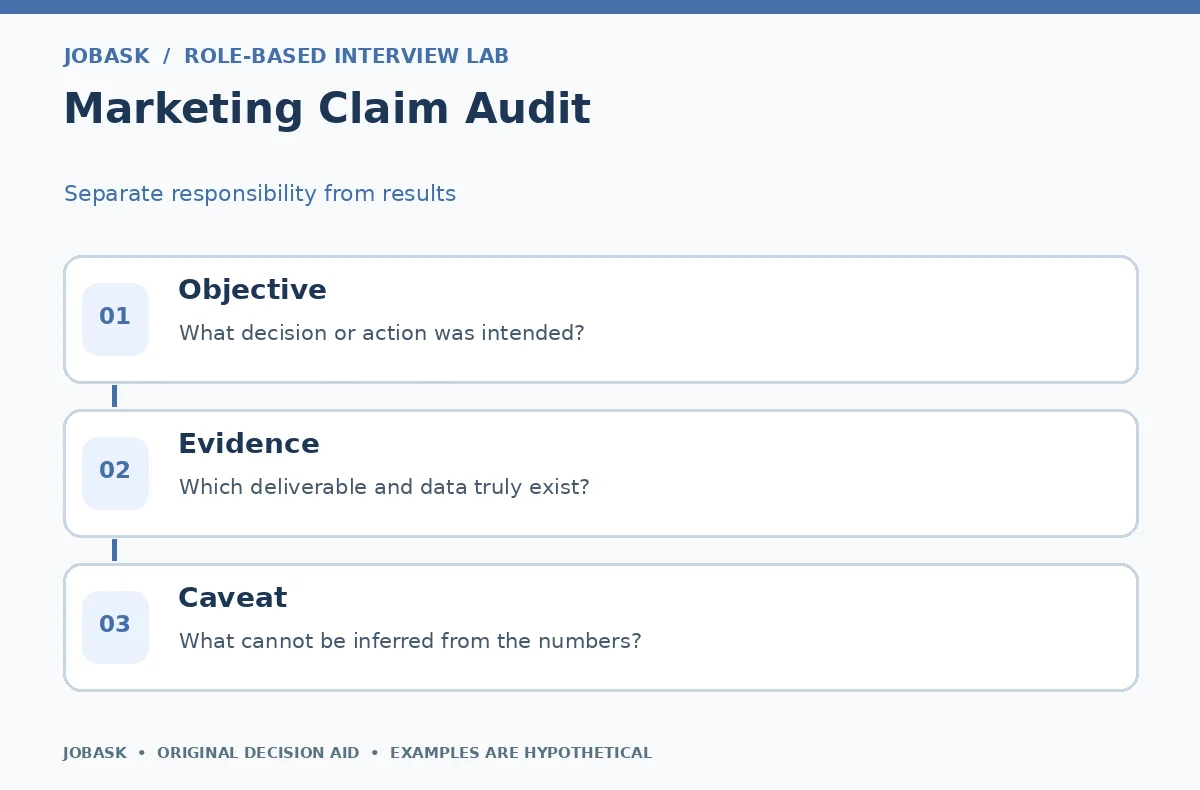
For interview practice, distinguish “I assembled the draft schedule” from “I designed the organization’s marketing strategy.” If you worked in a class project, state that it was academic and identify who supplied the data. A hypothetical sentence is: “In a simulated class promotion, my responsibility was to organize the creative files and present a draft schedule.” This is not evidence of a real company campaign, conversion rate or return on investment. An interviewer can value careful project handling without exaggerated seniority.
Answer Audience Research Questions With Traceable Evidence
“How would you learn what a potential audience wants?” should trigger questions about purpose and method. Clarify the product or message, what decision the research must support, which sources are authorized and how sampling limitations might affect conclusions. You could examine existing customer feedback, approved website data or a small survey, depending on company policy. Never imply that a handful of friends speaking about a brand represents a national customer segment. Ethical research requires describing what was actually collected.
A clearly imaginary interview answer might be: “I would define whether we are trying to understand first-time visitors or current customers, then select a reasonable existing information source and document what it cannot tell us.” If asked for a past example, use an authentic survey or analysis you conducted and state the sample and question. Do not invent a dataset, participant consent or a statistical result to make the story appear stronger. Show reasoning about uncertainty as well as curiosity.
Explain a Campaign Calendar and Missed Deadline
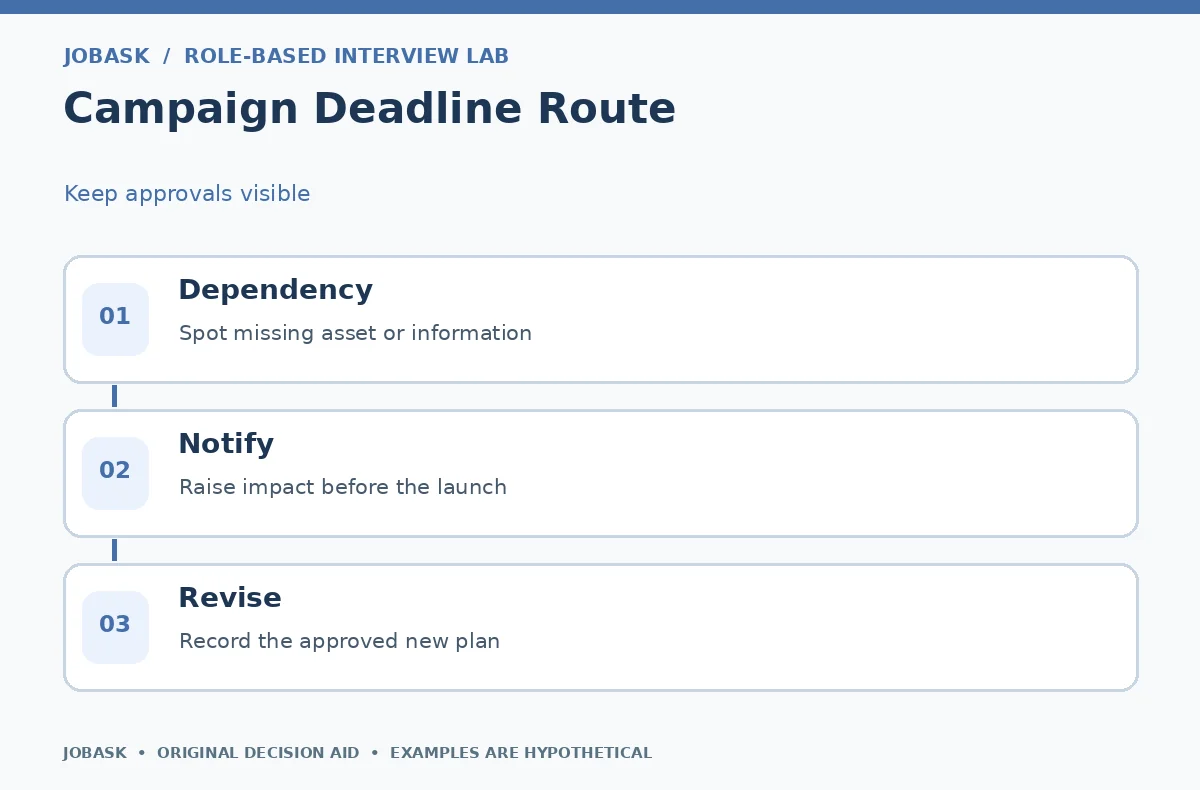
A marketing coordinator may be asked, “What if a designer cannot deliver an asset before a scheduled email?” Describe identifying the dependency early, telling the responsible owner, checking what alternatives are actually approved, updating the calendar and recording the new decision. A deadline issue is partly a communication problem. Avoid claiming that you would launch an unapproved draft or use a customer list without permission. The interview value is transparent coordination within a real review process.
In a fictional scenario, a campaign graphic is delayed by two days. A careful practice response is: “I would check which pieces are approved, flag the timeline impact to the campaign owner and update dependent tasks once a decision is made.” The two-day delay is an illustrative choice, not a report from a real marketing team. If your true example comes from managing a college event, identify that context and explain the task you owned rather than claiming enterprise campaign experience.
Discuss Metrics Without Inventing Attribution or ROI
Questions such as “Which metrics would you report?” need a decision-first answer. For awareness work, reach or traffic could be useful; for a sign-up action, properly defined completions might matter more. But no metric alone proves the campaign caused a business outcome. Identify the goal, measurement source, time period, tracking gaps and who owns access to the analytics. O*NET refers to measuring marketing effectiveness; it does not establish an industry-wide success threshold or guarantee that a given metric is accurate.
A hypothetical practice answer is: “If the goal is to understand visits to a landing page, I would confirm the tracking setup and report visits with the dates and source limitations. I would not call every visit a sale.” This avoids fabricating a conversion percentage. If you observed a project’s actual results, say whether the numbers were available to you or were provided by a supervisor. Rehearse the distinction among activity completed, observed outcome and causal claim. The third is often the hardest to support.
Show How You Test and Explain a Marketing Idea
“How would you improve an underperforming email?” is not a cue to promise a magic headline. State the target behavior, check the validity of the audience list and tracking, look for an approved variable you can change and seek permission for an appropriate test. Explain that a comparison should keep enough factors consistent to interpret differences, while recognizing that small audiences and timing can distort conclusions. This is interview reasoning rather than a prescription for an unverified employer campaign.
For a hypothetical content test, imagine two approved subject lines for an informational email. Your answer should say what success would mean, what the comparison could reveal and what it could not prove. If you do not know whether the company has enough volume for meaningful testing, ask instead of asserting a result. Never invent a lift percentage or claim one phrase always wins. Present an idea with a measurable hypothesis and an explicit caveat.
| Decision to practice | Evidence or next step |
|---|---|
| Define | State metric and time period |
| Locate | Identify the measurement source |
| Limit | Explain gaps in tracking or attribution |
Close With a Campaign Evidence Card
Draft one short card for each authentic project: objective, audience, your responsibility, concrete deliverable, available evidence and limitation. Practice talking through it in under ninety seconds. The card is especially useful when an interviewer asks, “Tell us about a campaign you are proud of.” If the project was a practice exercise, write “simulation” beside it. If results are private, discuss your permitted role without exposing confidential reports. This allows accuracy and usefulness to coexist.
Ask the interviewer how success is defined for the position, who approves messaging, how creative deadlines are coordinated and which measurement tools the team actually uses. Different organizations may have incompatible dashboards and definitions. You can also ask how new employees learn brand approval rules. None of these questions presumes hidden recruiter preferences; they help you understand the real work. Before sending a follow-up, revisit your claims and remove invented numbers or implied responsibility you did not hold.

How We Research Interview Questions
We used O*NET occupation data to ground the distinction between market research, reporting and coordination, and compared it with contemporary marketing coordinator interview topics. These sources do not validate any particular company’s dashboard or interview grading. All creative projects, delays, emails and metrics discussed here are hypothetical. The unique practice tool is an evidence card that prevents unsupported attribution claims. Public sources were checked October 20, 2026; no confidential campaign or verified hiring outcome was reviewed.
Sources and Editorial Disclosure
Sources reviewed October 20, 2026: www.onetonline.org — O*NET reference; www.indeed.com — Marketing reference; www.onetonline.org — O*NET’s reference. Campaigns, audience samples, delays and marketing results are strictly hypothetical. No live company reports, private dashboards or hiring statistics were inspected, and no outcome is promised. JobAsk affiliate disclosure explains possible monetization; the links in this article are informational only.
Related Guides
- Marketing Assistant Interview Questions: Briefs, Claims, and Campaign Proof
- Tell Me About Yourself in a Marketing Interview: Audience and Evidence
- Marketing Coordinator Cover Letter: Link Campaign Work to Reliable Reporting
- Marketing Coordinator Cover Letter: Campaign and Handoff Examples
- Customer Service Interview Questions: Resolve Complaints With Evidence
Expect some mixture of audience research, campaign planning, deadline management, collaboration, metrics, and examples of work you personally performed.
Yes. Clearly label it academic or simulated, explain your own contribution and avoid presenting invented business results as factual.
State your actual experience, explain relevant transferable skills and ask about training instead of pretending you used the platform.
Only when it is real, appropriate to share and calculated from defensible inputs; otherwise discuss the project goal and verified evidence.
Ask about the role’s priorities, approval workflow, audience research sources, campaign measurement definitions and coordination expectations.