
A mechanical engineer cover letter should connect an employer’s design or testing needs to one project you can explain technically. Start with the problem, say what you personally designed or analyzed, and distinguish an observed test result from a prediction. A hiring reader does not need a pile of software names without context. The letter should provide an intelligible engineering decision and point to relevant documentation where appropriate.
The University of Oregon Career Center’s cover letter guide recommends matching a few actual qualifications from the posting with concrete experiences, while University of Pennsylvania Career Services advises tailoring the letter to a particular organization.
Read the Posting Before Choosing Your Example
Check whether the position involves mechanical design, manufacturing support, prototyping, testing, thermal work, or reliability. These roles ask for different evidence. A design posting may care about your modeling assumptions and design iterations, while a test role may focus on controlled procedures, recording observations, and explaining failures. Never pretend that an academic model is a deployed product.
Before you write, list two or three requirements from the posting, such as CAD or testing, and match each to a real project. If a requirement names an analysis method you have not used, do not force it. Choose a skill you can show, such as design or testing, and state the limit plainly.

Select Evidence You Could Explain in an Interview
Choose a real task with a defined constraint, such as limited material, a fit requirement, a manufacturing method, or an observed mechanical issue. Explain your own contribution: model creation, component selection, drawing revision, test setup, or failure analysis. If the work was done by a team, use “our team” for shared outcomes and “I” only for actions you performed.
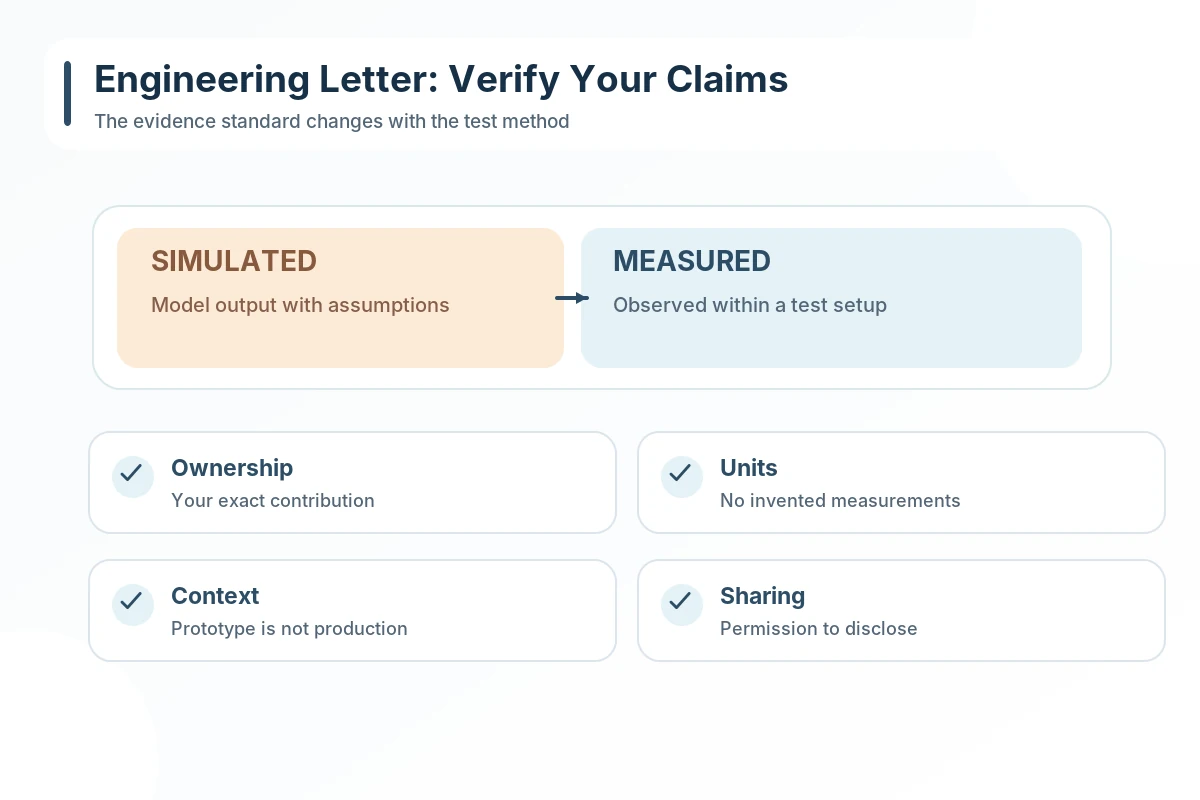
Evidence has levels. A CAD drawing proves you created a representation; a simulation is a prediction under assumptions; a prototype test offers observed data within a test setup; production results require actual production records. Do not collapse these into “proved the design works.” If you have numbers, specify whether they were measured, calculated, estimated, or supplied by the team and ensure you can explain them.
Build the Letter With Four Clear Moves
Open by naming the position and the engineering work that interests you. Follow with one paragraph about a design or test: what you did, how you decided, and what the results showed. Connect it briefly to a need named in the posting, such as product testing. Close with thanks and an offer to walk through your project in more detail.
The Oregon guide groups a letter into an introduction, evidence-focused body, and closing. The Penn guidance treats it as a narrative about relevant skills, not a duplicate of your resume.

Read a Hypothetical Sample Letter and Replace Every Claim
Hypothetical sample only: a fictional engineering letter, not a real candidate or company. Fill every bracket with your own true engineering work.
Dear [Hiring Manager or Hiring Team],
I am applying for the [mechanical engineer role] at [organization]. Your posting emphasizes [specific design, manufacturing, or testing task], which connects with my documented work on [real project and context]. For the fuller picture, see our administrative assistant cover letter guide.
For [actual academic or work project], the constraint was [defined requirement]. I personally [design, calculation, drawing, or testing action], then reviewed [actual analysis or observation] with [team or supervisor, if relevant]. The result I can substantiate is [observed result or honest limitation], rather than an unverified production claim.
That process strengthened my ability to make an assumption visible, revise a design when information changes, and explain trade-offs across a team. I would apply those habits to [the employer’s stated engineering responsibility].
Thank you for your consideration. I would welcome a discussion of my technical contribution, any relevant project documentation I can appropriately share, and your engineering team’s priorities.
Sincerely,
[Your name]
Adapt the Sample for This Employer
Research the employer’s products and posting without inventing a problem they have. Connect your design example to an advertised responsibility, not to a sweeping statement that you will transform operations. A short honest note about collaborating with technicians, communicating drawings, or revising based on tests may be more persuasive than a string of ambitious future results.
Mention a real product line or capability the company describes, then link it to your experience. Remove the brackets, check the hiring manager’s name, and keep a professional tone.
Write Honestly When You Have Limited Experience
If you are a new graduate, a capstone can be strong evidence when you state your contribution and the limits of the test. Describe the assignment, tools you actually used, how the team reviewed the output, and what you would test next. Never imply that a classroom project met an industry standard unless you can verify the standard, process, and result.
In the body, show your own work and do not claim a team’s design as yours. If your example is far from the posting, choose a closer project or explain the skill you are building. For the fuller picture, see our registered nurse cover letter guide.
Remove Claims That Could Undermine Trust
Avoid claiming proprietary projects you cannot disclose, exaggerating proficiency in CAD or simulation tools, or inventing tolerance figures. Do not publish confidential drawings. Replace “improved efficiency by 60%” with a specific verified observation or a plain explanation of the improvement you attempted. Technical readers can ask detailed follow-up questions about your claims. Our guide to engineering resume format goes into more detail.
Before you cite any test result or saving, make sure you measured it and may share it; otherwise, describe the work. Neither the career-center guides nor the occupation source certify a sample cover letter, predict hiring decisions, or validate a candidate’s personal history.
Run a Final Submission Check
Verify the engineer specialty, tool names and versions if relevant, project ownership, what your evidence actually measured, and whether portfolio links are shareable. Proofread units carefully if you mention any. A readable project sentence should name the problem, contribution, evidence, and link to the role in ordinary language.
Keep the letter short and easy for a busy engineering manager to scan. Penn Career Services recommends a tailored letter with a conventional readable format and a clear connection to the position; one page is a practical convention for most nonacademic applications, subject to employer instructions. Check the company name, role title, portfolio links, and attachments. Do not guess the hiring manager’s name.
Read the draft as the engineering manager would: is the role clear, is your project yours, and does it match the posting? Submit through the company’s application channel and keep a copy for interview preparation. For the fuller picture, see our elementary teacher cover letter guide.
How We Research This Cover Letter Guide
The occupational details come from the U.S. Bureau of Labor Statistics occupation profile; letter structure and personalization recommendations are drawn from the University of Oregon Career Center and University of Pennsylvania Career Services.
JobAsk’s general relationship policy is available at our affiliate disclosure.
More Resume and Cover Letter Guides
- Electrician Cover Letter: Explain Training and Safety Without Overclaiming
- Data Analyst Cover Letter: Explain Your Project and Decisions
- New Graduate Nursing Cover Letter: Explain Clinical Training Honestly
- Teacher Cover Letter: Show Classroom Practice With Clear Evidence
- Cover Letter When You Do Not Meet Every Requirement: Explain the Fit Honestly
Yes. Name it as academic work, identify your own contribution, and distinguish simulations from tested or deployed results.
No. Mention tools tied to the specific task and only at the proficiency level you can demonstrate.
Describe the actual observation, what you learned, and the change you proposed; do not invent a successful outcome.
Yes, if the employer accepts links and you have permission to share the materials, with confidential information removed.
Attribute team results to the team, specify your individual design or test actions, and avoid claiming all work as your own.