
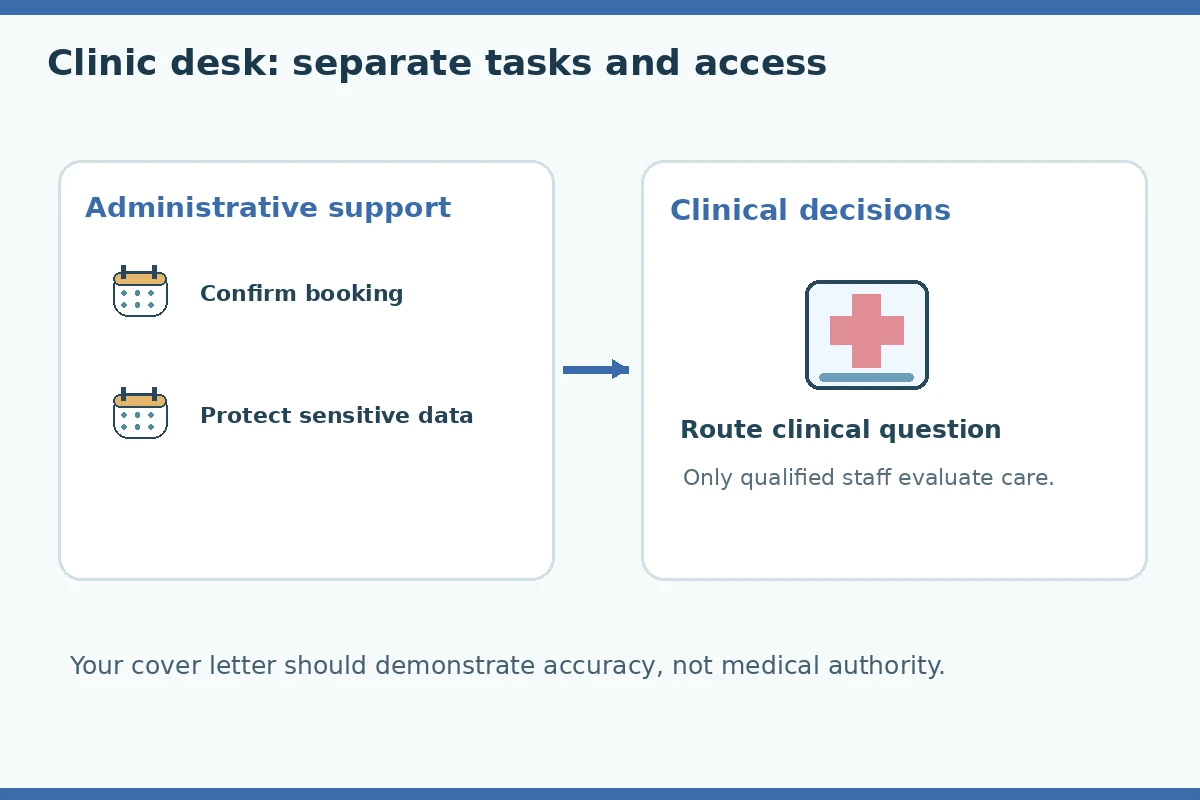
A medical receptionist cover letter with no clinic experience should demonstrate careful scheduling and respectful communication without claiming patient-record expertise you do not have. Pick an actual example of confirming details, handling calls, or directing visitors; then explain that you will learn the practice’s approved procedures for registration, appointment changes, and protected information. Reception work is administrative support, not clinical assessment.
The BLS describes receptionist duties such as answering calls, greeting visitors, scheduling appointments, and maintaining records. Medical offices add sensitive information and strict employer-specific workflows. HIPAA requirements apply to covered entities and relevant personnel; the exact information an employee may access depends on authorized duties and practice policies. Do not imply a new receptionist may discuss medical details, review every chart, or decide which cases need clinical care.
Match the real opening before drafting the letter
Look for requirements about multi-line phones, appointment reminders, insurance forms, patient check-in, referral routing, and electronic records. A scheduling example should distinguish confirming a time from deciding the medical priority of a request. If you learned a generic booking calendar at school or another business, that is transferable practice—not proof that you can operate a particular electronic health record or interpret insurance eligibility.
Before writing, separate the vacancy into three columns: work you can already explain, work that requires workplace training, and work that appears to need special authorization. For a medical receptionist role, these are not the same. In the first column, gather proof from coursework, volunteering, previous part-time work or an independently completed project. In the second, state clearly what you want to learn. In the third, avoid promising authority the job title alone does not give.
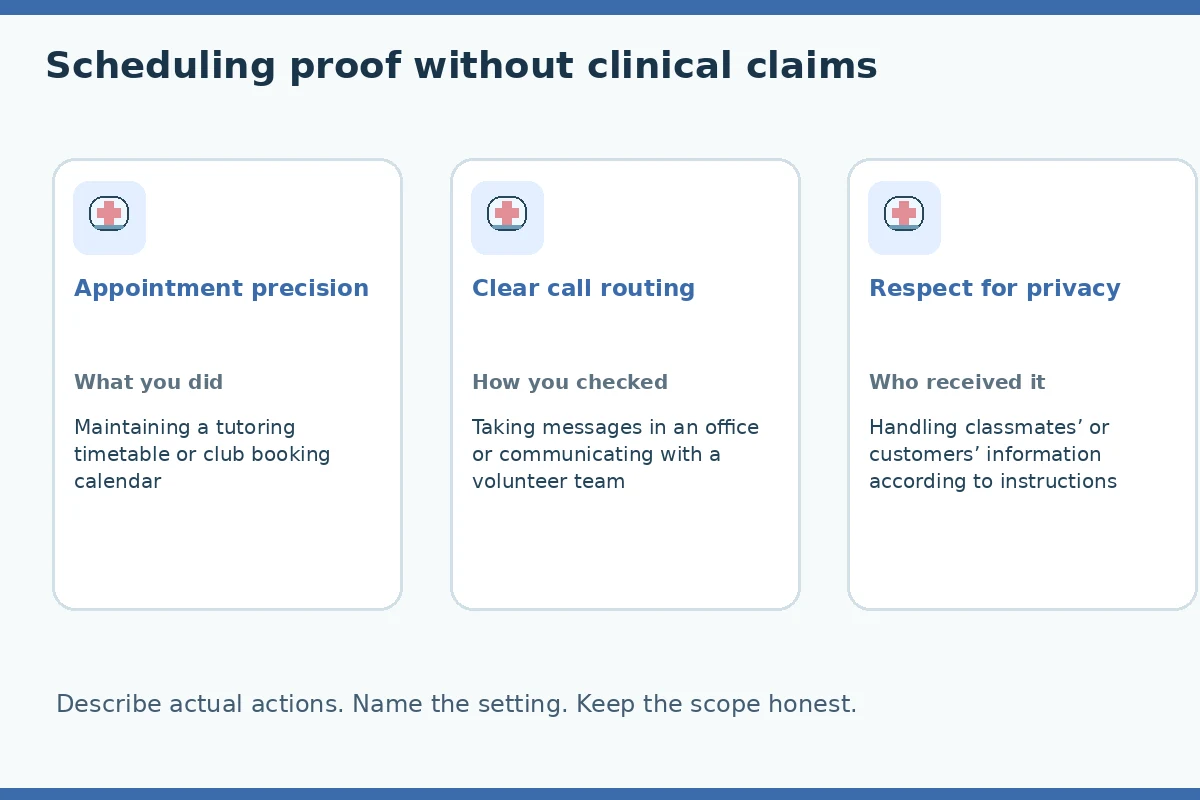
Choose a genuine example instead of claiming experience
Appointment precision: If your actual background includes maintaining a tutoring timetable or club booking calendar, use that as a starting point. Explain how you verified time, spelling, and changes. Your evidence is the repeatable check, not a claim that you have scheduled medical procedures. When possible, mention a check, document, conversation or handoff that a supervisor could recognize; you do not need a grand achievement. Keep the setting and your responsibility visible so a hiring reader can distinguish a school exercise from employment.
Clear call routing: If your actual background includes taking messages in an office or communicating with a volunteer team, use that as a starting point. Show what you recorded, to whom you passed it, and what you did when the question was outside your authority. Do not include any real person’s health details. When possible, mention a check, document, conversation or handoff that a supervisor could recognize; you do not need a grand achievement. Keep the setting and your responsibility visible so a hiring reader can distinguish a school exercise from employment.
Respect for privacy: If your actual background includes handling classmates’ or customers’ information according to instructions, use that as a starting point. Describe following access rules and avoiding public discussion of sensitive details. Do not claim HIPAA certification unless you actually completed relevant training. When possible, mention a check, document, conversation or handoff that a supervisor could recognize; you do not need a grand achievement. Keep the setting and your responsibility visible so a hiring reader can distinguish a school exercise from employment.
Make the evidence-to-role connection in one sentence rather than introducing a long list of adjectives. For example, “I maintained a current list and confirmed changes with the team” explains a process; “I am a natural leader, highly organized, and an excellent communicator” tells the reader very little. Do not copy numbers, awards, qualifications, job titles, or outcomes from another person’s sample letter. The employer may ask you to explain the story at an interview, so choose one you can discuss calmly and accurately.

Adapt this illustrative cover letter to your own experience
The following fictional training example is written for someone seeking an entry-level medical receptionist position. It is not a record of a real applicant or employer. Use the structure but replace every action with something you have actually done. Never send it word for word, and confirm the employer’s submission format first.
I am applying for the Medical Receptionist position listed for your practice. I am interested in work that combines clear phone communication, precise scheduling, and a respectful first point of contact for patients.
I do not yet have medical-office experience. In a campus administrative volunteer role, I maintained a booking calendar, confirmed changes with the appropriate contact, and passed requests I could not answer to the staff member responsible. I learned to check dates and names carefully and to avoid sharing information beyond the people who needed it for the task.
I would bring those habits to patient greetings and routine appointment work while learning your office’s approved registration, messaging, and privacy procedures. I understand that medical questions belong with appropriately qualified clinical staff, not a newly hired front-desk employee.
Thank you for considering my application. I would value the opportunity to discuss how my customer-service and scheduling practice could support your reception team.
This example is hypothetical; substitute your own real school, service, or administrative experience. Its strength is that it separates transferable calendar management from medical registration knowledge. Saying you routed questions is not the same as saying you triaged patients. Unless a course or employer actually trained you on a healthcare system, omit software names and medical terminology that would suggest credentials you cannot document.
Remove claims that are outside the beginner role
Do not write that you can diagnose symptoms, advise on urgent care, interpret test results, authorize disclosures, or access full patient histories. Avoid real patient anecdotes even if names are removed; a letter is not the right place to share confidential records. Instead, say you know when to refer questions to staff, can follow role-specific access procedures, and are willing to complete required training. Verify any job-specific certification or bilingual requirement rather than declaring a universal rule.
If a job advertisement lists a requirement you have not met, do not try to disguise the gap with an implied certification. Where the position is genuinely entry-level, explain closely related preparation and what supervision or training you would need. Where it is not entry-level, look for an opening with an appropriate scope. A cover letter can explain a match but cannot replace a mandatory qualification or a required background, license, or safety procedure.
Send a short letter that matches the employer instructions
If the employer is a small family practice, the posting may combine calls, reminders, and arrival check-in. A larger outpatient service may separate patient access, front desk, and records tasks. Pick the responsibilities you can support now and say which skills need training. An accessible, professional tone is more useful than claims that you can make every anxious patient feel better or guarantee zero booking errors.
CareerOneStop recommends a tailored cover letter, typically about 200–400 words across several short paragraphs. Open by naming the position; give one or two specific proof points; explain why the work itself interests you; and close politely. If the portal says not to upload a letter, follow its instructions. If it asks you to email an application, use a clear subject line and the requested attachment format. Check names, dates, contact details, links, and spelling in the final file before submitting.
For this medical receptionist application, read the vacancy a second time with a highlighter. Every important assertion in your letter should connect to something stated there, to something verifiable about the employer, or to your own experience. Delete promises that are not under your control, such as perfect attendance forever, guaranteed customer satisfaction, instant expertise with proprietary systems, or independent decisions beyond your authority. Save a copy of the letter that matches the version of the job posting you applied to.
How We Research and verify these recommendations
Our source review on 2026-10-30 used CareerOneStop cover letter guidance; BLS occupational description; official role, training, or privacy guidance. CareerOneStop provides advice about short, tailored letters. The occupational and safety or privacy sources describe work responsibilities and boundaries; our transfer examples and fictional letter are editorial illustrations, not quoted employer policies. We checked candidate topics against the provided JobAsk production index and WordPress title export, but cannot see unpublished WordPress drafts or guarantee a search engine has indexed every existing page.
No example in this article represents a real hiring outcome, employer endorsement, certification, or verified applicant. Use your own facts and review the specific employer’s instructions and applicable training requirements. The site’s affiliate disclosure explains our editorial and commercial relationships. There is no paid product recommendation or assumed affiliate partnership in this guide.
Related Guides
- Medical Receptionist Resume Objective: Show Scheduling and Privacy-Aware Skills
- Library Assistant Cover Letter With No Experience: Show Service and Accuracy
- Cover Letter With No Work Experience: Use Coursework and Volunteer Proof
- Medical Receptionist Interview Questions: Scheduling and Privacy
- Dental Receptionist Cover Letter: Prove Scheduling and Privacy
Yes, where the posting permits it. Use verified scheduling, reception or service examples; do not assume specific credential requirements are waived.
Only describe training you actually received. A useful alternative is to explain that you follow confidentiality procedures and will complete employer training.
No. Use a hypothetical process or a nonmedical customer-service example without exposing personal health information.
Only if you have actually used that system. Generic calendar skills are not the same as clinical software experience.
Yes, if you can accurately describe your real proficiency and the ability is relevant to the vacancy; do not exaggerate fluency.