
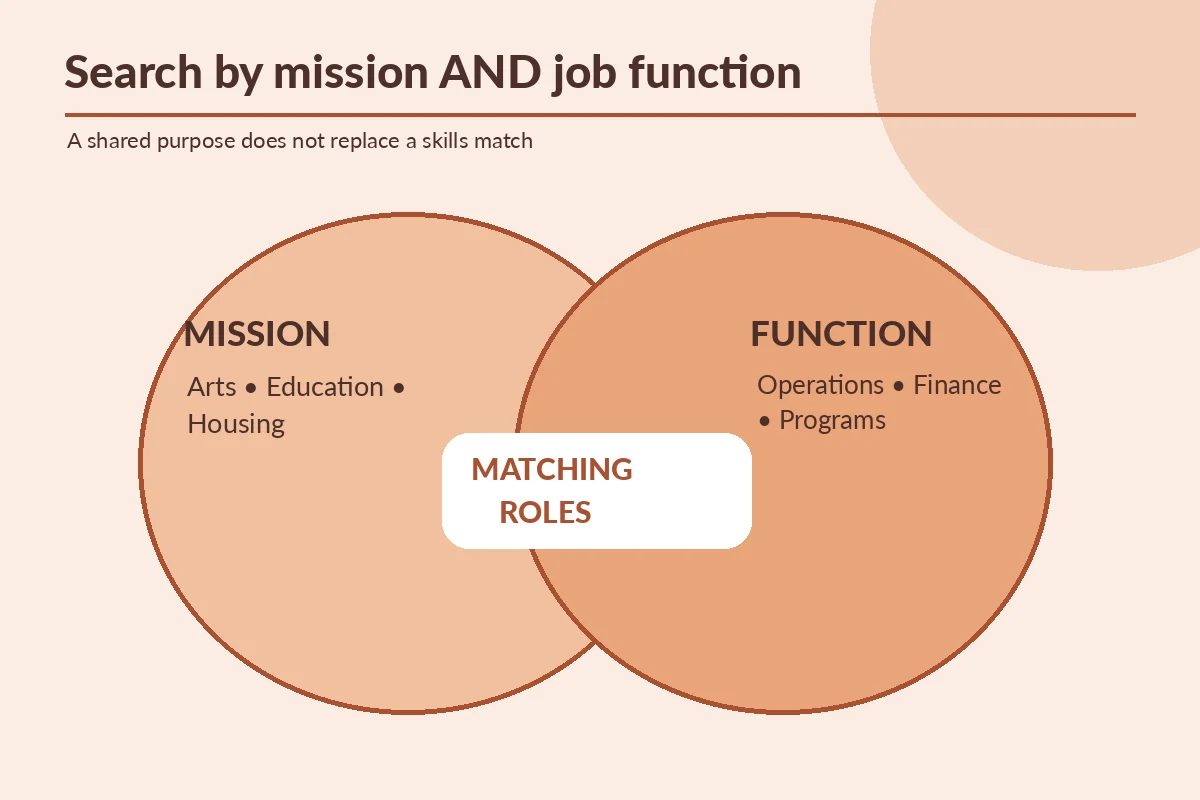
The best nonprofit job board for you is the one that separates a cause you care about from a role you can actually perform. Searching only by mission can bury openings that match your experience; searching only by job title can hide a good fit at an unfamiliar organization. Use both dimensions, then examine the employer independently.
Define two filters before browsing: issue area and actual function. Issue area may be education, housing, health, arts, or conservation; function may be accounting, communications, operations, research, or direct services. A person with bookkeeping experience can work for a health nonprofit without claiming clinical expertise. Mission alignment strengthens motivation but never replaces the required skills.
Select the Right Search Route for Your Goal
The National Council of Nonprofits hosts a career center for sector roles. Idealist includes nonprofit employment and volunteer opportunities, with filters for cause, location, and experience level. These sites have different emphases; test both against the same role requirements instead of declaring one universally better.
Use two search passes. The first begins with your function (“grants assistant” or “program operations”) and adds issue area. The second begins with a mission term and examines which functions are actually open. In each result, label the work: fundraising, program delivery, administrative support, policy, or leadership. Do not assume that a “community outreach” title automatically means the same duties at every organization.
The National Nonprofits job-seeker guide explicitly separates searches by focus area, job function, and custom filters. Use that distinction to avoid collecting unrelated jobs. Location can change whether the employer requires in-person service or public events; “hybrid” and “field-based” need their own commute checks.
Interpret Real Job Requirements Before You Apply
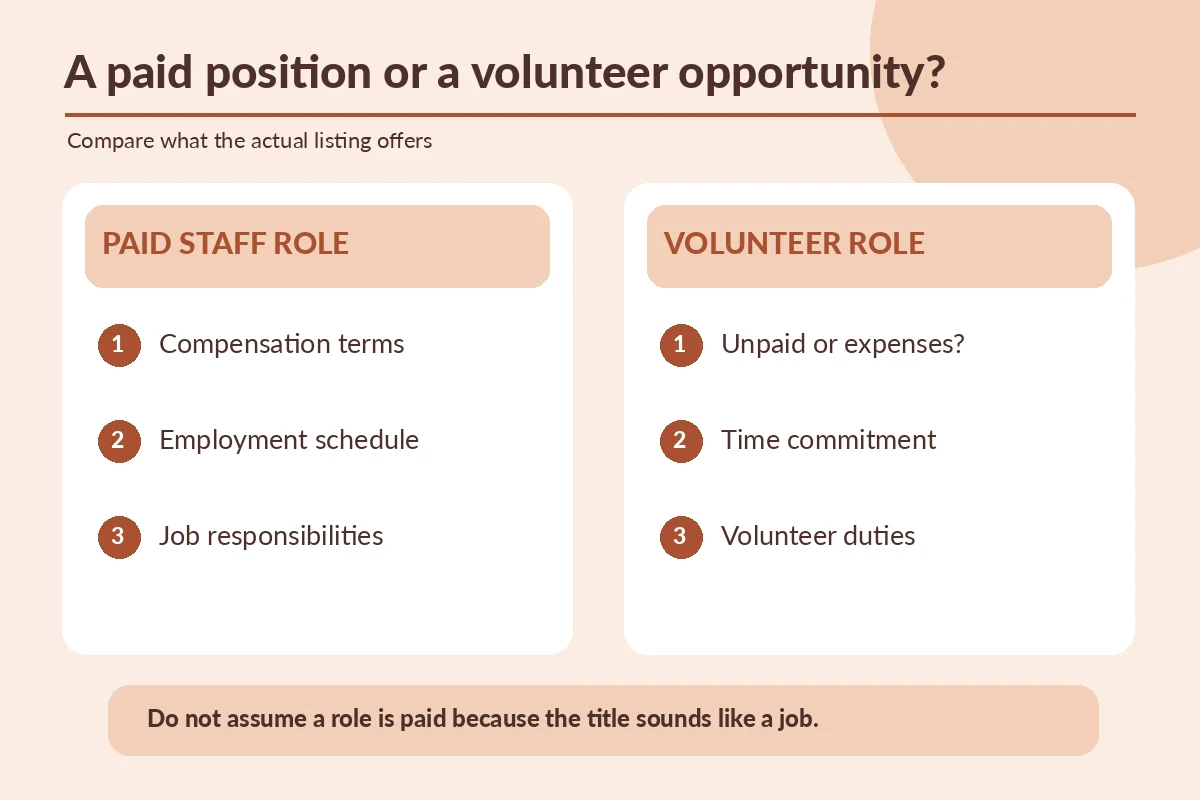
Read for the reporting line, regular deliverables, funding or project duration when stated, and whether the role is paid employment, a stipend, an internship, or volunteering. These are different arrangements. If grant funding is mentioned, ask appropriate questions about the position’s expected duration without assuming that a grant-funded role is necessarily temporary.
A good board is a discovery tool, not a promise of an interview. Decide what is required, what is merely preferred, and which questions need clarification. When a listing gives few details, do not add qualifications to your resume just to make it fit. Save the full position text or a dated note for legitimate interview preparation, while respecting copyright and employer restrictions.
Compare the practical application path: does the board redirect to a company career site, collect an application itself, or ask you to email a named contact? Different platforms use different flows, and even one board may display multiple application mechanisms. Confirm the destination address before entering information. Avoid assuming that clicking a bookmark or starting a form means an employer received your materials.
Independently Confirm the Employer and Vacancy
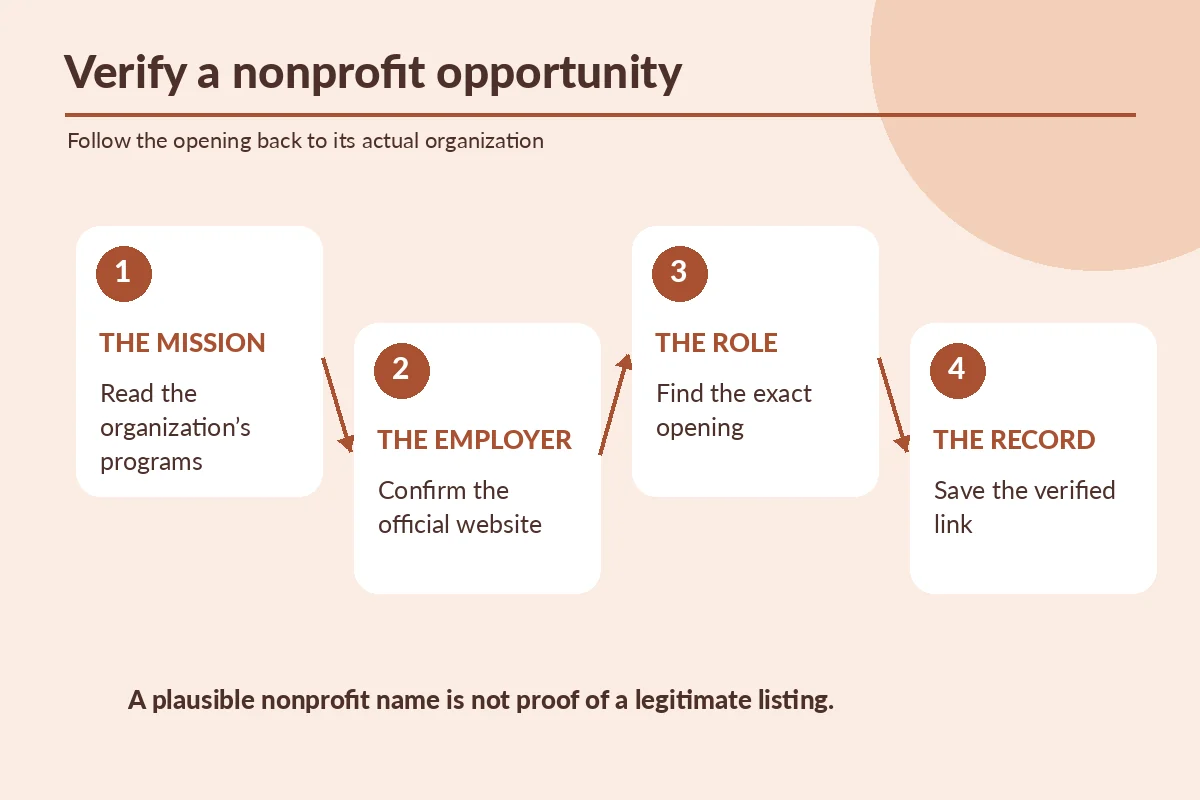
Research the organization outside the board: open its official website, compare the contact details, inspect its program descriptions, and find the same opening on its careers page where possible. A nonprofit-sounding name does not prove tax status or reliability, and a famous cause does not confirm that a person contacting you represents the organization.
Be skeptical of a listing that relies on a moving personal email address, asks for bank information immediately, or will not disclose basic job duties. Confirm whether “volunteer coordinator” is a paid staff position or a request for unpaid help. Use the FTC employment-scam checklist whenever an offer or recruiter moves unexpectedly fast.
Keep Accurate Notes and a Reusable Search Record
Track the organization’s program focus separately from position duties. Record whether the post came from Idealist, the National Council career center, or an employer page; add title, location, pay disclosure if provided, application status, and an unanswered question. Keep your notes factual and revisit the employer page before a follow-up.
If search results are thin, broaden the mission before broadening the job function. A grants assistant can use similar administrative skills across health, education, or arts organizations. Conversely, if you are specifically seeking direct-service work, narrow to the program type and examine training or credential requirements rather than treating every social-impact listing as interchangeable.
A useful tracking row contains the company or organization name, role, original search location, verified link, date found, deadline when stated, status, and your next action. Separate “saved for later” from “submitted”; keep a submitted confirmation or official email when available. Never interpret silence as rejection or an interview invitation. Some boards show old listings, so verify that the employer is still accepting applications.
Follow This Hypothetical Search Example
Hypothetical example: Eli is interested in environmental conservation and has experience organizing inventory records. Eli searches “operations assistant” in an environmental issue-area filter, then checks a conservation organization’s website for the role. The application describes documented recordkeeping skills; it does not invent field research or imply a volunteer project was paid employment.
The example above is hypothetical. It demonstrates the decision steps, not a verified job advertisement, employer, candidate accomplishment, or hiring outcome. Replace every practice detail with your own accurate qualifications and the current description of the role. If a board changes a filter, label or application flow, follow its updated official instructions rather than a screenshot from a guide.
Avoid Common Mistakes When Comparing Job Sites
Do not rank a website as “best” merely because it contains many postings, advertises large user counts, or charges employers to promote listings. Decide whether it provides relevant roles, understandable terms and a trustworthy path back to the employer. A smaller specialized board may yield a clearer search for one role; another user may need a public job bank, professional association or direct district/company website instead.
Do not submit confidential records, banking details, passwords, copies of identity documents, or payment to a recruiter contacted only through an unverified listing. Legitimate hiring processes can require sensitive onboarding information at appropriate stages, but always verify the recipient and timing first. The FTC warning about online job scams highlights impersonation and payment schemes; use its guidance whenever something seems inconsistent.
Also pay attention to workload: duplicate postings, vague roles, and unsuitable locations can consume more time than focused applications. Review your search once a week. Drop sources that repeatedly send irrelevant openings, add official employer pages for high-priority organizations, and preserve a short list of credentials or evidence required for each role. Never inflate a title, employment history, degree, portfolio or certification to fit a keyword.
How We Research Job Search Platforms
We reviewed the linked first-party job-board and professional or government pages listed below, checked the intended use of their filters and hiring guidance, and built a US-focused search procedure. Platforms and individual openings change frequently; this is a comparison of workflows, not firsthand testing of every vacancy or a live inventory.
Source notes: The National Council of Nonprofits offers a nonprofit career center with employer listings and alerts.. Idealist provides social-impact job and volunteer searches using issue-area, experience, and location filters.. National Nonprofits describes separate focus-area, job-function, and custom searches.. FTC guidance advises checking real employers instead of trusting platform appearances.. No source guarantees a response, endorsement of a candidate, or vacancy authenticity. JobAsk does not claim an affiliate partnership with these boards. See our affiliate disclosure for our general editorial and commercial disclosures.
Related Job Search Guides
- Creative Job Boards: Evaluate Portfolios, Project Scope, and Fit
- Remote Job Boards: Filter by Location, Time Zone, and Hiring Rules
- Technology Job Boards: Match Stack, Level, and Project Evidence
- Local Job Boards: Find Regional Employers and Check Real Openings
- Online Job Boards: Find Relevant Postings and Verify Opportunities
The National Council of Nonprofits career center, Idealist, and organization career pages are useful starting points; compare results by role.
No. Check whether the opportunity is paid employment, volunteer service, an internship, or a stipend-based arrangement.
Not always. Administrative, finance, design, or operations experience may transfer, but each posting sets its own requirements.
Review the organization’s official site, published contact information, and the precise role, then independently verify the application route.
No. Match both the mission and the day-to-day duties so that your application explains relevant evidence.