
For a U.S. nonprofit program assistant or support role, use a clean resume that identifies relevant work, volunteer service, administrative tasks and the organization’s mission only where your experience supports it. Georgetown’s nonprofit career guidance emphasizes both skills and the purpose of the organization, while Yale offers a Common Good career resume template. Do not turn volunteer participation into paid employment, or turn a support role into responsibility for restricted funds, client decisions or program outcomes you cannot verify.
Read the job’s operating duties before writing the mission line
A nonprofit may employ program assistants, outreach coordinators, database support, event staff and development administrators. Those titles are not interchangeable. A posting could emphasize contact records, volunteer scheduling, intake preparation, event logistics or confidential administrative work. Separate the tasks you have done from those you would need training to do. Writing “passionate about the mission” without any work evidence does not answer the hiring team’s practical question.
Start by highlighting three tasks from the actual advertisement, then create a simple evidence map showing where you performed similar work. A school club event may demonstrate logistics; office reception may demonstrate careful routing; volunteer outreach may demonstrate respectful communication. When you lack direct nonprofit experience, the format can still show transferable tasks honestly, with the context labeled rather than disguised.
Choose section headings that identify the real contribution
Possible sections include Experience, Community Service, Projects, and Skills. Use “Volunteer Experience” when that is the truthful classification. “Program Support Experience” can be useful if the entries actually relate to programs, but avoid constructing a heading that suggests a formal organization or paid role that never existed. Yale’s Common Good resume resource is a starting point, not a requirement for every nonprofit employer.
Place the strongest relevant entry high enough that a reader can see it without searching. If you have worked in an office and volunteered at an event, either may lead depending on the posting. Keep the actual position names and dates attached to their organizations. A recent volunteer activity should not erase a long paid work history just because you want your resume to sound more mission-driven.
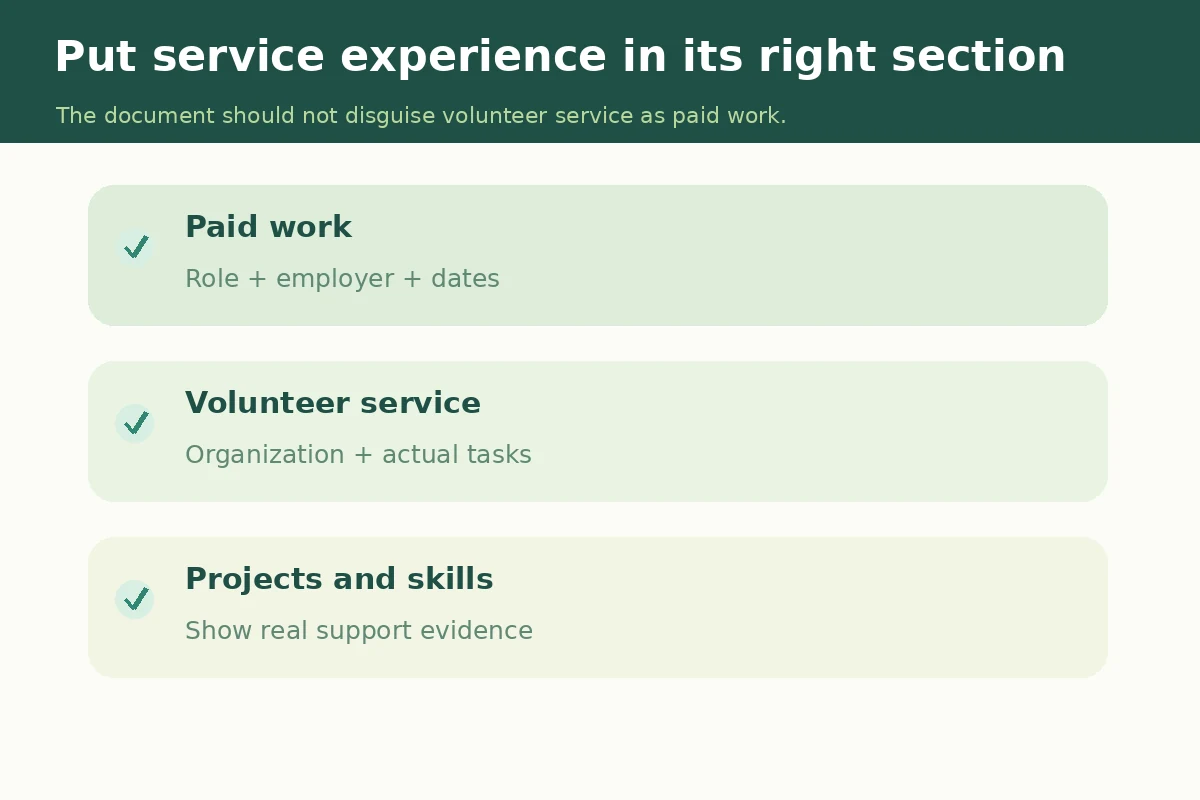
Show delivery work without claiming program ownership
A program assistant may organize check-in materials, update approved schedules, communicate instructions, track received forms or prepare reports for review. Those are concrete support tasks. They do not automatically grant authority to select beneficiaries, approve spending, interpret eligibility rules or represent the board. Choose verbs that show what you personally completed and whom you supported rather than broad assertions that you “led strategic program transformation.”
Illustrative bullet: “Prepared registration packets for a community workshop, corrected duplicate entries in the approved spreadsheet, and referred unresolved records to the program coordinator.” That is a hypothetical example, not a real accomplishment. The value lies in clarifying task, evidence and escalation. Replace it with the applicant’s actual documents and supervisor approval, and leave out private names or personal records.
Keep funding and donor information within your actual authority
A development or fundraising role can involve donation acknowledgement, event records, pledge follow-up and data entry, with different access permissions. Do not state that you administered grants or approved expenditures if you merely prepared materials. Avoid revealing individual donor amounts, client histories or internal contact lists. A strong resume can say you maintained an approved event attendance log without disclosing any confidential participant data.
If you helped assemble a report, identify which part you prepared and who reviewed it. Do not copy unapproved fundraising totals or claim an increase in donations without verified records and permission to cite them. This is especially important when a team effort included paid staff and multiple volunteers. “Supported a fundraising event” is acceptable when accurate; it is not the same as “secured the organization’s entire budget.”
Describe volunteer time and community involvement plainly
Volunteer projects can show dependability, event planning, communication, translation or record accuracy. List the sponsoring group, role, timeframe and meaningful tasks, and clarify whether a project was a single event or ongoing commitment. Georgetown’s general formatting guidance recognizes extracurricular and volunteer experience as possible evidence; it does not require you to call them jobs. A truthful label helps rather than hurts a first-time nonprofit applicant.
A hypothetical entry could read: “Volunteer sign-in assistant — checked attendee names against the approved list and directed missing registrations to the event lead.” Do not add a program evaluation score or claim “managed 500 clients” without records. If you worked with vulnerable groups or sensitive services, avoid disclosing identities, case information or protected details. Describe the general work and supervision, not the private circumstances of beneficiaries.

Connect your skills to the nonprofit’s actual workflow
Use a small Skills section for tools and processes you can demonstrate: approved spreadsheet sorting, calendar coordination, accessible document preparation, meeting notes or CRM data entry where legitimately learned. Do not list a donor database, financial system or social-service certification you have never used. Some programs ask for language skills or community knowledge; give an accurate level and avoid guessing at employer requirements.
For interviews, prepare one example of handling a changed schedule, one example of checking a record, and one example of asking for guidance rather than overstepping. A support role is often judged on accurate follow-through. The resume should provide an honest preview of that behavior, not a list of every social cause the applicant supports.
Make format and length serve a fast operational review
For many entry-level nonprofit roles, a concise one-column resume works well because it keeps duties and dates together. Georgetown nonprofit guidance recommends a focused one-page resume for its audience, but employer instructions control and experienced applicants may have different needs. Use readable headings and clear chronology, and show enough detail for the relevant tasks without turning the page into a grant proposal or a personal mission statement.
Test your final export for readable text, valid links and legible contact information. An email address that sounds professional and a correctly spelled organization name matter more than an ornate color scheme. If you include a portfolio or project link, ensure permission to share the content. Do not imply an affiliation, board appointment or funding relationship through borrowed nonprofit logos.
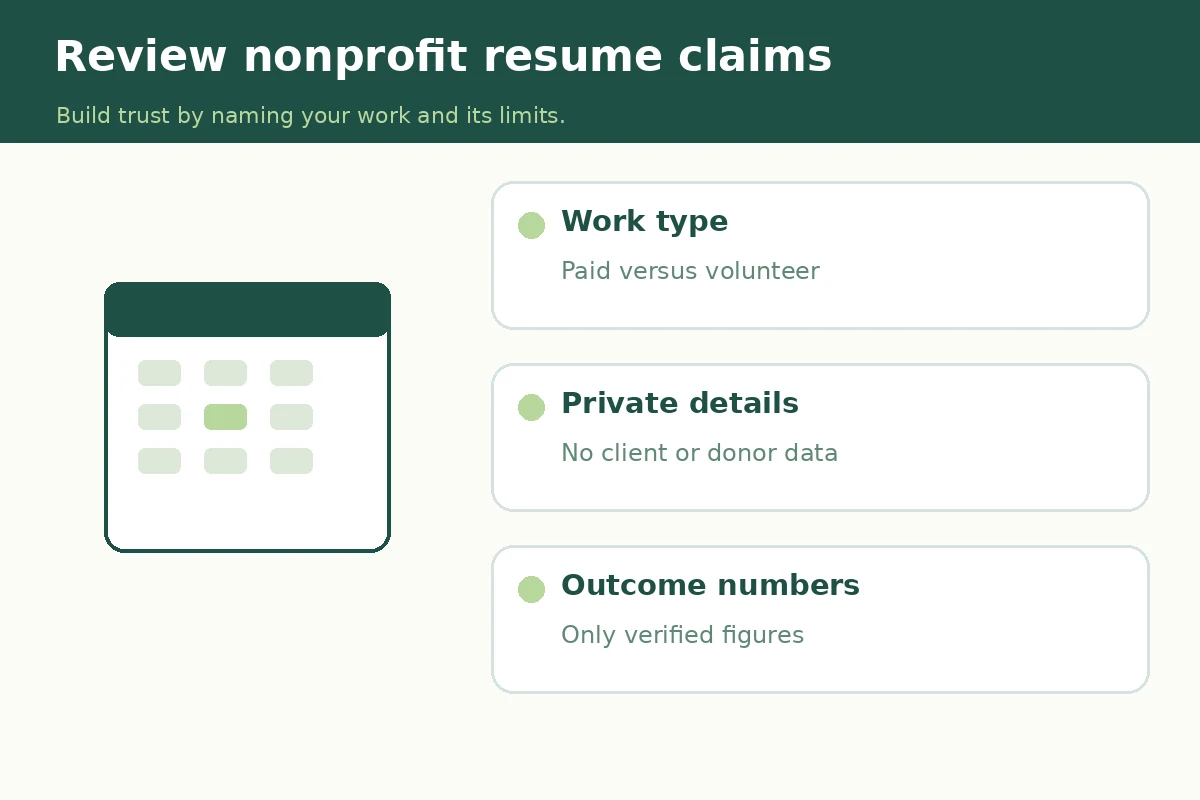
Audit mission fit, privacy and evidence before submission
Before sending, compare the resume against the posting and ask whether the first few entries truly show program support or service. Check that paid work, volunteer service, and class projects are distinguishable. Verify any numbers and outcome statements, especially those touching donors, clients or program beneficiaries. Ask a supervisor about permission before quoting internal metrics, and substitute process evidence when numbers cannot be shared.
A focused closing test is to explain each item in a few plain sentences: where it happened, your individual contribution, which records you handled with authorization and who approved exceptions. If you cannot answer those questions, revise or remove the entry. Nonprofit employers need reliable collaborators and accurate records; a layout that separates supported tasks from claimed authority can help them understand your candidacy without overstating it.
How We Research Resume Format Guidance
This guide compares firsthand university career-center advice and occupational or medical education sources with a reader-facing layout and factual-claim audit. University samples are examples for their audiences, not binding employer requirements. All resume lines and portfolio descriptions above are hypothetical and must be replaced with the applicant’s real credentials, dates and duties. We do not infer hiring decisions, universal applicant-tracking-system outcomes, licensing rules or work authorization from a resume template. Confirm the current application requirements with the employer, school or relevant authority.
Sources reviewed November 10, 2026: careercenter.georgetown.edu (Georgetown nonprofit career guidance emphasizes relevant evidence and mission fit, not only broad enthusiasm.) careercenter.georgetown.edu (Georgetown career guidance recommends consistent concise formatting, verified descriptions, and a document tailored to the posting.) ocs.yale.edu (Yale offers targeted templates including a Common Good career resume and encourages tailored, readable documents.). These sources explain the recommended format and occupational scope, not an individual employer’s application process or result. Review our affiliate disclosure. This informational guide does not imply paid endorsement or approved affiliate partnerships.
More Resume and Cover Letter Guides
Yes when it is the most relevant evidence for the specific nonprofit position, provided it is clearly labeled and dates remain accurate.
A concise statement may add context, but specific responsibilities and outcomes that you can verify are more useful than broad enthusiasm alone.
Only if those figures are accurate and you are authorized to share them. Otherwise describe your genuine workflow and contribution without disclosing private data.
No. Describe scheduling, records, communications or other duties you performed; do not claim final funding, eligibility or strategic authority without evidence.
It can provide relevant evidence of communication, planning and follow-through when honestly labeled and clearly connected to the job’s requirements.