
Put an online-earned college degree in your Education section under the name of the institution that actually awarded it, followed by the official degree and major. Do not substitute the name of a learning platform or course website if it did not grant the credential. A resume normally does not need to announce that classes were online unless the delivery format is directly useful to the job or the employer asks.
The diploma and transcript—not the sign-in portal—define what you earned. Arizona State University explicitly advises graduates to use the awarding university and full degree title. For programs or schools you are considering, the U.S. Department of Education supplies a database of accredited institutions and recognized agencies; it does not itself accredit colleges.
Choose the education wording that matches your record
Fully awarded university degree. Name the university, formal credential, field of study and completion date where useful. Online attendance itself need not change the degree name. Check the record or provider documentation before you choose a resume label. The point of the entry is to let a reader verify your actual education, not to turn an aspiration or a course into a credential.
University extension certificate. If only a non-degree certificate was awarded, call it a certificate and name the issuing unit, not an undergraduate or graduate degree. Check the record or provider documentation before you choose a resume label. The point of the entry is to let a reader verify your actual education, not to turn an aspiration or a course into a credential.
MOOC or third-party platform. Completed online coursework can support specific skills; it does not establish that the learner earned a university degree. Check the record or provider documentation before you choose a resume label. The point of the entry is to let a reader verify your actual education, not to turn an aspiration or a course into a credential.
Institution or program recognition. Check the school and any program-specific requirements through current official sources if the qualification is regulated or a job requires accreditation. Check the record or provider documentation before you choose a resume label. The point of the entry is to let a reader verify your actual education, not to turn an aspiration or a course into a credential.
Build a clear entry from verified details
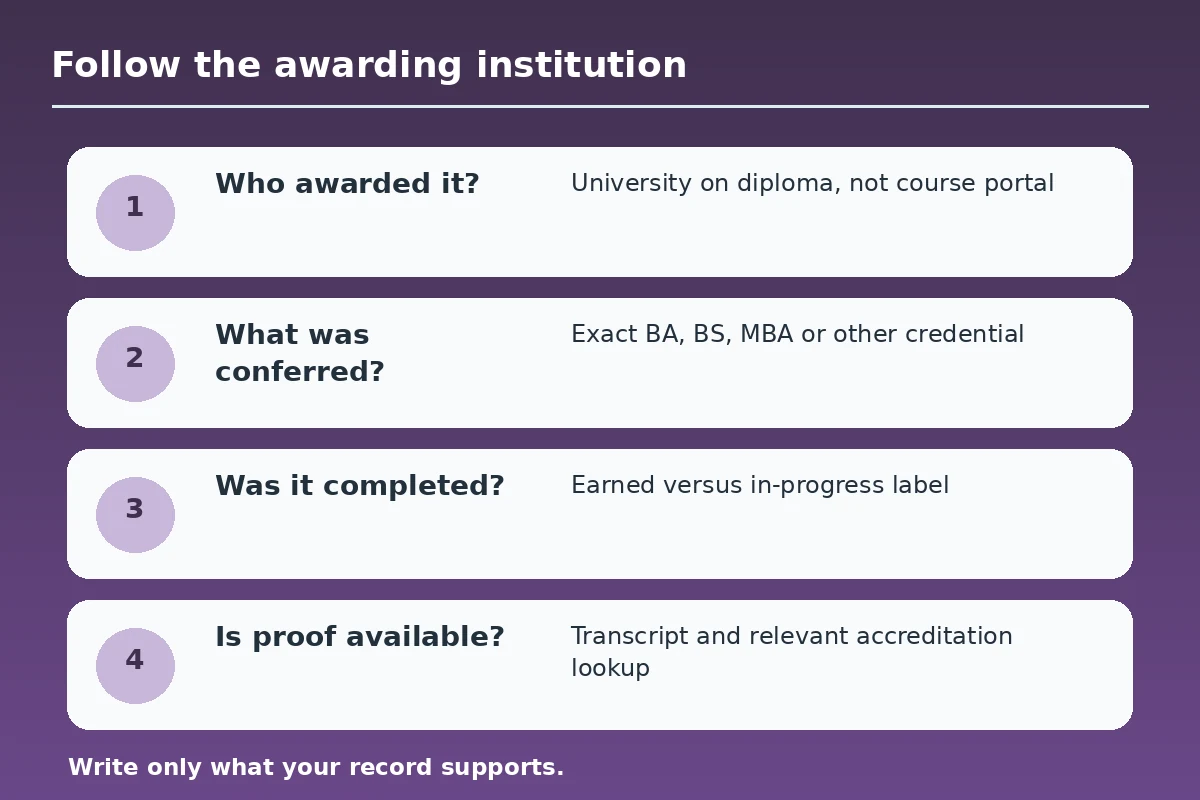
First open the credential, transcript, registration record or completion confirmation that applies to your situation. Copy the official name rather than relying on memory. Compare dates, the issuing organization and the exact qualification with the posting. If the application form asks for a highest degree earned, answer that question literally; a truthful resume entry describing non-degree study does not substitute for a completed-degree requirement.
Illustrative example only: Hypothetical applicant Theo completed an online Bachelor of Science in Accounting conferred by Example State University in 2025. A suitable entry is “Bachelor of Science in Accounting | Example State University | 2025.” Theo should not write “Bachelor of Science, Learning Platform X” merely because classes were delivered through that platform; the transcript names the awarding university. The school and applicant names in this example are fictional. Replace every variable and institution with verifiable facts from your own documents; never copy a sample credential as though you received it.
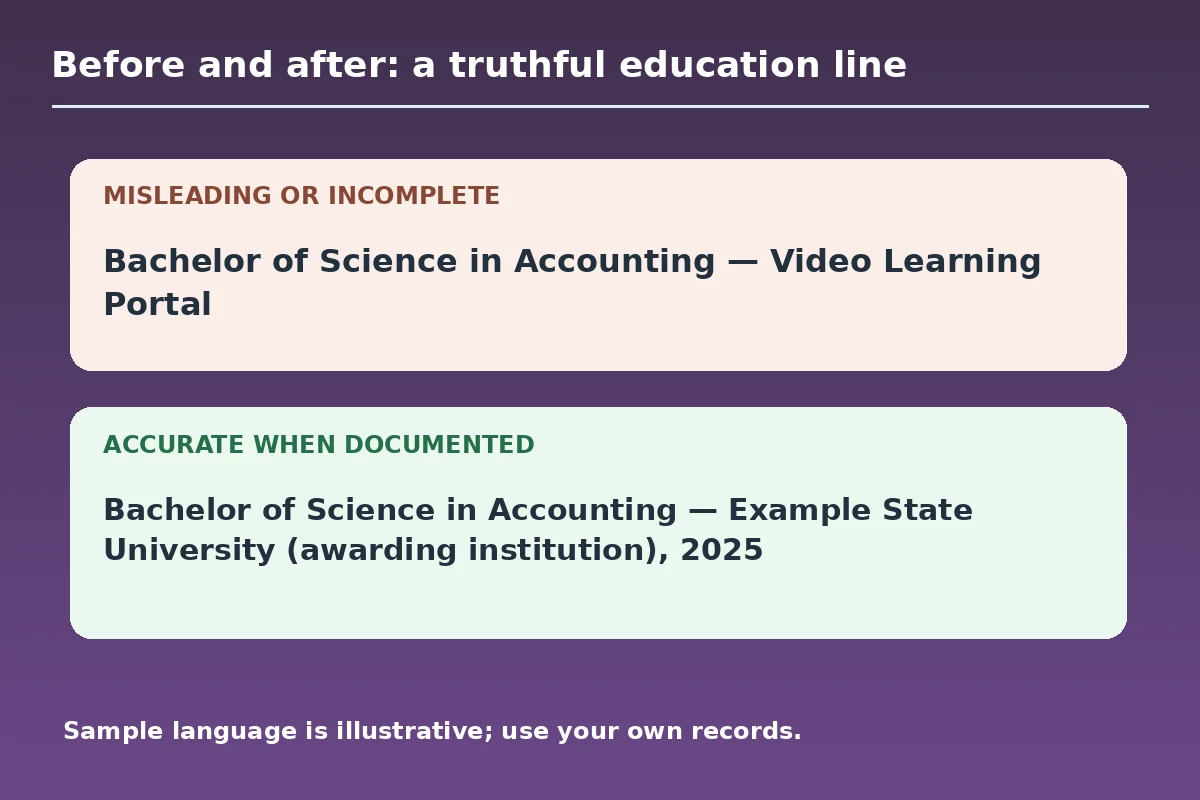
Less accurate: Bachelor of Science in Accounting — Video Learning Portal. More accurate, only if true: Bachelor of Science in Accounting — Example State University (awarding institution), 2025. The useful difference is not more impressive wording. It is the boundary between what the person studied, what the issuer actually awarded, and what the job requires. Make the wording easy to read by someone outside the school or training program.
Keep education separate from hands-on experience
A classroom assignment or training exercise can demonstrate knowledge, but it is not automatically paid employment, a professional qualification or independent authorization to perform regulated work. If a project matters, give it a separate Projects or Relevant Coursework line: name the tools you personally used, the task you completed and what you checked. Mark invented examples as illustrative when writing sample resumes, and never use fabricated scores, pass rates or employer outcomes.
As you tailor the resume, copy a genuine phrase from the position description only when it matches your background. Instead of claiming “expert” or “certified,” explain what you practiced or documented. For instance, a class project involving spreadsheet cleaning might support “organized and checked spreadsheet records,” but not “managed confidential company records” unless you actually did so in an authorized setting. Training can support readiness; employers determine whether additional supervision or credentials are necessary.
Common misstatements that weaken the resume
Check 1: Do not turn a course completion badge into a college degree. Read the employer’s exact requirement and the issuing organization’s description. If the wording is ambiguous, a plain explanation is safer than a title that may be interpreted as an official award.
Check 2: Do not invent a campus address if classes were remote; location is optional when not useful. An honest level of detail beats a confident but unverifiable claim. If you cannot verify a number or status, remove it or request the right record before applying.
Check 3: Do not claim current accreditation without confirming the specific institution and program. Education records and eligibility rules change. Review completion status at the time you send the application, not based on an earlier draft of your resume.
Check 4: Do not describe a degree as earned while coursework or conferral is pending. A potential employer may request evidence later. Save accurate private records but do not put account numbers, grades, certificates containing sensitive details, or student IDs into a public resume.
Audit this section against your target job
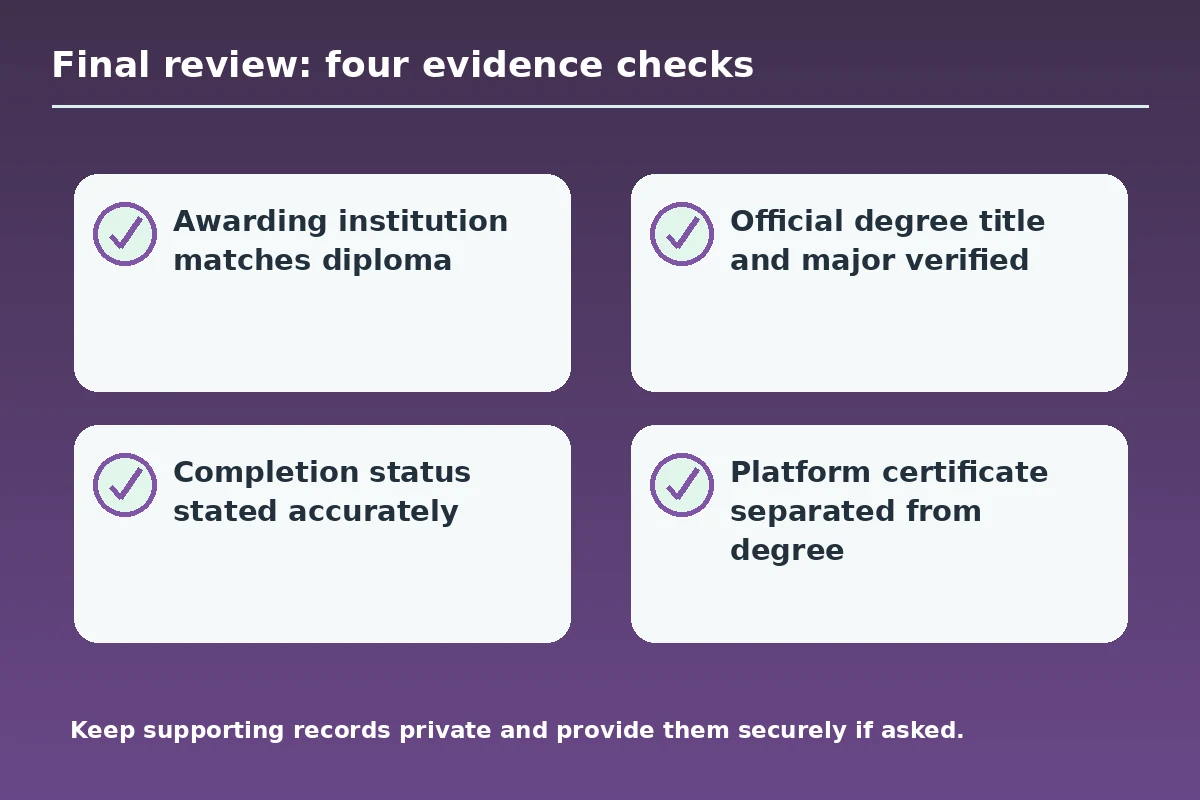
Use the following four-step check as you edit. The purpose is to find a mismatch before someone else has to ask about it; a strong entry should survive a straightforward question about who issued it and what you completed. Keep your wording readable in the exported PDF and editable file so the school, title and completion status stay together rather than being separated by columns or decorative icons.
1. Awarding institution matches diploma. Look at a genuine record, not an auto-filled resume profile or certificate mock-up. If you cannot find proof, ask the registrar or training provider for the right document.
2. Official degree title and major verified. Use the official organizational name. If the reader needs context, add the location or awarding jurisdiction rather than a marketing name.
3. Completion status stated accurately. Distinguish awarded, in progress, paused and attended. Those words answer different employer questions and should not be silently swapped.
4. Platform certificate separated from degree. Select only a course, example or project that demonstrates a real requirement. Keep any protected class, student or client materials out of attachments.
A useful last test is to read the education line without its section heading. Could a recruiter wrongly infer that a degree or license was awarded when it was not? Could they tell who issued the document? Would you be comfortable supplying the requested verification through a secure process? If any answer is unclear, simplify the entry. This is a writing and evidence test, not a promise of ATS compatibility or employer acceptance.
How We Research resume education examples
The guidance was reviewed on 2026-10-30 using primary or institutional resources: University career guidance; CareerOneStop; U.S. Department of Education. These sources support how to describe education, issuing institutions, completion status or verification routes; they do not establish that any sample candidate earned a credential. Some career centers differ on whether to display unfinished coursework or older education, so relevance and the employer’s instructions govern that editorial choice.
Every named applicant and sample school on this page is hypothetical, not an employer testimonial or verified student record. No resume wording guarantees an interview, automated parsing result, admission or hiring. We do not assert an affiliate relationship with the named schools or providers. See our affiliate disclosure.
More Resume and Cover Letter Guides
- Double Major on a Resume: Distinguish One Degree From Two Degrees
- GED on a Resume: Present High School Equivalency Without Mislabeling It
- Associate Degree on a Resume: Name the Award, Major, and School Correctly
- Unfinished Degree on a Resume: Show Coursework Without Claiming Graduation
- Resume Headline Examples: Use a Job Title and Specific Proof Without Hype
Usually no. Name the actual awarding institution and credential; explain delivery format only if it is relevant or requested.
List it as a certificate or completed course, not a university degree unless an accredited institution awarded a degree.
Use official institutional and program records, including the U.S. Department of Education’s accreditation database and relevant accreditor.
Follow the formal awarding name on your diploma and transcript. Add an official division if it clarifies the credential.
Yes. Identify them as coursework or independent projects and explain your actual contribution.