
An overall performance review comment should summarize the whole period, not simply repeat a compliment or list every project. Name the applicable expectations, the strongest evidence for your judgment, a meaningful strength or gap and the next action. If the form includes a rating, the summary should explain the rating in language the employee can verify.
This guide focuses on the closing summary box found in many reviews. It is different from a detailed self-evaluation, a quality-of-work criterion or a dispute response. UW–Madison’s manager-writing guide links overall comments to expectations, work examples and rating support. All model comments below are hypothetical and must not be pasted as real employee assessments.
Identify the Period and the Decision the Summary Must Explain
First determine whether the box is a manager assessment, an employee final comment or an acknowledgment of a discussion. They require different perspectives. In a manager summary, make the rating’s factual basis clear. In an employee summary, state your understanding, contribution and next step without pretending you determine the official rating. Check the period, role and standards before choosing language.
If responsibilities changed during the cycle, acknowledge which part of the role the evaluation covers. A broad statement like “consistently went above and beyond” is difficult to verify without an identified standard. The MIT review guide recommends observable examples and consideration of both strengths and development. Good overall comments explain rather than merely decorate a score.

Draft a Four-Sentence Summary With Clear Roles
Try a four-part structure: overall assessment against known expectations; one representative work example; a specific improvement or continuing strength; and a realistic next step. A hypothetical manager version is: “Performance met the documented expectations for assigned records. The employee maintained complete handoff notes for reviewed requests. Some exception descriptions still needed clarification. We will check the updated note format during regular meetings.”
That model is deliberately modest. It does not assert a perfect accuracy rate, a bonus outcome or a promotion recommendation. If your workplace uses an official rating, use its terminology and evidence. If the score is still being reviewed, avoid treating a draft label as final. A concise summary is useful because readers can trace each conclusion to a particular part of the work.
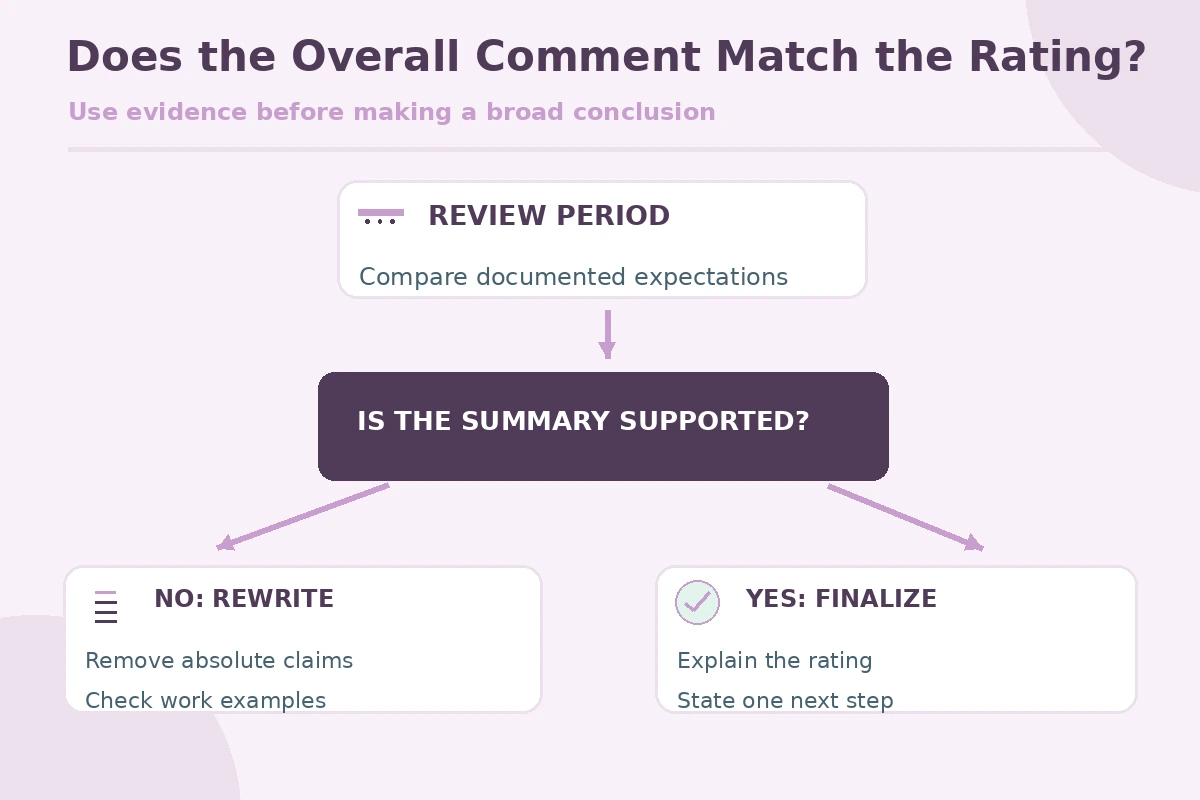
Use Rating-Aligned Examples Without Inventing Levels
For a hypothetical “meets expectations” assessment, you might write: “Completed the agreed duties with reliable documentation and raised unresolved issues appropriately; the next focus is clearer status notes for cross-team handoffs.” For work below a communicated expectation, identify the gap without a character judgment: “Required approval references were missing from several reviewed drafts; include them before submitting future work.”
For performance beyond the standard, explain what supported the difference, such as independently handling additional approved complexity with documented quality. Do not assume an employer has “exceeds” or “partially meets” categories unless the current rubric says so. The OPM standards discussion illustrates the importance of defined appraisal levels; its government criteria are not a template that every workplace must use.

Balance Strengths and Development Without False Equivalence
A balanced comment does not force every excellent performance assessment to contain a serious weakness, nor does it hide an important shortfall behind generic praise. Select the issues material to the documented expectations. If one operational strength stood out, explain the work context. If one gap affected a major responsibility, name the relevant behavior and what should change.
A hypothetical example for a support role is: “The employee consistently maintained assigned intake records and sought clarification before acting outside delegated scope. Next cycle, status notes for pending approvals should identify the next owner.” The first and second sentences describe distinct dimensions and a plausible action. They do not claim quantified savings, customer satisfaction gains or supervisory authority.
Give the Employee a Distinct Final-Comment Option
If the form allows an employee comment after the manager’s review, the employee can note what they heard, add relevant evidence and confirm the next step without repeating the rating as though it were their own decision. A hypothetical employee comment is: “I understand that clear ownership in handoff notes is the priority. I will use the agreed format and ask for feedback at the next check-in.”
If the employee does not agree with a factual assertion, a calm comment can identify the specific record to revisit. Whether and how a formal response is attached depends on the employer’s procedure. JobAsk has a separate guide on disagreements with reviews; the examples here are for composing an accurate overall closing comment, not negotiating legal rights or contesting a disciplinary action.
Use an Evidence Audit Before Finalizing the Language
Underline every absolute claim: “always,” “never,” “all,” “none,” “100%.” Do you have records that support it throughout the full period? If not, replace it with a narrower observation. Ensure that positive and corrective claims refer to the same agreed standards as the rest of the review. Check that the summary does not attribute another team member’s final decision to the person being reviewed.
Where the manager and employee describe the same incident differently, separate documented facts from interpretations and follow the organization’s fact-checking procedure. UW–Madison recommends neutral, evidence-based wording rather than labels about personality. You may need a follow-up conversation instead of a polished summary if the core record is still uncertain.
Close With One Follow-Up That Can Be Checked
A closing comment should give the reader an understandable next conversation. It might identify a check-in, a clarified standard, an agreed documentation method or a training request. The action should have a realistic owner and be within their authority. Do not promise that a new goal, pay decision or job change has already been approved unless your organization confirms it.
Read the comment aloud without the rest of the form. Could the employee tell what work was assessed, what example mattered and which step follows? If not, replace generic praise or criticism with a specific fact. Keep the summary brief enough to be usable, while retaining any important context needed to avoid a misleading account. A useful final comment is accurate first and elegant second.
How We Research This Performance Review Advice
Reviewed UW–Madison’s October 2026-accessible manager comment instructions and MIT’s review process; used OPM to distinguish defined standards from ambiguous ratings. The hypothetical comments are not actual appraisals, and employer-specific processes prevail. Sources reviewed: University human resources guidance University human resources guidance OPM performance standards.
This is general educational guidance, not legal or human-resources advice for an individual case. Follow your employer’s written review procedures and handle confidential performance records only through approved channels. Every example is hypothetical and must be replaced by real, authorized facts. See the affiliate disclosure; no affiliate endorsement or employment outcome is claimed.
Explore Related Career Guides
- Quality of Work Review Comments: Judge Accuracy and Follow-Through
- Initiative Performance Review Comments: Recognize Ownership Without Hype
- Teamwork Performance Review Comments: Evaluate Collaboration Fairly
- Job Knowledge Performance Review Comments: Skills and Evidence
- Time Management Performance Review Comments: Deadlines and Trade-Offs
Summarize the period, role expectations, representative evidence, a meaningful strength or gap, and one next step.
Use enough sentences to explain the assessment clearly; a short paragraph often works if it covers evidence and follow-up.
No. The examples are hypothetical and must be replaced with documented performance and your workplace’s approved rating criteria.
An employee can describe their understanding, contributions or response; the manager explains the official assessment under employer policy.
Only include accurate, clearly defined measures you may disclose and that support the statement for the actual review period.