
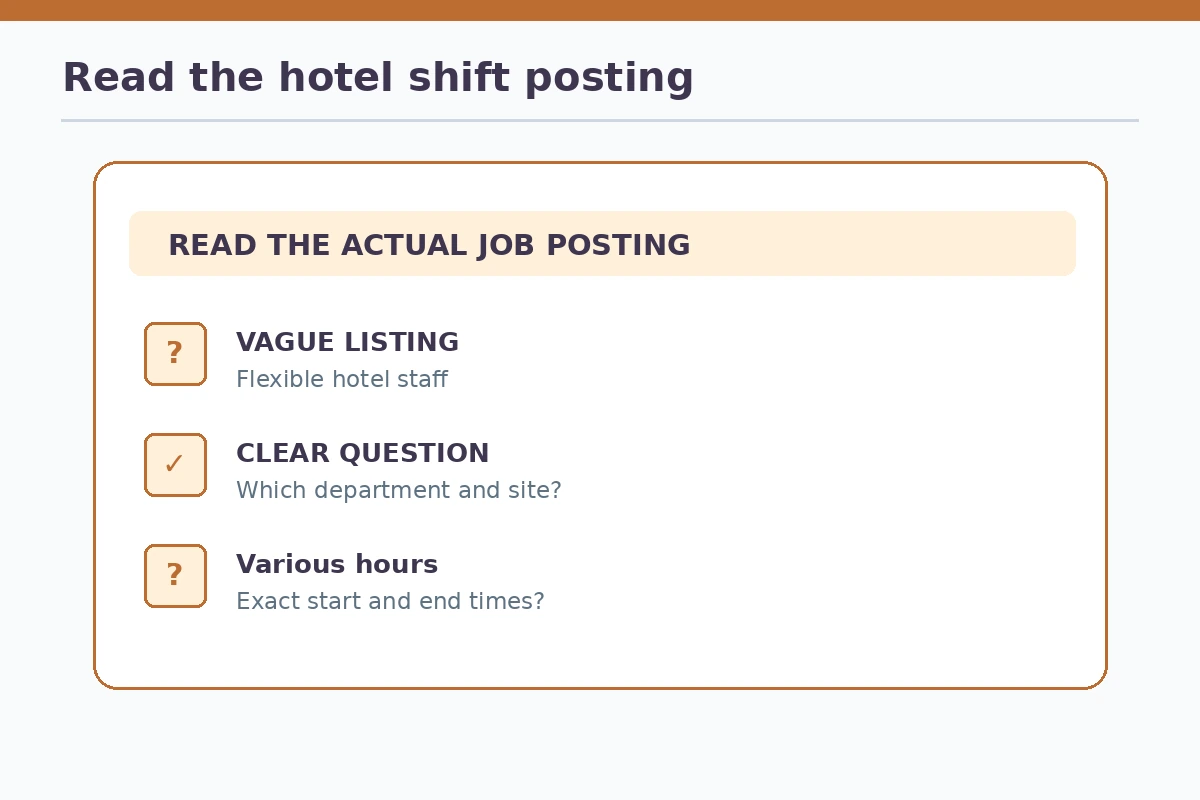
Quick answer: Part-time hotel jobs vary sharply by department. A front-desk shift handles guests, reservations and handoffs; housekeeping is organized around room readiness and cleaning tasks; event support often involves setup and breakdown around a booking. Choose based on the actual work window, physical demands, supervision and location—not just an ad that says “flexible hospitality hours.”
This is a US-focused search and application guide, not a live job board or a claim that a particular employer has an opening. Examples below are hypothetical. Verify each employer, worksite, schedule, pay arrangement, policy and qualification against the actual posting before applying.
Choose the Department Before the Shift Label
Hotel hiring titles can hide very different working days. Desk clerks typically help with check-in, reservations, guest questions and records. Housekeeping workers prepare guest rooms and shared areas according to the property’s procedures. Event-support staff may arrange furniture, move supplies, direct guests or reset a room between bookings. A general “hotel associate” title can mean rotating across several of these tasks; confirm the primary department.
Ask whether a role is at the front desk, in room operations, in food service or in a conference area. If a hotel advertises cross-training, find out when it happens and whether it changes your physical duties or shift. You should not be surprised by payment handling, heavy equipment, guest identification checks or access to restricted rooms after accepting an apparently simple guest-service opening.
Map the Real Hours Around Guest Activity
Hotels operate across time windows that ordinary office jobs may not. A front-desk opening shift may overlap with checkout and incoming reservations; late shifts may extend until another clerk arrives. Housekeeping schedules often track room turnover, although the exact timing is property-specific. Events can require early setup and late breakdown even if the guest-facing portion lasts only a few hours.
Build a realistic schedule using actual start and finish times rather than words like “morning” or “weekends.” Include arrival, change of uniform, station setup, mandatory briefings and end-of-shift notes if required. Ask whether the published end time is the last guest activity or the time you can leave. For short shifts, commute and parking constraints can outweigh the listed weekly hours.
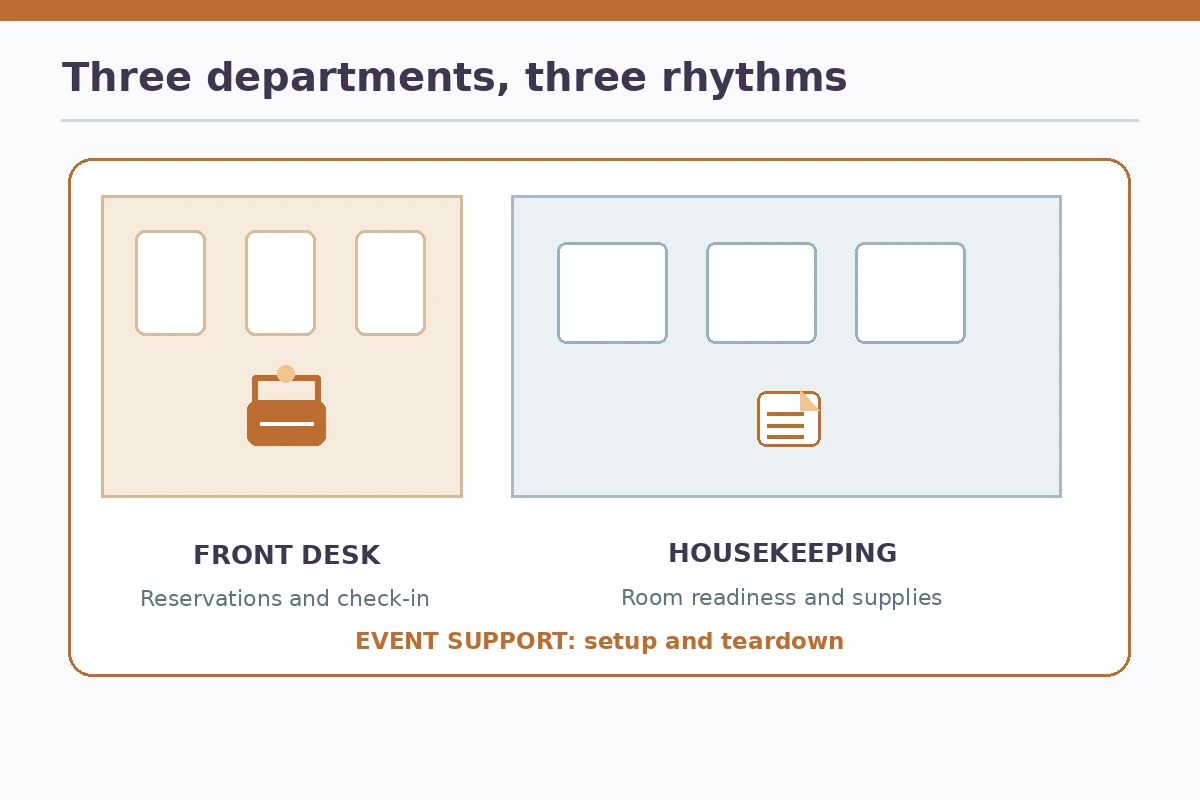
Understand Desk, Cleaning, and Event Boundaries
A front-desk clerk may use reservations and payment systems, but not all hires can waive charges or resolve complex disputes. Find out the escalation channel for refunds, unavailable rooms and safety incidents. Housekeeping roles have different safety needs: correct chemical handling, equipment training, access rules and how to report hazards or missing property. Never assume you can enter a room or handle a guest’s belongings outside policy.
Event support calls for clear responsibility for setup instructions, lifting or moving heavy objects, food service where applicable and return of equipment. Ask who approves floor plans, safety decisions and room changes. Good candidates show that they can follow the property’s documented process, pass along exceptions and ask for help when tasks exceed their training.
| Department | Actual work to investigate | Coverage question |
|---|---|---|
| Front desk | Check-in, reservations, guest requests | Who handles overnight issues? |
| Housekeeping | Assigned rooms, equipment, cleaning | How many rooms and by what deadline? |
| Event support | Room setup, guest service, breakdown | Is teardown after the event included? |
Compare Workload Instead of Guessing From Titles
“Assist with guest operations” does not explain whether you will cover 30 minutes of high-volume check-in or a quiet service desk. Likewise, “clean assigned rooms” leaves open the number, condition and deadlines of rooms. Ask how assignments are made, what training is available and who reviews completed work. A job can be genuinely part time and still involve demanding peak periods.
In interviews, use hypothetical work examples without pretending to know the employer’s occupancy or staffing. For instance: “If a guest reports a room issue while another person is checking in, I would follow the desk’s escalation and handoff procedure.” This demonstrates judgment without inventing a customer-service statistic or claiming independent authority to issue compensation.
Present Transferable Evidence for Each Hotel Role
For front-desk roles, draw on verified examples of customer questions, calendars, record accuracy or calm complaint escalation. For housekeeping, relevant evidence might be following a checklist, safely handling supplies, noticing a problem and notifying the appropriate person. For event support, coordination, arrival on time and following a room plan may matter. Keep the work you actually did distinct from tasks you only observed.
A simple application note could say: “Available Friday evenings and Sunday mornings; experienced in scheduling and written handoffs in a campus reception role.” That statement is useful only if it is true. Do not make up hotel software training, cash-handling limits, guest feedback, hotel brands or shift availability. If the listing names a system you have not used, say you can learn it and identify comparable actual tools.
Verify the Job Listing and Ask About Training
Check the vacancy against the hotel or management company’s official hiring page. Large properties may use a separate employment portal, so follow the real instruction rather than sending documents to a person who approaches you on social media. Track which property, department and time window you discussed; hotels with similar names can be easy to confuse.
Confirm whether orientation, safety training and uniform requirements apply to part-time hires, and whether any event work is scheduled in advance or on short notice. The FTC warns that fake job ads can ask for payment or personal information. Do not send banking credentials or pay an unfamiliar recruiter to “reserve” a hotel shift. Verify a suspicious offer using a independently sourced hotel phone number.
Choose an Offer With a Clear Handoff Plan
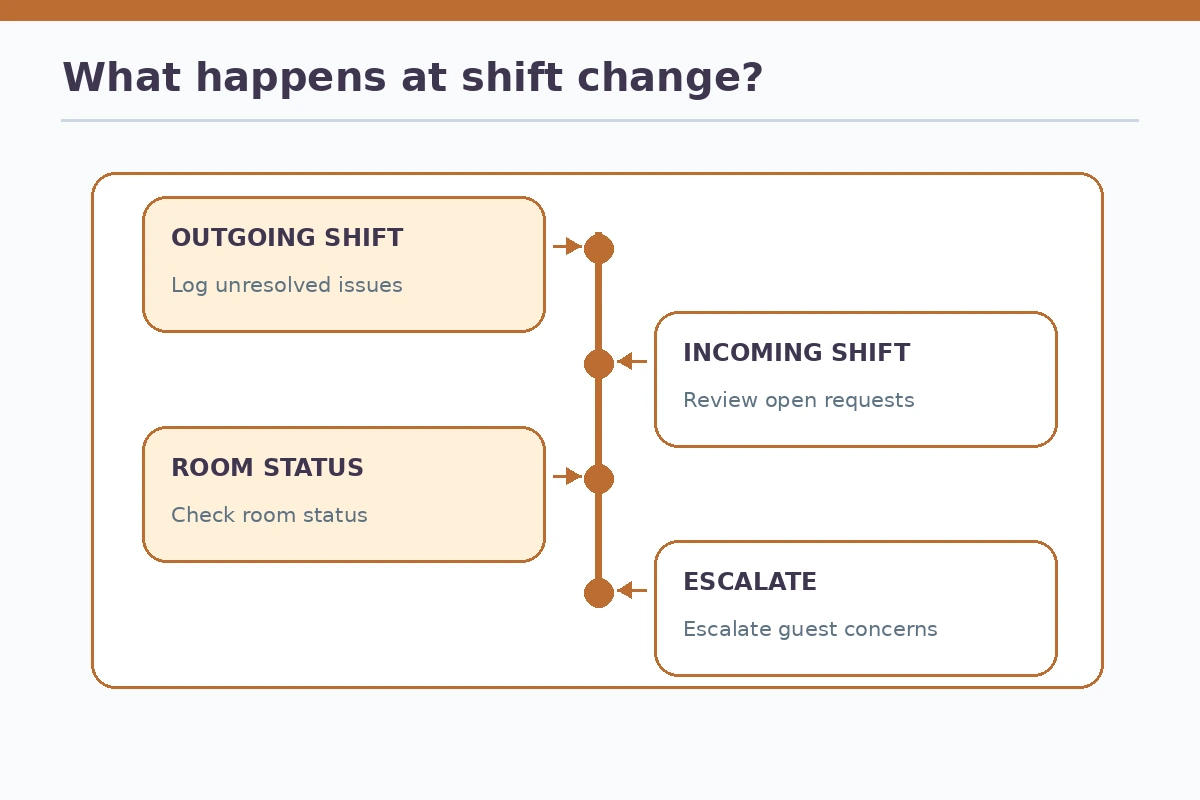
Before agreeing to a shift, ask who receives unresolved guest requests, where the next worker finds the status log and when escalation is mandatory. The best part-time hotel roles make room for continuity between teams. If a front desk is left unattended during your break, clarify the designated cover; do not guess how the property will handle it.
Compare the written offer with the advertised department, location, schedule, any rotating duties and training plan. Keep your own record of agreed availability, especially when event bookings or occupancy change. A sustainable hotel job is one where the duties and handoff responsibilities remain manageable within the hours you can reliably work.
How We Research and Verify These Job Examples
We checked US Bureau of Labor Statistics occupational guidance, US Department of Labor-sponsored CareerOneStop application advice, and Federal Trade Commission scam-prevention material on 2026-10-29. Relevant references: Source 1, Source 2, Source 3, Source 4. Occupational descriptions explain common duties, not the requirements of every employer or state. The examples here do not verify any specific vacancy or guarantee an interview.
All sample actions, candidate experiences, team processes and interview questions are illustrative; adapt only to verified facts and current employer procedures. The site’s affiliate disclosure explains site relationships. No paid placement, special access to employers, or hiring outcome is implied.
Related Job Search Guides
- Part-Time Restaurant Jobs: Compare Host, Server, and Kitchen-Support Shifts
- Part-Time Museum Jobs: Visitor Services, Event Shifts, and Real Requirements
- Hotel Jobs With No Experience: Choose Front Desk or Housekeeping
- Part-Time Event Staff Jobs: Compare Venue Roles and Irregular Shifts
- Entry-Level Hospitality Jobs: Compare Front Desk and Guest Service Work
No. Schedules vary by property and department; ask for the exact days and whether rotations or holiday coverage are expected.
Not necessarily. Confirm the shift pattern, relief coverage and any overnight rotation before applying.
Ask about assignments, equipment, room-turnover deadlines, training and how to report hazards or problems.
Setup and breakdown may extend beyond guest-facing hours. Request the complete expected shift window and how changes are communicated.
Use a verified employer onboarding process and independently check the offer before sharing sensitive identification information.