
Part-time inventory counting jobs usually focus on checking quantities, recording item identifiers and flagging discrepancies rather than personally deciding how financial or stock records should be changed. Look for terms such as inventory counter, physical inventory associate, cycle count assistant or stock count team. Some postings describe short projects or evening audits; others combine counting with regular receiving and stocking. Read the equipment, lifting, travel and shift requirements carefully. O*NET describes related stock and inventory occupations, while OSHA identifies important material-handling and vehicle hazards in warehouse environments.
Distinguish independent counts from regular stocking
An inventory counting assignment may ask you to scan product labels, count units on a shelf and enter observations into a controlled system. A stocker may spend more time receiving, moving and replenishing goods. A shipping or inventory clerk may reconcile records and coordinate shipments. Titles overlap, so identify the real workflow: Is the employer hiring people for a one-night physical count, repeated cycle counts or a permanent stockroom shift? The answer changes the schedule and what skills matter.
O*NET describes stockers and order fillers as people who receive, store and issue merchandise and includes inventory technician among reported job titles. It also describes shipping, receiving and inventory clerks as verifying records. Those occupational descriptions are useful context, not proof of what a particular employer will permit. Never assume that being assigned a handheld scanner authorizes you to adjust official counts or approve a loss.
Check evening, overnight and travel expectations
Counts can be organized outside a store’s customer hours or during normal operations, depending on the workplace. Ask whether shifts are fixed, event-based, on-call or scheduled several weeks ahead. A headline describing flexible part-time work can still involve late finishes, long standing periods or travel between locations. Request the expected location, reporting time, paid travel rules if applicable, and the procedure when a count finishes early or runs late.
Use your own transport and sleep constraints to compare opportunities. A hypothetical count shift lasting from 7 p.m. to midnight is merely an example, not a typical requirement everywhere. Ask about scheduled breaks, start-time changes and whether a team leader controls sign-out at the end. If you need a predictable weekly paycheck, a temporary project with variable hours may not fit even when each individual shift is appealing.

Understand the item-to-record workflow
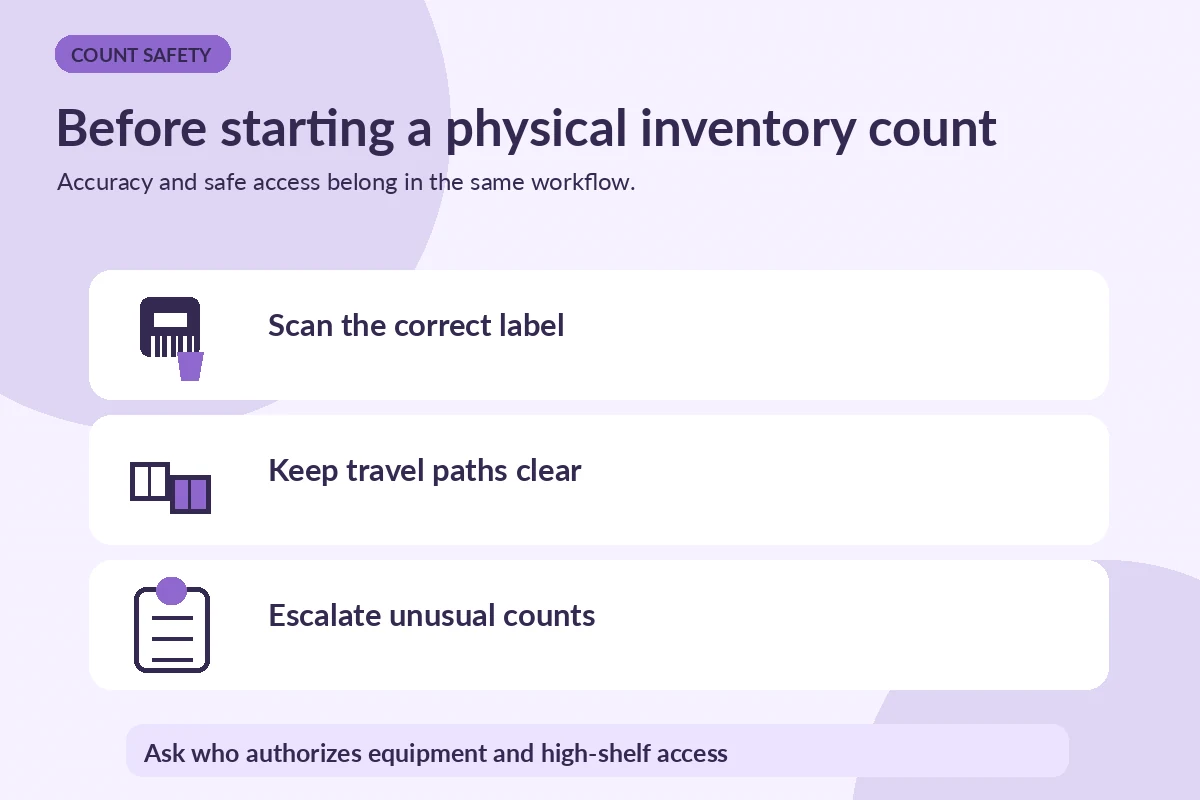
A straightforward process is identify the shelf or bin, read the product identifier, count the quantity actually present and record it according to the employer’s method. If a label does not match the product or the number appears inconsistent, follow the discrepancy procedure and request a recheck. Do not create a product ID, change the reference database or silently force a count to agree with a system value. The organization should define who resolves exceptions.
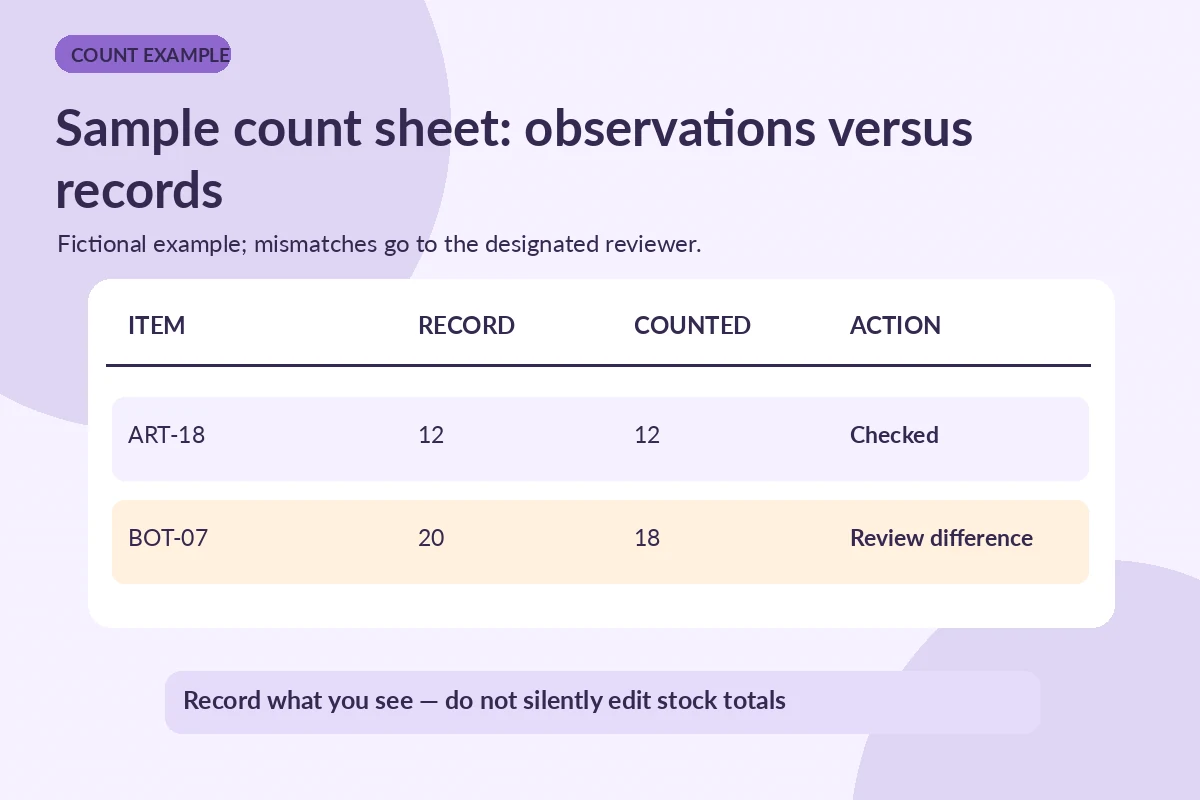
For a training exercise, imagine a worksheet with two fictional items. One physical count matches the system quantity and can be marked checked; another differs and is labeled for supervisor review. Those invented numbers teach how to document an exception, not how to approve an inventory adjustment. A good applicant can explain why accurate observation and a traceable handoff matter more than a promise to make every shelf match.
Clarify scanner use and data permissions
Employers may use barcode scanners, tablets, paper count sheets or a combination. Ask whether training is provided before the first shift and what happens when a barcode is damaged or a device loses connectivity. Some teams use two-person counts or separate verification for high-value stock. Never guess an item code from memory or photograph customer or employer records on a personal device without permission. Request a sanctioned process for errors and device returns.
In an interview, describe tools you have actually used rather than claiming proficiency from observing somebody else. If you have handled spreadsheets but not an inventory scanner, say you can enter and check data accurately and would need device training. Reliability, careful identification and prompt escalation can be demonstrated through class projects or volunteer records when those examples are described honestly.
Screen physical tasks and equipment hazards
Inventory work may involve bending, reaching, standing and walking through receiving areas. Some postings include ladder use, pallet movement or stock lifting; others are mostly clerical counts. OSHA’s warehousing guidance identifies material handling, forklift traffic, slips and trips, and ergonomic risk as important hazards. Ask about lifting ranges, footwear, access to safe platforms and how pedestrian routes are kept separate from operating equipment.
Do not operate a forklift, climb on shelving or move unstable inventory without the appropriate employer instruction and authorization. Where a count would require access to an unsafe place, report it to the lead worker instead of inventing a shortcut. Avoid a job ad that treats training and safety questions as evidence you are unwilling to work. Clear task boundaries protect accuracy as well as people.
Apply with evidence of accuracy, not fake outcomes
Look for official postings from inventory services firms, retailers, hospitals, campuses and distributors, but verify who actually employs the count team. Some roles are temporary agency assignments and some are direct hires. Use search terms that include cycle count, physical inventory, stock audit assistant or inventory associate plus your location. Verify the named organization through its own contact information; do not pay a recruiter to reserve a shift.
A hypothetical bullet might read: “Checked item labels against a supplied list, recorded quantities and referred mismatches to a supervisor.” It signals the correct sequence without claiming responsibility for financial adjustments. If you have classroom lab experience, describe the inventory-like records you maintained and who reviewed them. Bring a truthful availability statement and discuss transportation if the assignment moves between sites.
Ask who owns a discrepancy before accepting
Every counting team should know how to handle duplicates, missing labels, inaccessible shelves and mismatched quantities. Ask whether discrepancies are rechecked by another counter, a team lead or a separate records group. The answer helps you understand supervision and speed expectations. A role promising payment only for unusually high counts deserves close review of its terms, because rushing can undermine the accuracy the job is supposed to provide.
Compare paid hours, site travel, device training, shift cancellation rules and physical demands before deciding. Do not assume that a short project leads to permanent employment or that an advertised job title guarantees a regular schedule. Request the actual assignment conditions and keep copies of the written offer for your records.
Compare the posting with a task and permission checklist
Use the comparison below as an interview worksheet, not as a statement of policy for a specific employer. Duties, schedules, training, safety practices and authorization depend on the organization. Ask for a job description or written procedure when those details are unclear.
| Task | Counter typically does | Escalate rather than assume |
|---|---|---|
| Mismatch | Record observed quantity | Who can change the system record? |
| Unreadable label | Flag item for review | Who assigns the correct identifier? |
| High shelf | Follow safe access process | Who approves equipment use? |
How We Research Part-Time Job Opportunities
On 2026-11-06 we compared these specific duties with the official occupational and safety sources below, reviewed the WordPress inventory supplied for this project to avoid overlapping existing part-time job guides, and checked public search context. This article is general US job-search guidance, not a list of currently verified openings or legal advice. Illustrative shifts, counts, scripts and resume statements are hypothetical. Employer procedures and local training requirements control. See the JobAsk affiliate disclosure for information about commercial relationships.
Sources reviewed on 2026-11-06: O*NET OnLine (U.S. Department of Labor) — O*NET describes stocker and order-filler tasks and related inventory titles.; O*NET OnLine (U.S. Department of Labor) — O*NET describes inventory-related clerk record verification and discrepancy-related tasks.; Occupational Safety and Health Administration — OSHA details material handling, vehicle traffic, slip and ergonomic hazards in warehouse work..
Related Job Search Guides
Not necessarily. Counting focuses on identifying and recording quantities; stocking and receiving can have additional handling duties.
Some employers use scanners, while others use tablets or paper. Ask about training and error handling for their exact system.
No. Some are overnight or after closing; other counts happen during normal hours. Check each assignment schedule.
Do not assume so. Record the observed count and follow the employer’s review and approval procedure.
Ask about walking routes near equipment, safe shelf access, lifting expectations, breaks and supervised equipment training.