
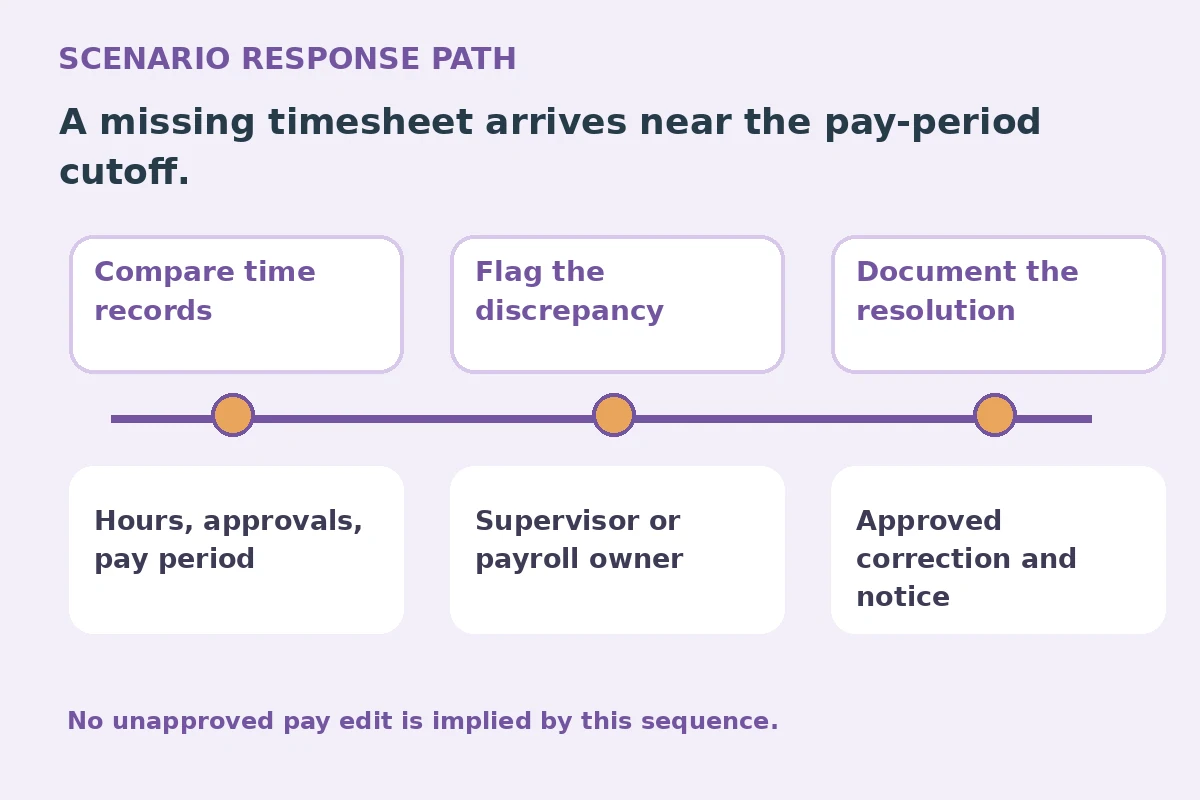
For payroll problem solving interview questions, interviewers may describe an unfamiliar event and ask what you would do next. A useful answer begins with the real-world risk, identifies the records or facts you can verify, and explains who has authority over the next decision. For example: A missing timesheet arrives near the pay-period cutoff. You do not need to invent the employer’s policies, assume an outcome, or claim powers outside the advertised position. Use this practical framework: compare time records, flag the discrepancy, and document the resolution. All sample answers below are hypothetical practice examples, not statements about actual employers or candidates. Replace generic claims with the employer’s published procedures, protect confidential information, and ask a follow-up question when the scenario leaves a material fact unknown.
Lead with accurate employee pay and defined authority
A payroll problem-solving interview asks whether you can protect accuracy under deadline pressure. Your answer should begin with the pay period, the disputed record, the authoritative source, and who can approve a change. Do not say you would enter a plausible number and revisit it later. Payroll systems, bargaining agreements, and approval chains vary by employer. Explain that you would verify what you can, document the discrepancy, and escalate promptly through the required process. Showing sensitivity to employees and audit trails is stronger than boasting that you never make mistakes.
Scenario: a timesheet is missing at cutoff
Imagine a worker’s timesheet is absent just before processing. Check the designated timekeeping system for an approved entry or another authorized source and review the applicable workflow for missing records. Contact the responsible manager or payroll approver through a secure channel. Do not substitute a schedule for hours actually worked without the employer’s approved process. If the missing record affects a payment deadline, escalate the risk instead of quietly excluding the person. Your answer must acknowledge both timely pay and the need for validated inputs, not invent a one-size-fits-all legal remedy.
Scenario: reported overtime does not match the system
A worker may say they worked more hours than the timesheet indicates. Listen carefully, confirm the pay period and work dates, and identify the records or supervisor who can verify the difference. Treat hours worked as the important fact, not whether an employee received advance approval to work them; any policy issue should be considered through the appropriate channel. Do not suppress reported time to make a budget look right. Explain how you would route adjustments and document the final approved change while respecting the employer’s applicable wage-and-hour obligations.
Scenario: a supervisor requests an unsupported deduction
A manager might request a last-minute deduction, retroactive change, or special rate without the necessary backup. Do not execute it just because the request came from someone senior. Verify the source document, ask whether the change has the required authorization, and escalate questions about pay rules to payroll leadership or qualified HR staff. Avoid giving universal legal conclusions about permissible deductions because rules depend on circumstances and jurisdiction. A useful response shows how to preserve the request, its review, and the disposition without exposing employee information to unrelated colleagues.
Scenario: an employee sees a smaller check
Acknowledge the concern without assuming the payroll system is wrong or revealing another employee’s wages for comparison. Confirm the identity and permitted information, review the worker’s actual earnings statement and input records, and distinguish a missing hour from a tax or benefits question. Explain which categories you can analyze and which require benefits or payroll-specialist review. If an error is confirmed, describe following the approved adjustment process and informing the employee of the documented next step rather than promising an unapproved immediate payment.

Explain what the official sources actually cover
The U.S. Department of Labor requires specified records of hours and earnings for covered workers, and O*NET describes payroll clerks reviewing time sheets and correcting discrepancies. Those sources support the importance of accurate records, not the assertion that every company must use the same electronic approval sequence. The IRS also details employment-tax recordkeeping. In an interview, distinguish these broad duties from employer-specific cutoffs, banking approvals, and software permissions. Do not invent a universal “payroll can always fix it next cycle” rule when timely payment obligations may be involved.
| Question to ask yourself | Evidence or action to describe |
|---|---|
| What is the immediate issue? | Compare time records: Hours, approvals, pay period |
| What can I verify? | Flag the discrepancy: Supervisor or payroll owner |
| Who owns the next action? | Document the resolution: Approved correction and notice |
Make a traceable payroll issue log
Describe a safe internal record with the pay period, discrepancy type, person responsible for source confirmation, date of approval, action taken, and employee communication status. Access to this material should follow the employer’s confidential-data rules. A useful log does not need to reveal a Social Security number in a training presentation. In a hypothetical response, you can refer to an invented employee ID, but label it as fiction. Your interviewer wants to hear that corrections remain reconstructable without spreading personal data through email chains or unsecured spreadsheets.
Differentiate payroll processing from policy decisions
An assistant may compile hours, compare reports, and prepare a proposed change, while a payroll manager, HR representative, or other designated official authorizes the adjustment. Never claim authority you do not actually have. If the interviewer asks about a suspected improper deduction or wage compliance issue, state that you would preserve the relevant evidence and consult the appropriate qualified lead. Payroll work is not improved by secret manual overrides. The dependable process is to report a concern before the file is finalized whenever possible and document what action was authorized.

Practice an answer with a before-and-after contrast
A weak answer might say, “I would change the missing figure so everyone gets paid.” A more credible hypothetical answer is, “I would verify the worker’s reported hours against approved records, flag the mismatch immediately, and obtain the designated review before processing a correction.” Add what you would tell the employee if you are authorized to respond. Then state how you would check that the adjustment appeared in the right record. Avoid invented savings, tax outcomes, or audit results; these are practice answers, not claims from a real employer.
Ask about cutoff ownership and correction procedures
Questions worth asking include who signs off on time edits, how disputed hours are handled before payroll closes, and which team owns urgent pay issues after cutoff. Clarify how the organization separates payroll processing, benefits decisions, and wage-compliance advice. Some roles handle only data entry; others maintain several stages of the payroll process. A job-specific answer should reflect that boundary and the system controls described in the vacancy. Show that you want accurate, timely payments, a clean record, and respectful communication with the employee who raised the concern.
How We Research Payroll Assistant Interview Scenarios
JobAsk reviewed the following primary occupational and agency sources on November 17, 2026: O*NET identifies payroll and timekeeping duties including verification, reconciliation, pay adjustments and recordkeeping. DOL Fact Sheet 21 explains FLSA recordkeeping of hours, earnings and timekeeping information for covered employers. IRS describes employer employment-tax records, wage payments and related documentation. They explain broad responsibilities and information-handling boundaries, not any particular employer’s selection criteria or the outcome of a real interview. Hypothetical questions and answers are editorial teaching examples. Follow the actual employer’s written procedures, training and legal obligations. We do not claim that an answer ensures hiring. See our affiliate disclosure for relationship transparency.
More Interview Preparation Guides
Do not invent hours. Describe verifying records, alerting the responsible approver and following the employer’s lawful exception process.
Request the proper documentation and approval, and escalate unresolved pay-policy questions to qualified payroll or HR leadership.
Only if an authorized process supports that timing; otherwise communicate the verified next step and avoid promises.
Not always. Confirm actual hours and applicable rules; a timekeeping discrepancy may require qualified payroll or wage-and-hour review.
Use fictional examples and follow confidentiality rules. Do not disclose another employee’s private payroll records.