
Poll worker experience can belong on a resume as paid temporary work, a public-service position, or volunteer experience, depending on how your local election office engaged you. List the real jurisdiction or organization, the date or election cycle, your assigned tasks, and relevant training. Useful evidence may include welcoming voters, helping with check-in, explaining approved procedures, preparing a location, and accurate materials handoffs. Avoid suggesting you certified results, made eligibility decisions independently, or represented an election authority beyond your assigned duties.
Determine whether the role was paid work or service
Begin by checking the appointment notice or election-office record. Some jurisdictions pay poll workers, some arrange stipends, and conditions vary. Do not call every poll worker a volunteer or every volunteer a salaried county employee. If it was paid temporary work, it may fit your Experience section; unpaid service can appear under Volunteer Experience. You can use a single “Election Worker” heading when that is the official title you held.
Identify the county, city, board of elections or local election office as accurately as your records allow. If you worked at a particular polling place, the administrative jurisdiction may be the better organization heading than the temporary building location. Never create a false statewide appointment, political campaign role or formal election-official credential. The reader needs the relationship and dates, not an inflated government title.
Translate the election-day timeline into relevant tasks
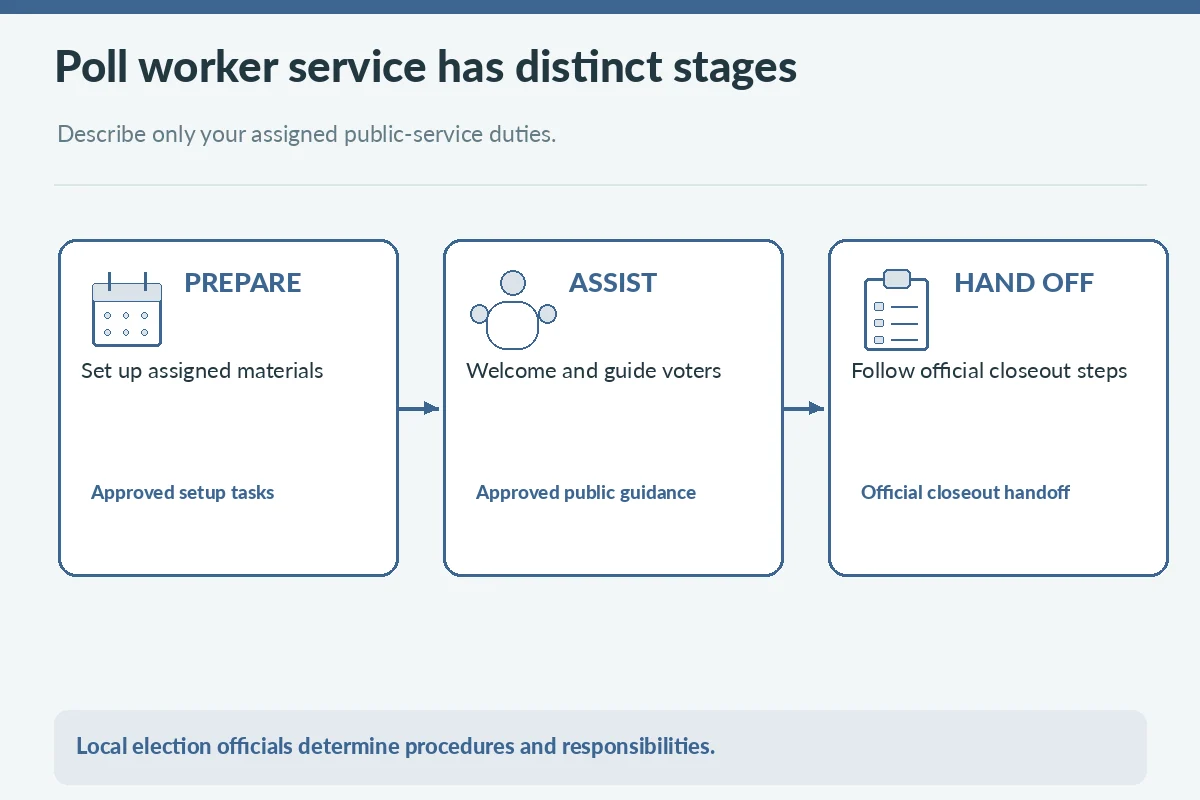
The U.S. Election Assistance Commission describes common poll worker activities such as preparing polling locations, welcoming voters, check-in, ballot issuance and communicating voting procedures. Actual duties vary by jurisdiction and local training. Make a simple timeline of what you were assigned to do before opening, during voting hours and at close. Then select only the stages in which you personally participated.
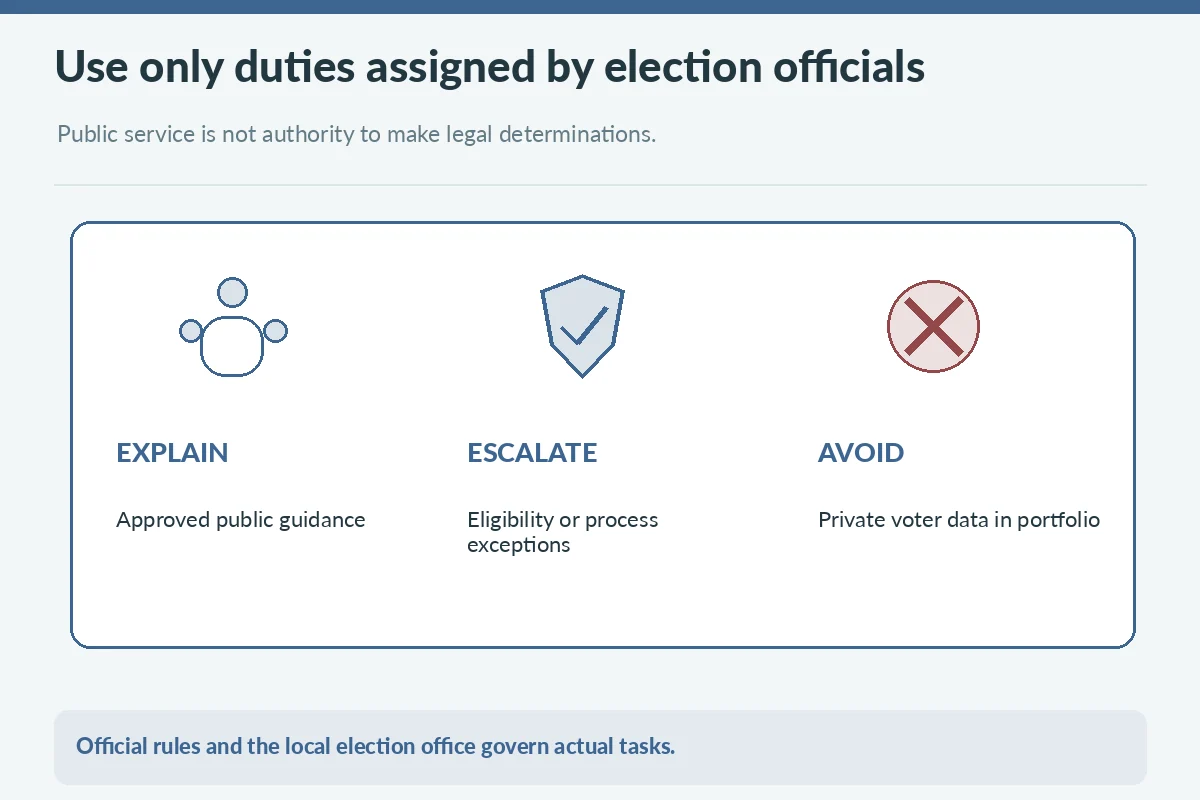
For a customer-service resume, voter greeting and accessible directions can demonstrate calm, accurate assistance. For administrative work, a task like following prescribed check-in steps or reconciling assigned materials may demonstrate attention to procedure. The distinction is crucial: carrying out a prescribed step is not authority to decide legal eligibility or certify results. State the task you performed and any applicable supervision rather than using broad slogans about “running elections.”
Use neutral, professional language for public-facing work
Your resume should focus on service, records care and nonpartisan procedures rather than persuasion, campaigning or political affiliation. For example, “Provided directions to voters and explained posted check-in steps using election-office instructions” is an illustrative bullet when it matches your assignment. “Led voting decisions” would be inaccurate and misleading. Do not imply that a poll worker influenced how a voter chose to vote.
If you used a language skill or helped a voter request accessibility assistance, describe only the scope you actually handled. Some actions require specific training, equipment or designated officials. You can note that you referred questions to the appropriate election lead. That is a useful handoff skill, not an admission of weak performance. Avoid stories about individual voters, ballot choices, identification details or disputes that could expose sensitive information.
Record training precisely without inventing credentials
Poll workers typically receive jurisdiction-specific training. A resume can say “Completed county poll worker training” if true. It should not transform a brief local orientation into a national certification or a license recognized across all states. The EAC notes that specific tasks and compensation vary, so check the terminology used by the election office that trained you. Include a training date or title only when you can verify it.
If you worked multiple elections in the same role, list the election periods that you can confirm. A line such as “Election Day assignments, 2024 and 2026” is clearer than “2024–2026 full-time,” which would be implausible for one-day appointments. If you performed early voting work as well, distinguish those shifts. Do not confuse time on a volunteer roster with time actually staffed at a polling location.

Write a short proof-based election worker bullet
Start with an action verb plus the authorized procedure and audience. Hypothetical: “Assisted with voter check-in using approved election-office instructions and routed exceptions to the precinct lead.” Another possible line is “Helped prepare accessible wayfinding signs and supported orderly voter flow during assigned shifts.” Use these only if they describe your participation. Neither line claims election authority or a measurable effect on turnout.
Verified quantities can be helpful only when you know them and are permitted to share them. A personal guess at the number of voters served or ballots handled is not an appropriate achievement metric. The accuracy of records and the respectful treatment of voters matter more than invented volume. For private-sector resumes, two strong bullets often suffice; readers do not need every equipment or procedural detail.
Keep operational details and voter information private
Do not include voter names, registration details, ballot serial numbers, equipment access information or actual election documents in a portfolio. If asked for a work sample, a wholly fictional queue diagram or generic customer-service description is more appropriate. Local election rules and training govern what election staff may share. Treat anything that could compromise privacy or operational integrity as off limits unless explicitly authorized.
If you observed a problem and reported it, describe the reporting chain at a high level without disclosing security mechanisms. For instance, “Reported check-in exceptions promptly to the assigned lead” demonstrates judgment and accountability. Do not present a personal narrative of an alleged procedural violation as a verified election finding. An application should convey transferable experience, not speculate about election outcomes.
Adapt the entry for office, service, or public-sector roles
For front-desk jobs, emphasize handling questions respectfully and using established procedures. For public-administration jobs, describe training compliance, scheduled attendance, material preparation or non-sensitive reconciliation support. For event operations, focus on setup, wayfinding, accessibility and team coordination. Keep titles honest; an election worker can demonstrate responsibility without pretending to have managed an entire government program.
A compact resume entry might include “Poll Worker — County Election Office,” the election date or period, and two lines about voter assistance and established handoffs. If you served on several occasions and acquired designated additional duties, show those separately only when verifiable. Avoid claims of political neutrality certification unless a specific credential was actually awarded. Your ability to describe the work calmly and accurately is itself evidence of professionalism.
Perform a final dates and authority review
Check the organization name, compensation status, assigned title and training against your appointment information. Remove wording such as “certified ballots,” “determined voter eligibility,” or “supervised the election” unless those specific powers were actually assigned and appropriate. Most resume readers value the service experience without needing a detailed narrative of the law. If employment verification is requested, use the official jurisdiction contact rather than a private voter or colleague.
Keep the final document short and accessible. Treat each example as a model of phrasing, not as a claim that you personally handled a particular process. Your entry should help an employer see reliable attendance, public service, procedure-following and respectful communication. Those are strong transferable skills without exaggerating the authority or sensitive nature of the election assignment.
| Experience type | What to show | What not to imply |
|---|---|---|
| Public assistance | Welcomed voters and explained approved steps | Do not claim political persuasion |
| Check-in support | Followed local procedures; escalated exceptions | Do not imply independent eligibility authority |
| Closing or setup | Performed assigned materials tasks | Do not claim you certified election results |
How We Research Resume Work Experience
We compared the supplied JobAsk WordPress post inventory and recent draft packages with the role-specific duties in primary public sources. We reviewed source guidance on 2026-11-05, while job duties, state requirements, organizational roles, and school policies can vary. All named workplace examples, invented labels, practice records and sample bullets here are illustrative, not actual candidate outcomes. We do not claim a particular resume format guarantees an ATS or job result. Read the JobAsk affiliate disclosure for information on commercial relationships.
Primary sources checked on 2026-11-05: CareerOneStop / U.S. Department of Labor — CareerOneStop describes how to present job titles, dates and responsibilities.; U.S. Election Assistance Commission — EAC identifies core poll worker tasks and training under local election officials.; U.S. Election Assistance Commission — EAC notes jurisdictional variation in assigned duties, compensation and training requirements.. Sources describe general professional practices or specific institutions; verify the actual employer and its policies before applying.
More Resume and Cover Letter Guides
It depends on your jurisdiction and appointment. Use paid work or volunteer experience according to the actual arrangement.
The local election office or jurisdiction is often the clearer organization. Add location details only if accurate, relevant and permitted.
Only label it as a certification if the issuing authority actually granted one. Otherwise call it jurisdiction-specific training.
Do not disclose private voter information or operational documents. Use only verified, shareable details.
Show the election date and two specific duties, such as voter directions and approved check-in assistance, without suggesting continuous employment.