
Write a presentation interview thank-you email that acknowledges questions and discussion, respects the employer’s material-sharing instructions, and avoids unsolicited slide revisions. Start with the actual interview format, the correct recipient and one detail you can verify from the conversation. Use the examples below as hypothetical models, not ready-made claims about your experience or the employer. A thank-you should reinforce professionalism, not imply a guaranteed offer.
Treat the presentation and the thank-you as different documents
A presentation interview thank-you email acknowledges the people who reviewed your work and one meaningful question from the discussion. It does not need to summarize every slide. During the interview, the panel had an opportunity to inspect your structure, assumptions, delivery and responses under questioning. A follow-up message may reinforce how you listened, but it should not attempt to replace the original exercise or demand another review.
Write three quick notes immediately afterward: who attended, the question or constraint that changed your understanding, and what the employer said about next steps or permitted materials. These notes help you produce a genuine email instead of a generic compliment. If the presentation was based on a confidential scenario, keep the message at the process level rather than restating internal numbers, customer names, research participants or unpublished strategy.
Decide whether slides belong in the follow-up
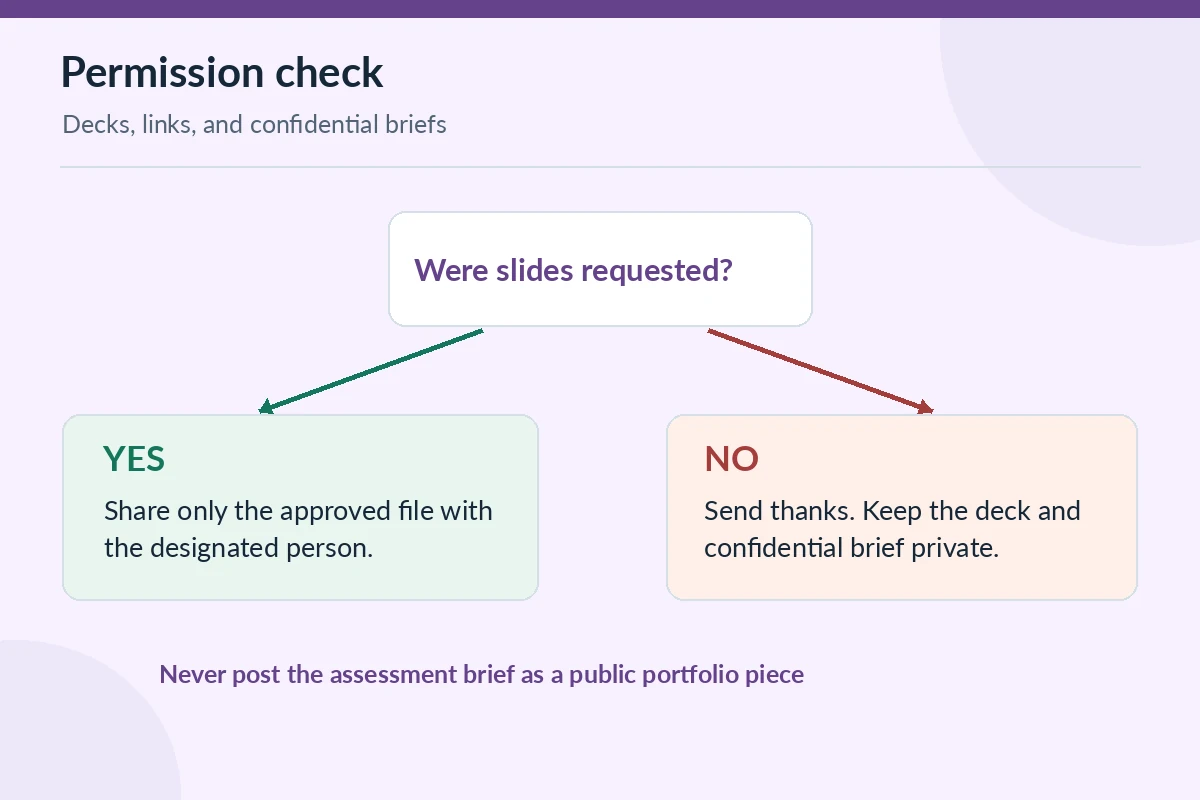
Some employers explicitly ask for a PDF of the slides; others provide a presentation task that should not be redistributed. The correct default is to follow the instructions rather than assume the deck is yours to share freely. If the interviewer requested a public portfolio link, verify that the destination reveals only work you have permission to show. If the presentation used the employer’s private brief, do not post it online or forward it to people outside the hiring team.
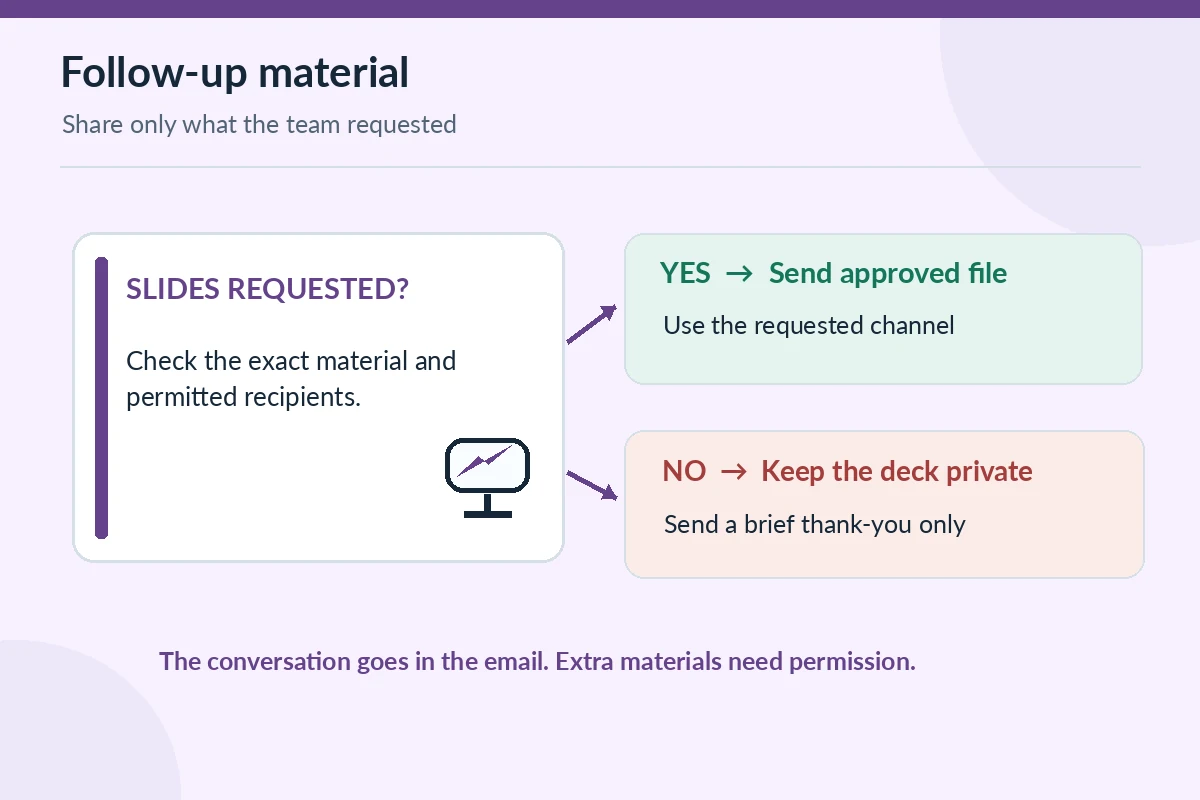
Use a simple decision: requested and approved material can be sent through the specified channel, with a clear filename and a short explanatory line. Unrequested material should generally stay with you. If access controls are unclear, ask the recruiter which format and recipient they prefer. Do not attach screenshots of private dashboards or copies of someone else’s proprietary work just because they appeared in a talk.
Draft an email anchored in one real question
Here is a fictional example to adapt, not a real message: “Subject: Thank you — Program Analyst presentation. Hello Morgan, thank you and the team for discussing my presentation today. I appreciated the question about how I would test the proposed pilot before expanding it. That conversation helped me better understand the role’s emphasis on evidence and coordination. I remain interested in the opportunity and appreciate your time. Best, Taylor.” The wording is useful because it captures a decision point without restating the confidential presentation.
You can substitute the real project, role and question, but do not fabricate agreement. The panel may have challenged your assumptions precisely because they were unconvinced, not because they endorsed the proposal. Avoid sentences such as “As we agreed, my plan will deliver a 40 percent improvement” unless there was a clearly documented and authorized basis for that claim. Let the interview remain an assessment rather than rewriting its outcome by email.
Use questions to show listening, not defensiveness
A useful presentation follow-up can acknowledge that a question highlighted an operational issue, stakeholder perspective or missing data source. For example, “I appreciated the discussion about how frontline teams would validate the pilot” is a respectful callback. A defensive email would include five bullet points explaining why the panel should have accepted your original model. Reviewers are unlikely to need the extra argument unless they invited it.

If you genuinely misrepresented your own credential or job history in the presentation, correct that factual issue promptly and unambiguously. For an ordinary analytical difference, there is usually no need to revise the argument after the fact. Interviewers may be interested in how you respond to uncertainty. Reflective language should describe actual learning, not make up a new decision or pretend you received an invitation to resubmit.
Choose the recipient carefully after a panel session
The most appropriate contact may be the panel chair, recruiter, coordinator or interview lead. If you have authorized contact details for panel members, short individualized notes can work, but they should not be copied word for word. If the organization asks that communication flow through HR, honor that arrangement. Reaching out privately to a panelist who did not offer contact details is not necessary to show enthusiasm.
Keep the subject specific enough to locate the role and session. Proofread names, the position, meeting date and the slide-related references. If you send a link the team requested, check its permissions in an incognito browser and ensure it does not expose extra unrelated content. An attachment that fails to open or contains confidential material can distract from an otherwise strong presentation.
Explain relevant experience in one grounded sentence
Suppose your presentation proposed a customer feedback process. If you previously collected feedback for an academic club, you may briefly say so, making clear that it was a student project. If you implemented a comparable process at work, name the action you personally handled without borrowing your team’s results as your own. The purpose is to reinforce the conversation, not to add a new resume paragraph or financial forecast.
Keep claims proportionate. “I would enjoy applying my experience maintaining feedback logs” is defensible when true. “I can guarantee faster launch cycles” is usually not. When the presentation was designed to test creativity, a thank-you can show that you value structured review and stakeholder input without promising a business result that has not been validated.
Respect the employer's timeline and next instructions
If the panel offered to share feedback or asked for additional details, follow that process. A promised public writing sample is different from an unsolicited revised deck. Record any stated hiring timeline so the thank-you email is not combined with a premature “did I pass?” question. If no response comes, use a separate, courteous status inquiry after the reasonable follow-up window rather than sending multiple slide versions.
There is no need to request detailed scoring immediately. A quiet inbox does not prove the presentation failed; decisions may be coordinated through several people. Continue applying elsewhere while keeping a clean record of the employer’s instructions, any material you sent, and when you followed up.
Review the note and files like a hiring-team recipient
Read your email with the attached files hidden. It should still make sense and communicate gratitude, one specific discussion point, and ongoing interest. Then verify every link, attachment permission, version number and recipient. If a presentation used private role-play data, do not include it as an email preview. Make sure your subject line matches the correct opening and that a greeting to one person does not accidentally name a different panel member.
A practical final check is to look for sentences that re-litigate the presentation. Replace them with appreciation for the exchange. Do not add decorations, quote the panel in ways they did not authorize, or invent next steps. A concise and accurate thank-you after a complex session will be easier for the hiring team to understand and safer to forward internally.
How We Research presentation interview thank-you email guidance
We reviewed guidance from university career centers about writing brief interview thank-you messages that refer to real conversations. The scenario-specific recommendations above are editorial applications of those general principles, not claims that a university endorses any particular template. Sources consulted on 2026-11-04: www.career.berkeley.edu career guidance (Recommends debriefing interview details and sending a specific thank-you note.). careercenter.ucdavis.edu career guidance (Recommends a concise interview thank-you email naming something learned in the exchange.). careerservices.fas.harvard.edu career guidance (Describes written samples or portfolio materials as appropriate when relevant to the interview.). Examples are fictional and should be adapted only to your actual experience. See the affiliate disclosure.
More Interview Preparation Guides
Only if the employer asked for it or clearly authorized sharing. Some assignments use confidential information or assessment materials, and an unrequested deck can add risk rather than value.
Yes. A brief reference to a real question can show attention and reflection. Do not use the email to debate the panel or replace the presentation with an argument.
Correct your private copy. Send a corrected version only if the error is materially misleading and the employer’s follow-up procedure permits it, or if the panel requests a revision.
Follow the contact instructions and availability of legitimate addresses. A single note through the designated contact can be appropriate; avoid duplicates and guessing private addresses.
A compact note with thanks, one discussion detail, real interest and a closing is normally more useful than several paragraphs rearguing your presentation.