
Questions in a second interview usually build on what an employer already knows, but there is no single script or guaranteed sequence. You may meet a hiring manager, future collaborators or several people in separate sessions. This guide helps you practice deeper job-specific answers, prepare questions for the employer and keep your examples consistent with the facts in your original application. It is not a prediction of a particular employer’s interview questions. Every candidate and answer below is explicitly hypothetical.
Ask what the second-round format will involve
Before rehearsing an imagined interrogation, confirm the practical details of your invitation. Ask who you will meet, whether it is one conversation or several, whether there will be a task or presentation, the expected duration and how to prepare. UMGC career services recommends requesting an agenda when one has not been provided. Second rounds can vary widely, including remote calls, structured interviews or onsite meetings. An invitation means you are continuing in the process, not that an offer is imminent. Keep travel, accessibility and scheduling questions separate from performance anxiety: they are ordinary planning matters that the recruiting contact can clarify.
A concise hypothetical reply could read, “Thank you for the invitation. Could you share the meeting format, participant roles and any exercises I should prepare for?” There is no need to demand confidential scoring information. If the employer asks you to complete a project, clarify scope and timing and avoid sharing proprietary information from a previous job. Save the agreed agenda and identify what each participant may want to understand. The prior JobAsk panel interview article deals specifically with several interviewers asking questions together; this article covers an entire second-round process and your role in evaluating the opportunity.
Prepare a deeper version of your opening answer
“Tell me about yourself” may appear again, sometimes with someone who did not attend the first meeting. Repeated questions are not proof that the employer ignored your previous answers. Give a coherent professional summary tied to the current role, then use a fresh level of detail rather than contradicting your initial story. Explain the work you do, a relevant accomplishment you can actually substantiate and why this particular team interests you. Avoid a memorized personal autobiography that never addresses the job. Update your preparation with details you learned at the first interview, while keeping names, dates and results consistent. For the fuller picture, see our guide “Second-Round Interview Preparation”.
Hypothetical answer: “I coordinate weekly schedules for a small volunteer program and document last-minute changes. In our last conversation you described a role that needs clear handoffs across shifts. That is the part of the job I would especially like to discuss.” The applicant must replace the example with a real experience. If they have no equivalent achievement, they can explain an honestly related learning project. An interviewer may ask what the schedule covered, how problems were tracked or who approved changes. Rehearsing those follow-up questions produces stronger evidence than memorizing a polished sentence alone.
Practice problem solving with truthful constraints
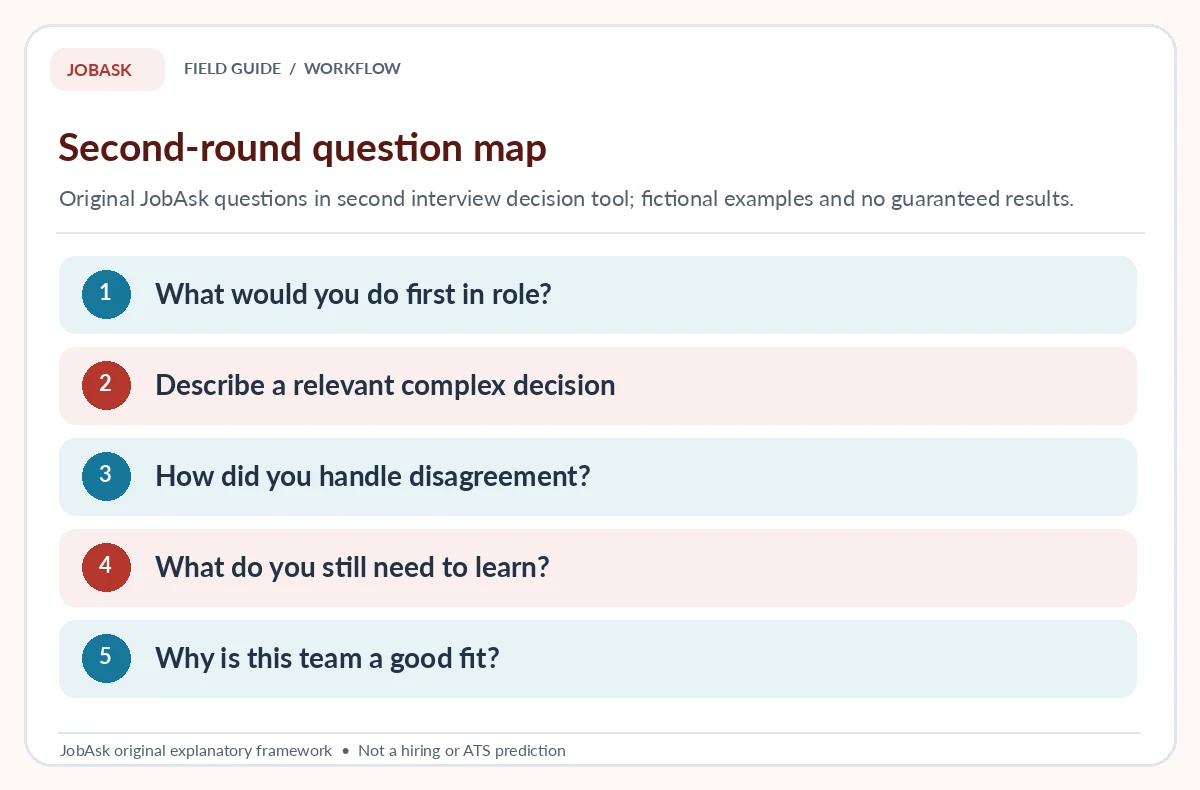
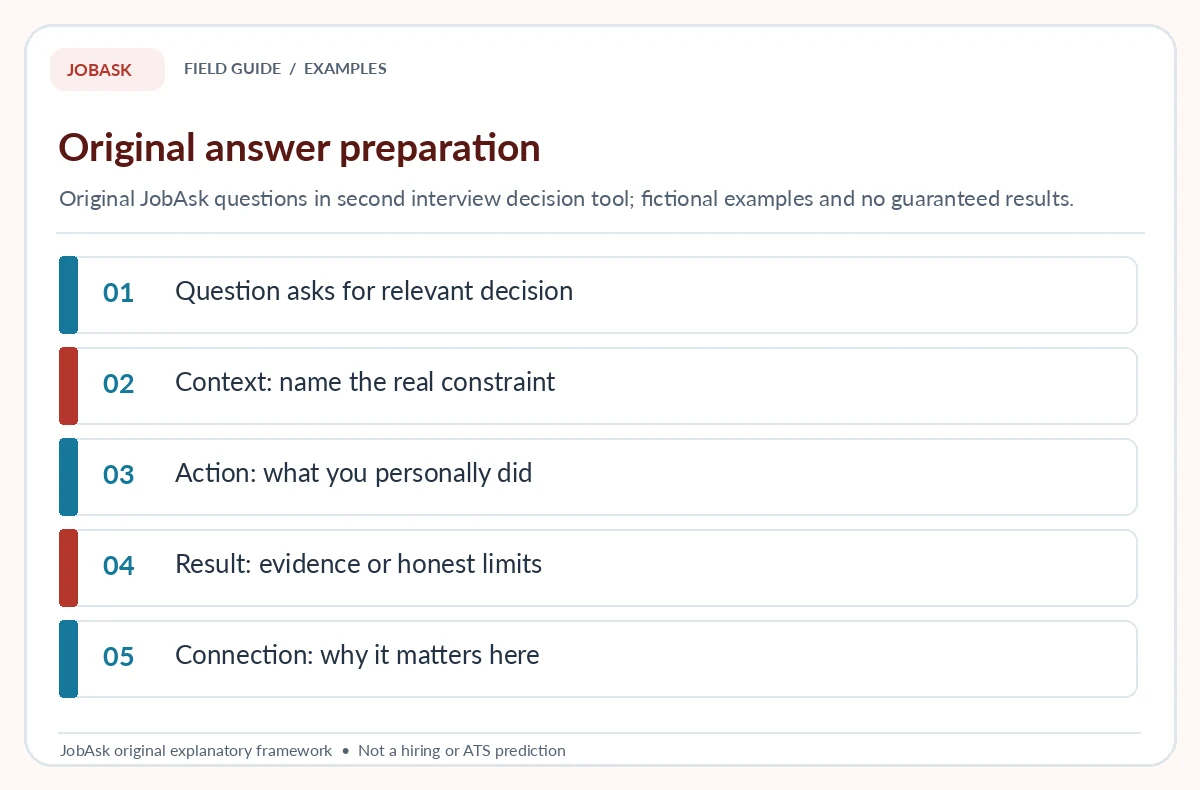
A later-stage interviewer may ask about a difficult choice, a process that failed or a time you had incomplete information. Prepare stories with a clear situation, the responsibility you actually held, the action you took and the known outcome. If the result was mixed, say so rather than inventing a victory. Be ready to describe alternatives and what you learned. The STAR structure can organize a behavioral story, but this second-round guide emphasizes selecting examples that answer the employer’s specific job concerns and responding to follow-up probes about trade-offs.
Hypothetical question: “Your team receives two urgent requests at once; how do you prioritize?” The applicant could explain that they would clarify deadlines and impact with the responsible supervisor, communicate a sequence and document the decision. That is a hypothetical response plan, not evidence that they performed it in an actual job. If asked for an experience rather than a scenario, switch to a real example. Do not present a simulated answer as a past workplace achievement. Demonstrate your reasoning, decision boundaries and communication, and acknowledge when the right next step is to seek guidance rather than act alone.
Discuss collaboration and disagreement without blaming
Second-round conversations often explore how work gets done among people with different priorities. Prepare a real example of listening, clarifying a disagreement or asking for help before a mistake grew. Focus on the actions under your control and your respect for confidential workplace details. Do not name former colleagues in a negative story or share internal business information merely to sound impressive. When a question asks about conflict, explain the professional issue, what you did to understand it, the agreement reached if any and what you would change today. Not every disagreement has a perfect ending.
A fictional applicant might describe conflicting instructions on a group research assignment. Their verifiable contribution could be organizing a quick meeting, writing down shared criteria and circulating the agreed division of tasks. The teaching example does not claim the group received a particular grade or that an employer values the answer. Practice articulating how you invited input, made a decision when authorized and escalated unresolved risk appropriately. The key skill being demonstrated is collaborative judgment, not the ability to tell an entertaining confrontation story. Choose an example you can discuss calmly under follow-up questioning.
| Likely purpose | Candidate evidence | Question to ask |
|---|---|---|
| Role judgment | True example of a decision | What outcomes matter first? |
| Team collaboration | Real handoff or disagreement story | Who sets shared priorities? |
| Longer-term fit | Honest development plan | How is feedback delivered? |
Answer role-specific and future-oriented questions
You may be asked what you would prioritize in the first month, how you would learn an unfamiliar system or how your background applies to a known team challenge. Research the published job duties and combine them with verified information learned from the first interview. Separate what you know from what you would need to ask after joining. A careful answer outlines how you would observe work, confirm priorities with a supervisor and choose a small achievable improvement. Do not promise revenue increases, hiring quotas or operational results when you lack the actual company data needed to predict them.
Hypothetical answer to “What would you do in your first few weeks?”: “I would clarify the key deliverables, understand existing handoff procedures, meet the people whose work connects to mine and document any unclear steps before proposing changes.” This demonstrates a plan without asserting inside knowledge. If the role is technical or regulated, avoid claiming you could perform tasks beyond your current permissions or training. Employers differ in expectations; ask what onboarding looks like before treating a suggested milestone as a contractual promise. Save specialized day-one and 30-60-90 planning for their separate JobAsk guides.
Prepare your own questions to assess the employer
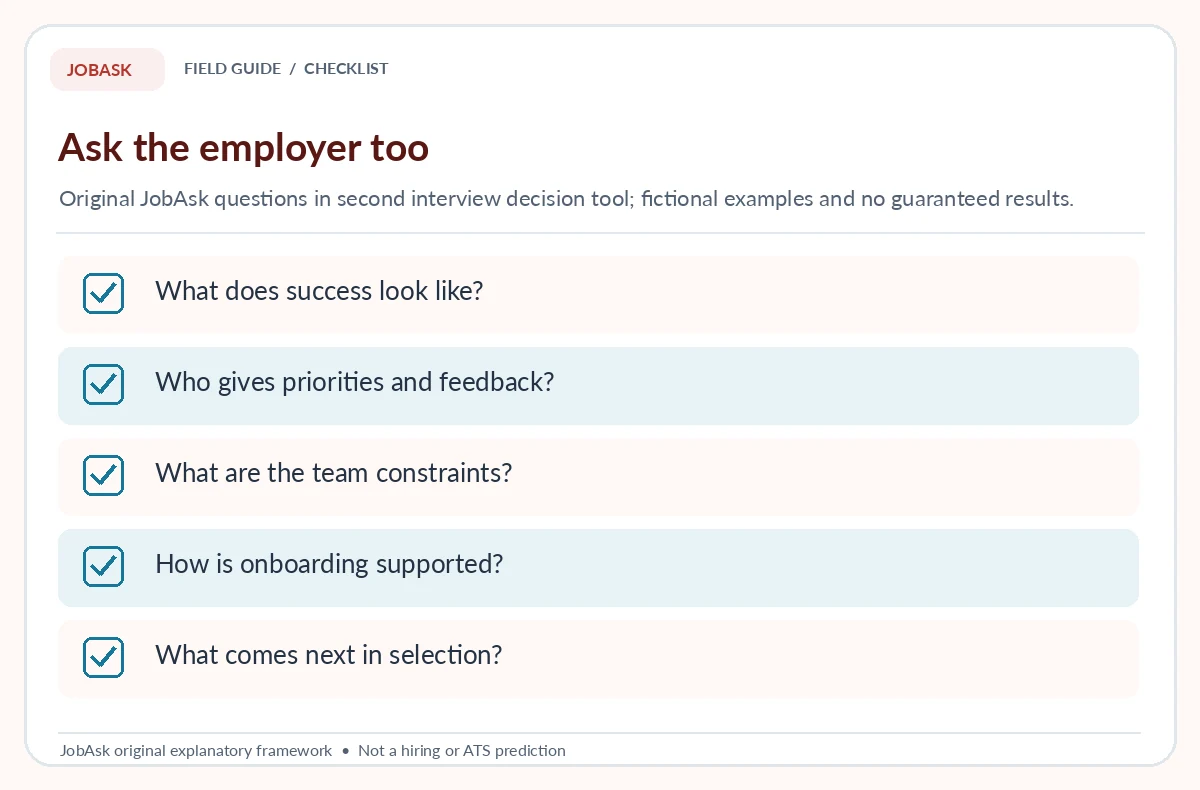
The second interview is also a chance to gather evidence about whether the position works for you. Ask about expected outcomes, decision authority, training, feedback, collaboration and workload. Questions should respond to what you have learned, not merely repeat facts visible on the careers homepage. UNLV offers examples about advancement, management style and challenges the role could address. Pick a few topics that matter to your situation. Pay and benefits may arise during the process; seek accurate written terms when appropriate instead of assuming that every conversation about compensation constitutes an offer.
A fictional candidate concerned about ambiguous priorities might ask, “When two teams need this coordinator at the same time, who sets the priority?” Another could ask, “What evidence would show that someone is succeeding after the initial onboarding period?” Record answers after the conversation, distinguishing statements about policy from informal impressions. You are not scoring the employer with a secret test; you are learning whether conditions match your needs. If an answer remains vague, you can ask for clarification later through the legitimate recruiting channel. Use the question matrix below to organize this mutual evaluation.
Review follow-up questions and communicate professionally
After the meeting, capture the names and roles of the people you spoke with, questions that surprised you, facts you learned and anything the employer explicitly asked you to send. A short thank-you note can reference a real topic and confirm continuing interest without exaggerating the interaction. If you promised a nonconfidential sample or additional factual information, provide it through an approved channel. Do not send unsolicited confidential material. Keep your records accurate: a friendly interview is not proof of selection, and an estimated timeline is not a binding employment agreement.
Use a three-part practice rubric before your next interview: relevance, evidence and mutual-fit questions. Did the answer address the requested skill? Did it clearly separate real history from hypothetical plans? Did you prepare questions that could change your decision? A candidate might discover that all of their stories describe individual work even though the role requires cross-team coordination. The next preparation step is to find a genuine collaboration example, not fabricate one. Finally, follow the employer’s stated timeline and avoid treating silence as a definitive outcome. The hiring decision belongs to the employer.
How We Research and Where This Guide Stops
We compared University of San Francisco, UMGC and UNLV career-service guidance for second-round formats, preparation and employer questions. The answer matrix and examples are original hypothetical exercises, not employer interview data. This article does not repeat the narrower JobAsk panel, STAR or first-round interview articles.
Authoritative sources reviewed October 19, 2026: University of San Francisco describes second-interview formats and mutual fit.. UMGC career services recommends clarifying the agenda and preparing deeper examples.. UNLV provides questions candidates may ask in second-round interviews..
Affiliate disclosure: No interview coaching product or hiring platform is presented as an approved JobAsk affiliate. See the JobAsk affiliate disclosure for the site-wide policy.
More Interview Preparation Guides
- Second Interview Thank-You Email: Add New Evidence Without Repeating Round One
- How to Practice a Mock Interview and Use Feedback to Improve Your Answers
- Sales Representative Interview Questions: Demonstrate Better Discovery
- Questions to Ask Future Coworkers in a Peer Interview
- Human Resources Interview Questions: Practice Confidentiality and Judgment
No. It means the employer is continuing the selection process; a decision remains uncertain.
Yes. Different participants may need a consistent account of your background and relevant work.
Practice clear evidence and structure, but respond naturally to the actual question and its follow-ups.
Yes. Thoughtful questions help you assess responsibilities, supervision, onboarding and fit.
Say what you genuinely know, explain how you would verify the missing information and do not pretend to hold an unavailable skill.