
The best questions to ask in a sales interview clarify exactly what is being sold, who the customers are, how opportunities enter the pipeline, what you will own and which support the company provides. Ask whether the role is primarily prospecting, managing existing accounts, retail service or closing deals. A title such as “sales representative” does not tell you whether you will travel, make outbound calls, handle renewals or prepare contracts.
The Bureau of Labor Statistics describes wholesale and manufacturing sales work as customer contact, product explanation, negotiation, order processing and follow-up. Those duties vary by sales setting, so do not assume every role uses the same quota system or compensation structure. Colorado Boulder’s career guide supports asking about expectations and training. Here you will map the sales process from first contact to post-sale responsibility before you decide whether the job suits you.
Identify the Customer and Selling Motion
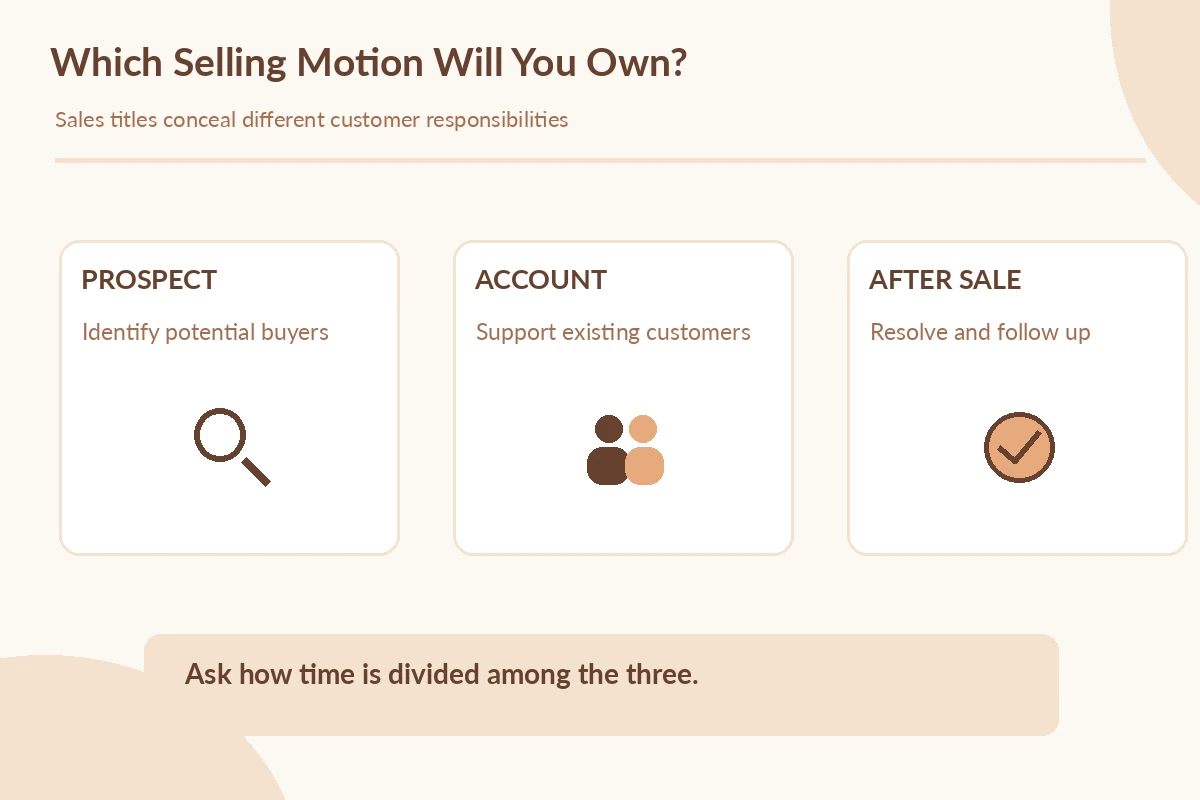
Start with “Who is the typical customer, and what problem are they trying to solve?” A business-to-business account role differs from store sales, inbound support or door-to-door prospecting. Follow with “What share of the work involves new prospects compared with existing accounts?” These answers help you picture the actual day rather than relying on an appealing title.
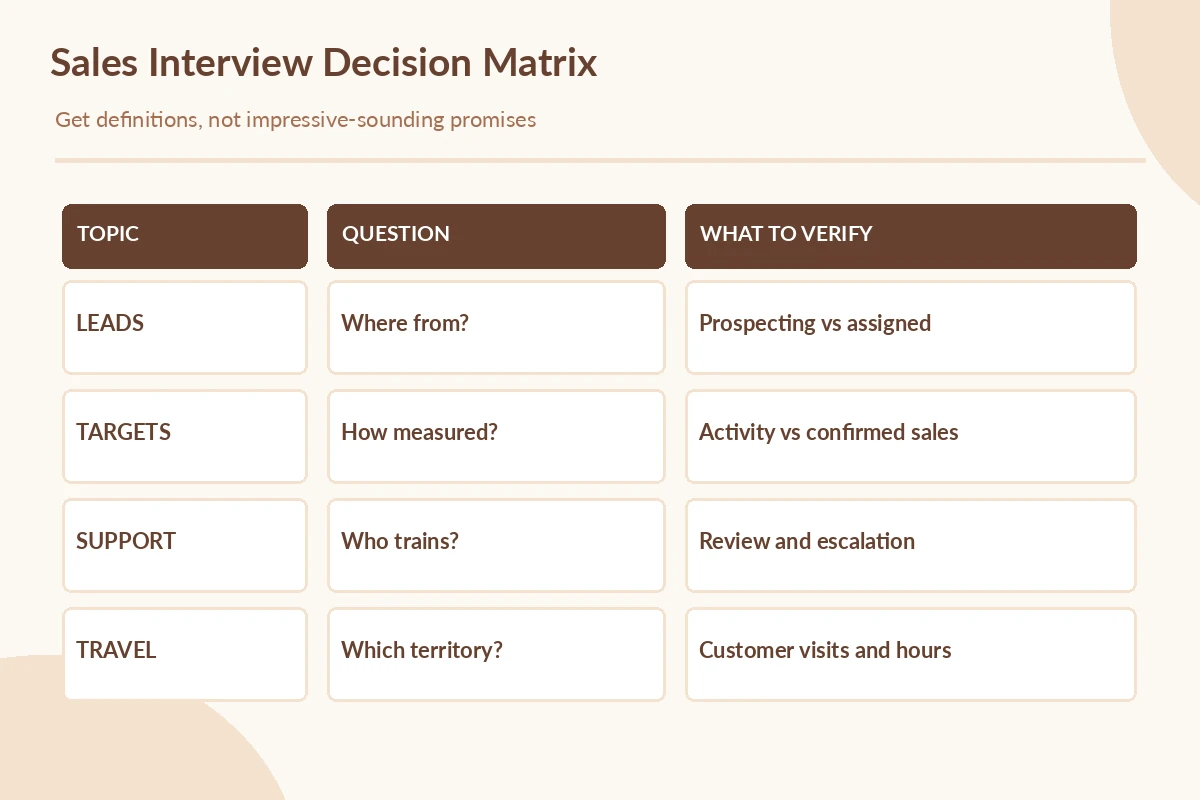
Clarify whether contacts come from the organization, self-directed outreach, customer referrals or another route. Ask whether territory and account assignments are fixed, shared or reassigned. Avoid assuming that the phrase “warm leads” means qualified buyers are ready to purchase; ask how that phrase is used and what work remains before a lead becomes an opportunity.
Trace the Full Pipeline and Ownership Boundaries
Draw the process as lead → discovery → proposal → approval → order or contract → follow-up. Then ask which stages the new hire personally controls and which require review or a specialist. In technical sales, a subject-matter expert may help with demonstrations or specifications. In other organizations, one person may cover several stages. The key is role clarity, not choosing one universal “correct” process.
BLS notes that wholesale representatives can work with technical colleagues and assist customers after the sale. Ask who handles contract terms, delivery problems, returns and customer complaints. A claim such as “You own the account” needs clarification if pricing approvals, contract signatures or implementation decisions remain elsewhere. A helpful answer names accountable teams and handoffs.

Clarify How Targets Are Defined and Reviewed
You can ask: “Which activities and outcomes are expected, and how are they measured?” and “What does the team review when targets are not met?” Separate activity measures such as calls or meetings from pipeline measures such as qualified opportunities and confirmed sales. Do not treat every number as a sign of revenue or a guarantee of success.
A newly created territory, seasonal customer cycle or delayed fulfillment may affect what is realistic. Ask how expectations change during training and whether targets are individual, team-based or mixed. This is a conversation about definitions and evidence; this guide does not estimate market pay, predict commissions or assert that any prospective employer uses a particular quota formula.
Ask Who Trains and Supports a New Representative
“What product training and supervised calls happen before a new hire is expected to work independently?” is more specific than “Do you train people?” Ask about demo materials, approved claims, pricing guidance, CRM instruction and escalation contacts. If the role serves a regulated or technical market, clarify when a specialist must answer a technical or compliance question.
Find out who reviews early opportunities and how coaching works: live call observation, written feedback, account reviews or formal training sessions. Colorado Boulder recommends asking about onboarding and first-month performance expectations. Training exists in many forms; a brief orientation alone does not establish that a new representative will have the tools needed for that specific job.
Differentiate Account Work From Prospecting
For account-management jobs, ask how renewals, service problems and cross-selling responsibilities are divided. For new-business jobs, ask what prospect research, outreach and qualification are expected. Some sales organizations have separate teams; others blend work. Neither structure guarantees an easier path, so focus on whether the arrangement is explained clearly.
Hypothetical exchange: Candidate: “If a customer asks for a product capability outside my knowledge, what is the handoff?” Manager: “You document the question and introduce our technical specialist.” This is a made-up teaching example, not an employer claim. It illustrates honest role boundaries: do not promise features or legal approvals that you have not verified.
Ask About Travel, Scheduling and Practical Constraints
Some roles include visiting customer sites or trade events; others involve phone and online interactions. BLS describes different inside and outside sales arrangements. Ask about actual territory geography, typical travel, customer meeting hours and the division between sales contact and administrative follow-up. Do not infer a universal schedule from the occupation name.
If the posting mentions driving, equipment, required certification or specific work authorization, follow the actual employer’s written instructions and applicable rules. Clarify whether travel is occasional or central to the role, what support exists and who books appointments. This helps you evaluate the logistics honestly without inventing benefits or expenses not stated by the employer.
Use a Sales Interview Comparison Worksheet
After each conversation, record the customer type, lead source, pipeline handoffs, outcomes measured, training arrangements and major unanswered terms. Keep interview statements separate from written offer details. A strong job fit for you depends on the product, the work model, the manager’s explanations and your own interests, not a universal “best sales company” ranking.
If a compensation topic arises, ask the authorized recruiter for written specifics at the appropriate stage rather than estimating commission income from a vague target. Iowa’s interview guidance encourages candidates to prepare researched questions relevant to the organization. Prioritize the two or three uncertainties that could materially change your decision.
How We Research and Check This Guidance
We reviewed a primary career or professional source alongside a second independent source on October 26, 2026. Other linked professional and agency sources support the specific practices and cautions described here. Our workflows and hypothetical examples are editorial illustrations, not reported conversations, proven hiring tactics or undisclosed company information.
Interview processes and company policies vary. This guide does not guarantee an offer, predict an employer response or provide individualized legal or compensation advice. Every invented exchange or workplace scenario is explicitly hypothetical. No affiliate relationship is claimed. See our affiliate disclosure.
More Interview Preparation Guides
- Tell Me About Yourself for a Retail Sales Interview: Needs Before Pitch
- Sales Representative Interview Questions: Demonstrate Better Discovery
- Questions to Ask in a Teacher Interview: Curriculum, Mentoring, and Support
- Retail Sales Interview Strengths and Weaknesses: Listening and Trust
- Questions to Ask in an Internship Interview About Learning and Projects
Ask who owns which customers, whether geography or accounts can change, and how a new hire receives assignments.
Yes. Ask what is measured, how targets are set and how expectations work during training; do not assume a universal formula.
Yes. Clarify the mix of inbound leads, assigned accounts and self-generated outreach and what qualification is expected.
Some do. Ask the employer about the actual territory and work schedule rather than making an assumption.
No. Targets and payment terms are different; ask the appropriate hiring contact for accurate written details.