
Quick answer: An email to a recruitment or staffing agency is not the same as applying directly to one named employer. The agency may be gathering candidates for several openings, and it may ask about your target roles, location, work arrangement and availability. Start by verifying the firm independently. Then explain what you can do, attach a relevant resume if appropriate, and ask how the agency obtains permission before sharing your information with employers.
This guide uses hypothetical sample messages and reader-side verification steps. Always follow the real employer or agency instructions; an email is not automatically a complete application. Do not invent an open vacancy, supervisor approval, work history, credential or hiring outcome.
Verify the Agency and Its Recruiting Scope
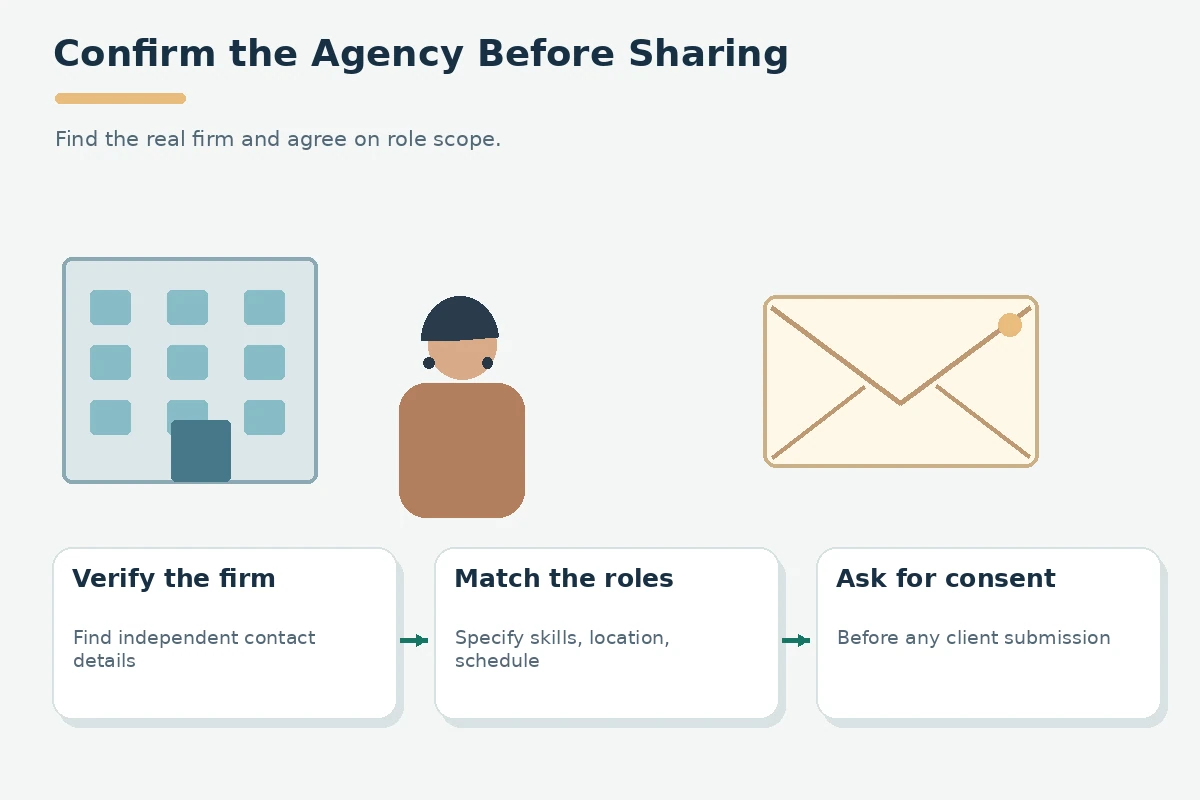
Look for a traceable business presence, official website, clear contact details and descriptions of the types of roles the agency handles. A firm that places warehouse workers may not be the right route for a specialized accounting position, and an executive search practice may not serve entry-level candidates. Check that the recruiter’s contact information matches the agency before you attach a detailed resume or discuss personal history.
The FTC warns that scammers imitate legitimate recruiters and may request money, sensitive identity information or financial documents. A plausible logo and polished email are not proof. Verify the agency through contact details you find independently, and refuse requests to pay for a promised placement or to deposit an equipment check and return money.
Describe the Roles You Actually Want
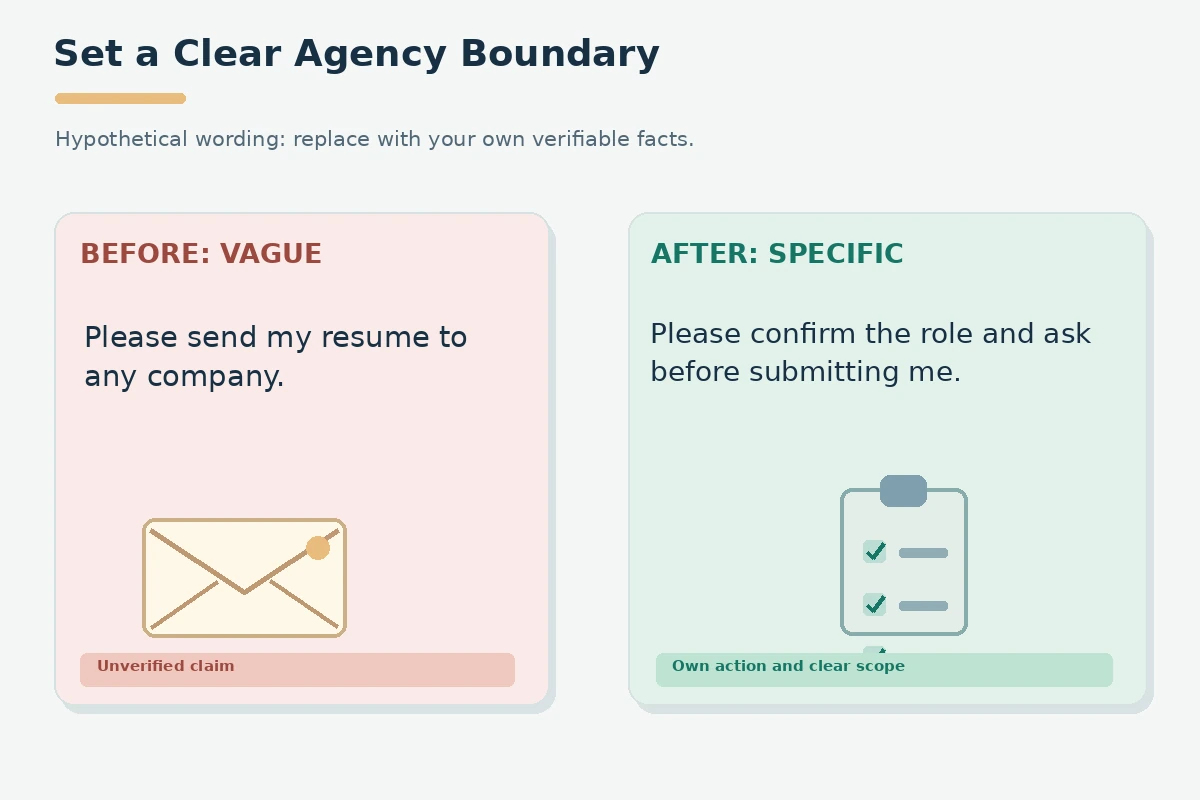
An agency intake email should help a recruiter determine whether a conversation is useful. State a role family, a few relevant tasks and your actual geographic or schedule limits. “Office administration roles involving calendars, records and client communication within the Chicago area” is clearer than “any job anywhere.” If you can work remotely only in certain states or time zones, name the real constraint rather than claiming universal availability.
Do not share preferred salary figures, confidential former-employer information or protected personal details unless they are appropriate and you are comfortable discussing them through a verified process. Work arrangement, schedule and relevant skills are often enough for a first contact. A strong match is about duties and realistic constraints, not inflated credentials.
Clarify Who May Share Your Resume With Employers
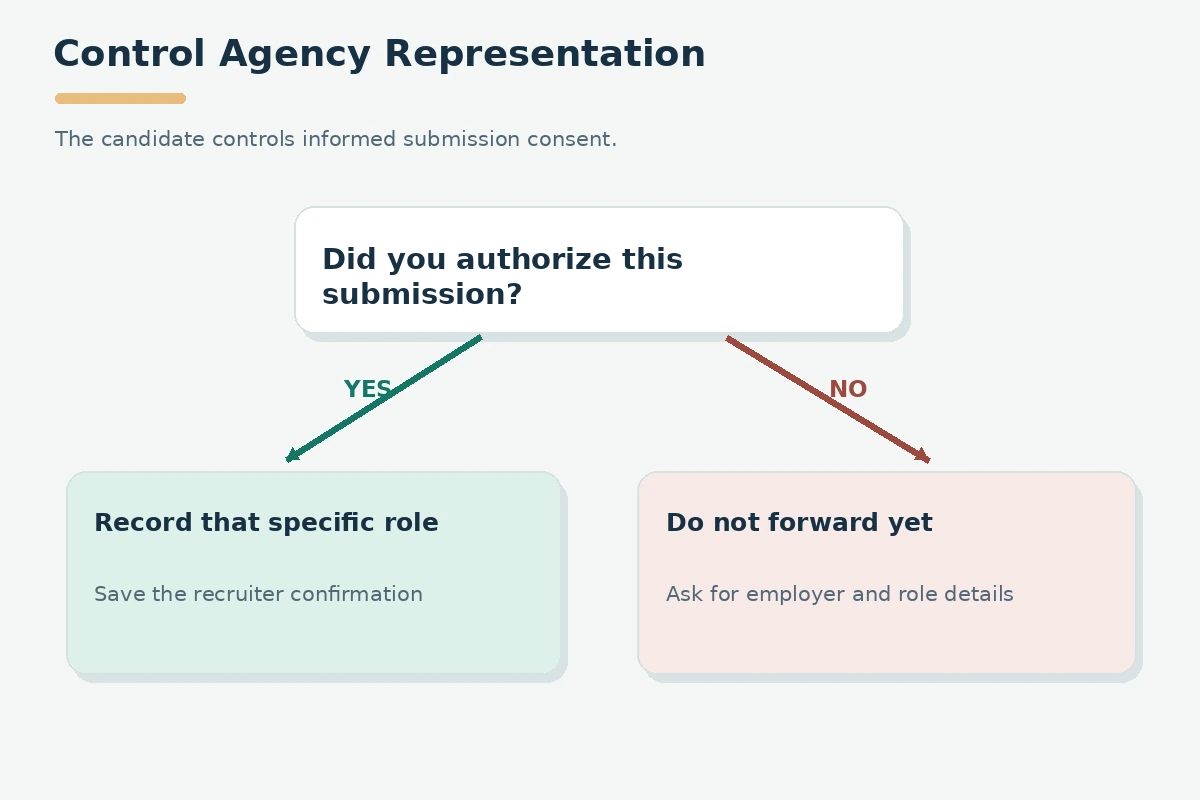
Ask whether the recruiter will seek your permission before submitting your resume to a client employer. Agencies differ in how they handle candidate records and representation; get their actual policy instead of assuming a single universal rule. If you are already in a direct application process with a company, tell the agency before it submits you for the same opening so you can avoid conflicting representation or duplicate submissions.
An agency may use an applicant tracking system to store a resume. Read its privacy notice and retention practice if available, and ask how to update or withdraw your information. Do not send government IDs, bank details or a full background-check package to an unverified email contact. Sharing a resume should be a considered step, not automatic consent to every future submission.
| Agency question | Reason to ask | Response to look for |
|---|---|---|
| Which roles do you place? | Tests your real target | Specific job families and locations |
| Will you ask before submitting me? | Avoids duplicate representation | Clear permission process |
| Who would employ me? | Clarifies assignment relationship | Direct hire or staffing arrangement |
| Is a fee required from me? | Checks scam risk | No up-front job-placement demand |
Write a Focused Introduction and Consent Request
The hypothetical template below names an office-support target and includes a question about representation. It intentionally avoids a named employer, a fabricated vacancy, salary promises and a claim that the agency has accepted the candidate. Replace the role family, location, skills and availability with your real profile. If an agency posts a specific opening, use that requisition number and any required submission portal instead.
Keep the message short enough to review quickly. The resume contains the detailed work history; the email sets the search criteria and professional boundaries. If you attach a portfolio or reference sheet, confirm that those files are requested and that the third parties listed gave permission. Agency intake is not an excuse to broadcast private information.
Hypothetical sample subject: Candidate Introduction — Administrative Support Roles. Hypothetical email: Hello Recruiting Team,
I am interested in administrative support opportunities you are recruiting for in [location or remote scope]. My experience includes maintaining calendars, preparing accurate records and escalating scheduling conflicts to the responsible lead. I am looking for roles focused on office coordination and records support, with [your accurate availability].
My resume is attached for an initial review. Before submitting it to a client employer, please confirm the role, work location and how you obtain my consent for representation.
Thank you,
[Your name]
Check the Contract, Pay Path and Recruitment Fees
Ask whether the role would be direct hire, temporary staffing, temp-to-hire, or a defined contract assignment. The answer affects who employs you, how assignments are offered and what documents you may eventually need. Do not guess at employment status based on a recruiter’s casual wording. Ask for written clarification when a specific opportunity is discussed, including the employer of record, work location and assignment duration.
The FTC states that legitimate placement firms and headhunters generally receive payment from employers rather than collecting up-front fees from job seekers. If someone asks you to pay to be introduced to an employer, to buy a résumé reformatting service, or to transfer money to secure an interview, stop and verify before continuing. Do not treat the existence of a fee as a normal mandatory step.
Track Submissions and Stay Available for Genuine Roles
Keep a simple log containing the agency name, verified recruiter, date, role family and any employers for which you approved a submission. If a recruiter asks for an updated resume, confirm which job it relates to and whether the new version will replace the older one. Correct inaccurate dates or qualifications quickly, while protecting the record of what was originally sent.
If an agency has no suitable role today, ask whether it will keep your profile for future opportunities, and how you may update or remove it. There is no guaranteed placement or interview schedule. Continue applying directly through legitimate employer processes where appropriate, avoiding duplicate submissions for the same vacancy.
How We Research and Check These Examples
We consulted official career guidance and primary professional or consumer-protection resources on 2026-10-29. The specific sources are Source 1, Source 2, Source 3. These references support application process, accurate representation, professional scope, or scam-awareness advice. They do not independently verify a reader’s vacancy, portfolio rights, employer policy or individual resume.
All sample senders, activities and application details on this page are hypothetical; replace them with your own verified facts. No hiring outcome or recruiter partnership is promised. See JobAsk’s affiliate disclosure for information on site relationships.
Related Guides
- Email a Resume When a Recruiter Asks: Reply, Attach, and Verify
- Temp Agency Work on a Resume: Show the Agency and Assignments
- Refer a Friend for a Job by Email: Consent, Evidence, and Limits
- How to Send an Updated Resume by Email After Applying: Version and Timing
- Railroad Jobs With No Experience: Compare Yard Roles and Safety Training
No. Choose verified firms that place your target kinds of work and follow their published intake method.
Ask for its actual candidate-consent and privacy policies before agreeing to representation.
The FTC says legitimate placement firms generally are paid by hiring employers; upfront placement demands are a warning sign.
Tell the recruiter before authorizing another submission so the application history stays accurate.
No. Verify the recruiter and only supply sensitive onboarding details through appropriate, legitimate processes.