
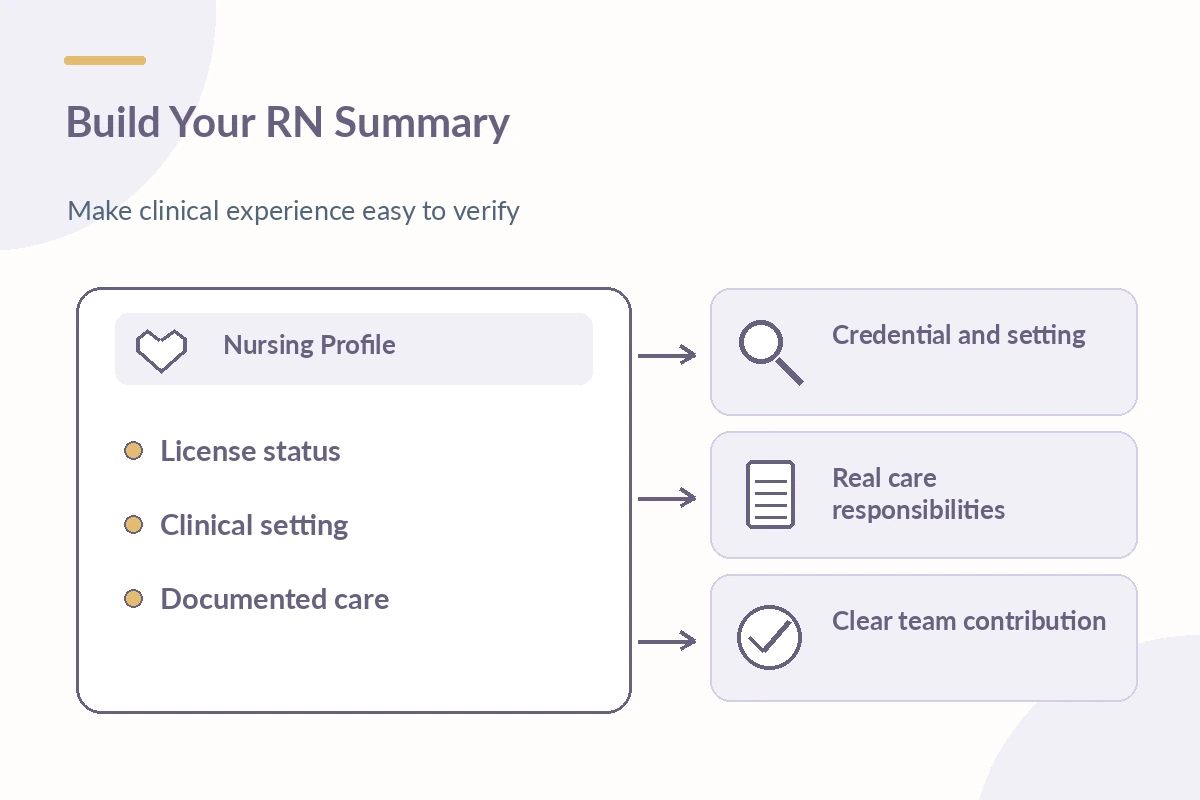
A registered nurse resume summary should make your actual nursing qualifications and care experience clear, without implying a license, specialty, or independent procedure you do not hold. Start with your true license status and relevant setting, then name a clinical process you performed within your role, such as documented assessments, care coordination, or patient education. The detailed credentials and experience sections must support each claim.
The U.S. Bureau of Labor Statistics describes RN work in patient assessment, documentation, care planning, collaboration, and education. These are occupational duties, not accomplishments that can be assigned to every individual nurse. Choose language that matches your authorization, training, employer setting, and actual participation.
Verify Licensure Before Wording the Summary
A nursing license is not an adjective; it is a status that should be accurate at the time of application. Confirm the license type, relevant jurisdiction, and current standing. The NCSBN explains Nursys verification services for participating boards. Requirements and license verification options can vary by jurisdiction, so follow the applicable board and employer instructions.
Do not use “registered nurse” as your current professional title if you have never been licensed. Passing a course or exam is not interchangeable with a granted license. If you are a nursing student or a graduate awaiting licensure, describe that status transparently and follow the job’s eligibility criteria. Do not imply you may practice independently when authorization has not been granted.
Name the Care Setting You Actually Know
A surgical floor, long-term care setting, outpatient clinic, home health practice, and supervised student rotation have different workflows. State the setting you have actually experienced. A reader can interpret “medical-surgical inpatient RN” differently from “nursing student with medical-surgical rotations,” so the distinction belongs in the summary when it affects qualification.
If your clinical exposure came solely from a rotation, call it a clinical rotation rather than full-time RN employment. If you worked in multiple units, avoid implying expertise in every specialty from a brief orientation. A truthful setting description helps the hiring team place your preparation in context without turning the summary into a complete shift history.

Choose Clinically Relevant Processes
Depending on the job, useful evidence may include patient assessment, documentation, medication administration within role and policy, collaboration, education, or planned follow-up. The BLS occupational description identifies these broad nursing activities. Your own summary should name only tasks you were licensed and trained to perform in your work environment.
Use accurate verbs and levels of responsibility. “Contributed to care planning with an RN preceptor” is not interchangeable with “independently managed complex care plans.” A nurse moving between specialties should focus on demonstrated processes that transfer, while acknowledging the different training or orientation requirements of the target unit.
Show Safety Judgment Rather Than Slogans
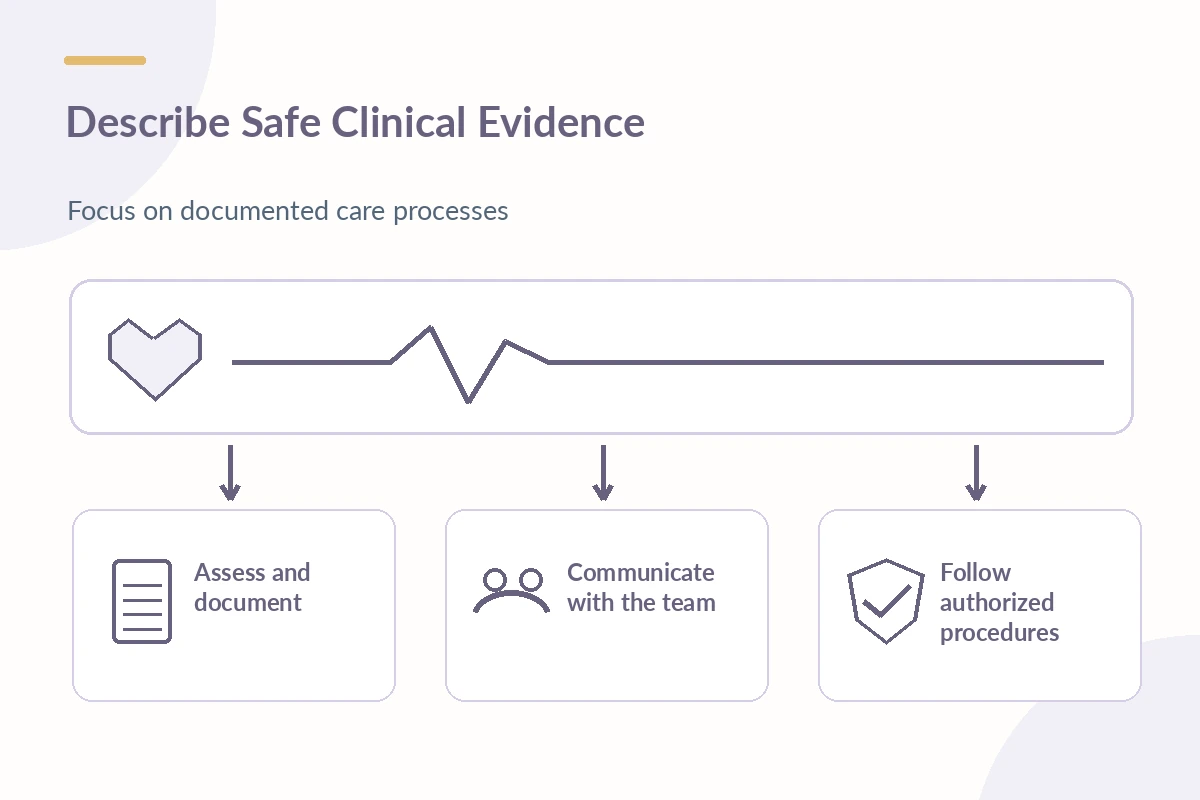
“Passionate patient advocate” may express a value but reveals little about how someone practices. Safer summary language points to checks, documented observations, timely escalation, or clear handoffs, if those were real actions. Do not manufacture patient recovery outcomes or claim individual credit for a team’s clinical results.
For example, a candidate who routinely documented changes and notified a charge nurse according to established procedures can state those processes. Avoid exposing patient identifiers or private case details. Employer-specific protocols and clinical responsibilities differ; an article about resume writing is not clinical instruction or a substitute for institutional policy. Our guide “Tell Me About Yourself in a Nursing Interview” adds more detail on this.
Write an Honest RN Summary Example
Hypothetical experienced-nurse example: “Registered nurse with inpatient experience documenting assessments, coordinating updates with interdisciplinary staff, and reinforcing discharge teaching under unit procedures. Brings careful chart review and clear handoffs to a collaborative care team.” This is an invented example; do not copy it unless your work, licensure, and setting genuinely match.
Hypothetical new-graduate alternative: “Nursing graduate with supervised clinical rotations in adult care, practice in structured patient assessments, and experience communicating observations to preceptors. Seeking an entry-level RN role upon meeting applicable licensure requirements.” The conditional wording does not assert that the graduate already holds RN authorization or meets a particular employer’s requirements. For the fuller picture, see our guide “CNA Resume Skills”.
Keep Certifications and Practice Claims Distinct
Licensure and specialty certification are separate. Completing employer training or possessing a life-support course completion card does not automatically establish specialty board certification. If the position requires specific credentials, list them accurately in the dedicated credential section with issuing bodies and applicable dates where appropriate.
The summary need not contain every abbreviation after your name. Prioritize the credentials essential to the role and make the complete record easy to find. Do not post sensitive identifiers unnecessarily in a public resume. If a license must be checked, direct the employer to the relevant official verification process rather than asking a reader to rely solely on a sentence in your resume.
Avoid Unsupported Patient Outcome Claims
Patient outcomes depend on teams, clinical conditions, systems, and many other factors. A resume claim of reducing complications by a dramatic percentage requires carefully documented, attributable evidence. If you cannot explain the metric, replace it with an accurate account of the activity you performed, such as completing handoff documentation and communicating changes promptly. Our guide to nursing resume format adds more detail on this.
Do not invent the number of patients, shifts, or procedures handled. Where a count is accurate and appropriate, it can provide scope, but an unsupported figure is worse than no number. Avoid converting observed student practice into independent procedures. Patient-safety credibility begins with honest boundaries and an explanation of actual responsibility.
Finish With a Credentials-and-Scope Audit
Check each part of the summary against your license and credential record, dated roles, clinical setting, and documented responsibilities. The UC San Diego resume guidance favors clear contributions; in nursing, that also means identifying whether you acted as a licensed clinician, supervised student, assistant, or other team member.
Read the vacancy for unit requirements and special certifications, then remove any language that could confuse the reader about your eligibility. A polished summary helps a recruiter locate evidence, but it does not override license requirements, employer judgment, or actual scope-of-practice rules. Our guide “Tell Me About Yourself in a Nursing Interview” goes into more detail.
How We Research Resume Summaries
The sources reviewed on 2026-10-22 are BLS, NCSBN, university career guidance. We compared their actual occupational descriptions or career-center guidance with the limited claims made above. These references do not verify any hypothetical candidate, guarantee a hiring outcome, or establish an applicant tracking system ranking. All examples labeled hypothetical are invented teaching cases.
Earlier generic resume-summary pages cover broad principles; this guide addresses a specific applicant context. No affiliate partnership is asserted; see the affiliate disclosure.
More Resume and Cover Letter Guides
- Registered Nurse Cover Letter: Connect Unit Fit to Safe Clinical Practice
- Pharmacy Technician Resume Summary: Show Accuracy and Safe Scope
- Medical Assistant Resume Summary: Confirm Credentials and Patient-Care Scope
- Nursing Assistant Resume Summary: Show Basic Care and Team Communication
- Accounts Payable Resume Summary: Show Invoice Controls and Scope
Do not claim an RN license before it has actually been granted. Describe student or graduate status accurately.
Relevant care setting, actual clinical responsibilities, and collaborative or documentation practices supported by your history.
Yes, if relevant, but label them as supervised educational rotations rather than licensed employment.
Do not share patient identifiers or confidential details. Summarize legitimate work processes instead.
No. A course completion credential is different from professional licensure; check the job and state requirements.