
A research assistant cover letter has to make two connections: why this particular project interests you and what method, documentation habit, or collaboration experience prepares you to contribute. An applicant who has completed one carefully described class project can be more convincing than a paragraph of scientific buzzwords. Name the type of research in the posting, distinguish techniques you practiced from software you only studied, and show how you handle uncertainty, records, and feedback.
The approach also follows University of Pennsylvania Career Services, which advises tailoring the letter to the employer and using evidence rather than generic praise. Replace every detail with your own lab, coursework, or project experience before you apply.
Read the Specific Job Posting Before Drafting
Research assistant positions are not interchangeable. Some involve recruiting participants, managing survey responses, or cleaning data; others use instruments, sample preparation, or field observations. The O*NET profile for social science research assistants identifies activities ranging from verifying data to documenting procedures and helping prepare reports. Use that profile to recognize potential duties, not as proof that every opening requires all of them. The advertisement and project website should decide which two experiences belong in your letter.
An undergraduate laboratory opening and a staff research coordinator posting may differ substantially in education and responsibility. A candidate should check prerequisites and the project’s expected schedule before applying. When discussing data quality, show a traceable practice—labels, version notes, error checks, or a review log—not a vague promise that you ‘guarantee accurate findings.’ Research outcomes depend on method, supervision, and conditions beyond a letter writer’s control. Our social worker cover letter guide adds more detail on this.
Turn One Real Task Into Relevant Evidence
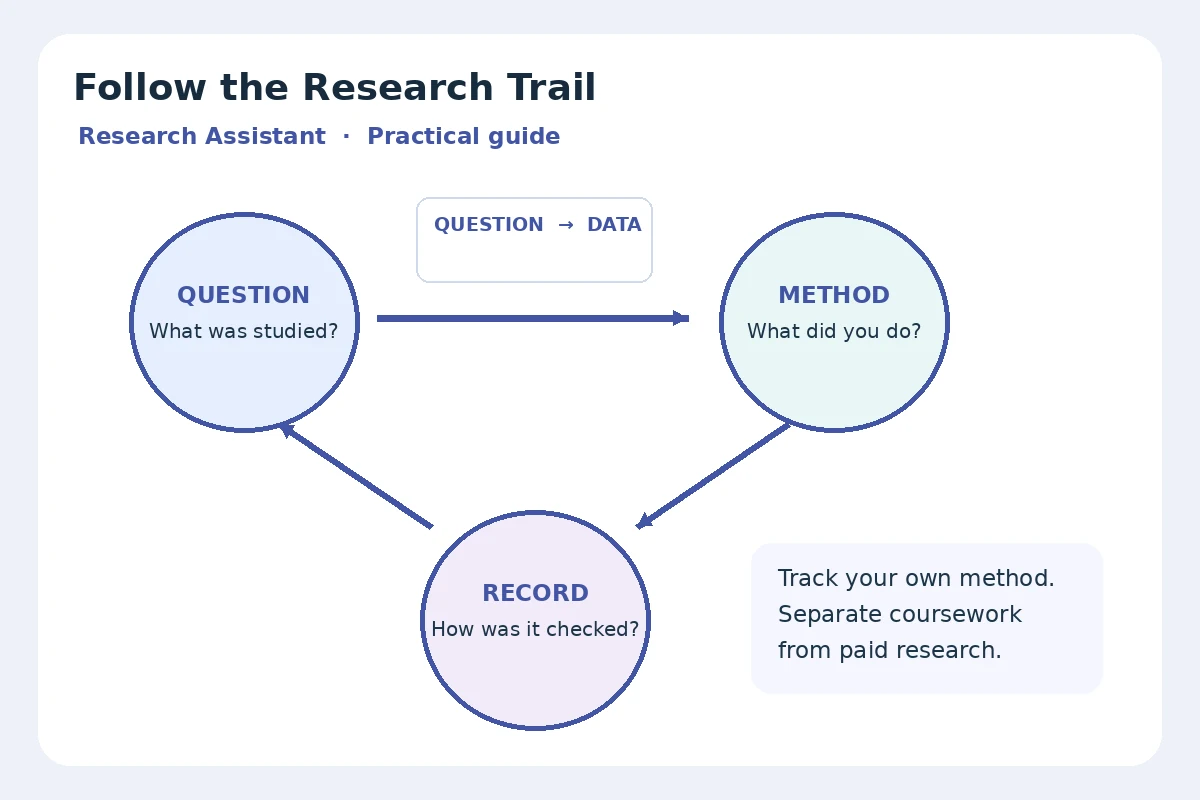
Build a project-to-method map. Record the project question, what you personally did, how results or records were checked, and what you learned. For example, a course research exercise could involve checking survey rows for missing responses and documenting exclusions under a supervisor’s instructions. That is evidence of care, not evidence that you led a published study. Clarify when you worked in a team and identify your own component. If participant information was sensitive, explain the procedures you followed without revealing data or claiming approval authority.
When a posting asks you to what was studied?, consider where you did comparable work. For the next step, what did you do?, identify any instructions, tools, or supervision that applied. The final step—how was it checked?—asks for a concrete and defensible action, not a guessed result. If you have not run a full study, describe the research tasks you did without calling them independent research. Our dental receptionist cover letter guide goes into more detail.
Use This Hypothetical Letter as a Structure
The full research assistant example below is hypothetical.
Hypothetical sample letter: Dear Research Team, I am writing about the Research Assistant position supporting your survey project. In a hypothetical university methods course, I helped clean a small survey dataset, checked inconsistent entries against the coding guide, and documented each correction for the course team. I enjoyed the discipline of keeping a clear record so another person could understand our choices. Your project’s emphasis on organized data collection and careful review is particularly relevant to that experience. I would appreciate the opportunity to discuss how I could support your team’s established procedures. Sincerely, Applicant Name.
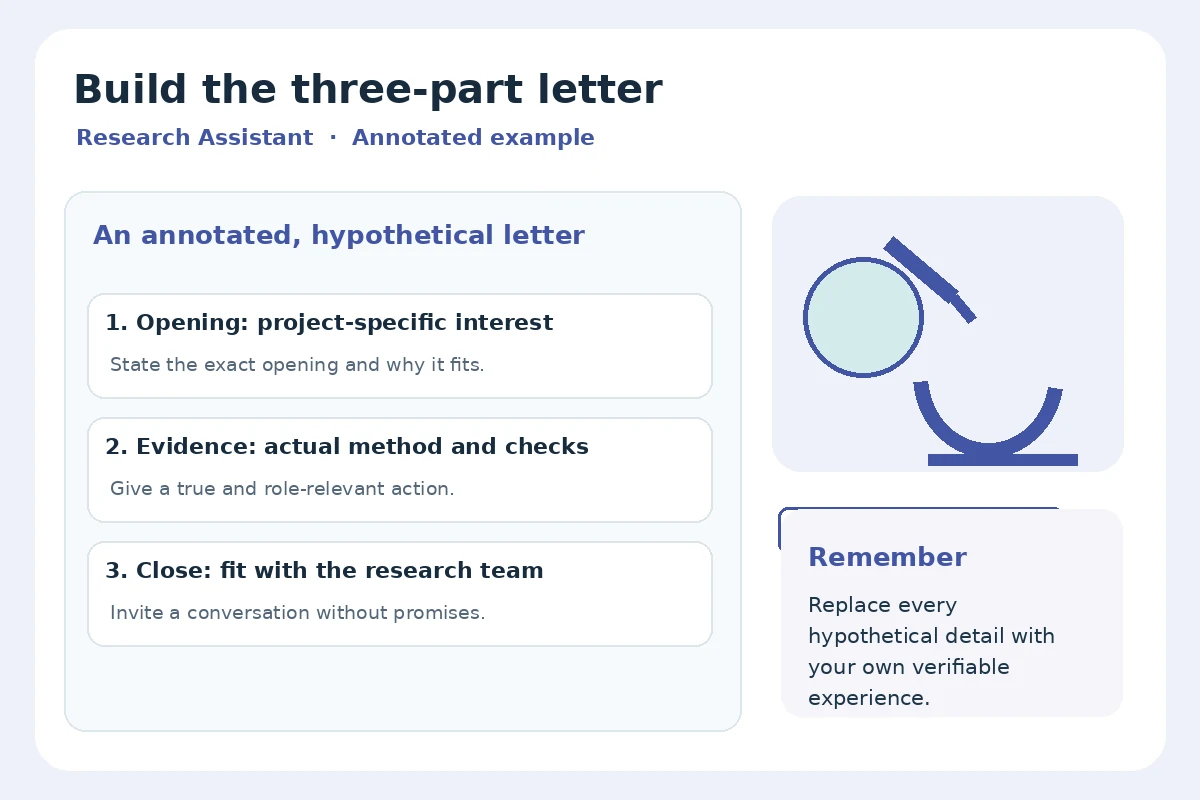
Do not send the sample to a lab or professor without rewriting it. Start with the lab’s posting, name the position, describe one research task you completed, and match your close to what the lab asked for.
Adapt the Letter to Your Actual Background
For participant-facing roles, discuss scheduling, careful instructions, or respectful communication, but never claim consent or clinical authority you did not have. For data-focused roles, identify the files, coding convention, and verification habit actually used. For field roles, state how observations were recorded and who reviewed them. University of Colorado’s research-cover-letter guidance recommends explaining relevant skills and teamwork rather than only naming interests. Avoid dropping a long list of platforms without explaining your level of proficiency.
If your best experience comes from a class lab, senior project, or volunteer study, say so plainly. The principal investigator should see what you did, where, and which procedures you were trained on.
Avoid Claims That Do Not Hold Up
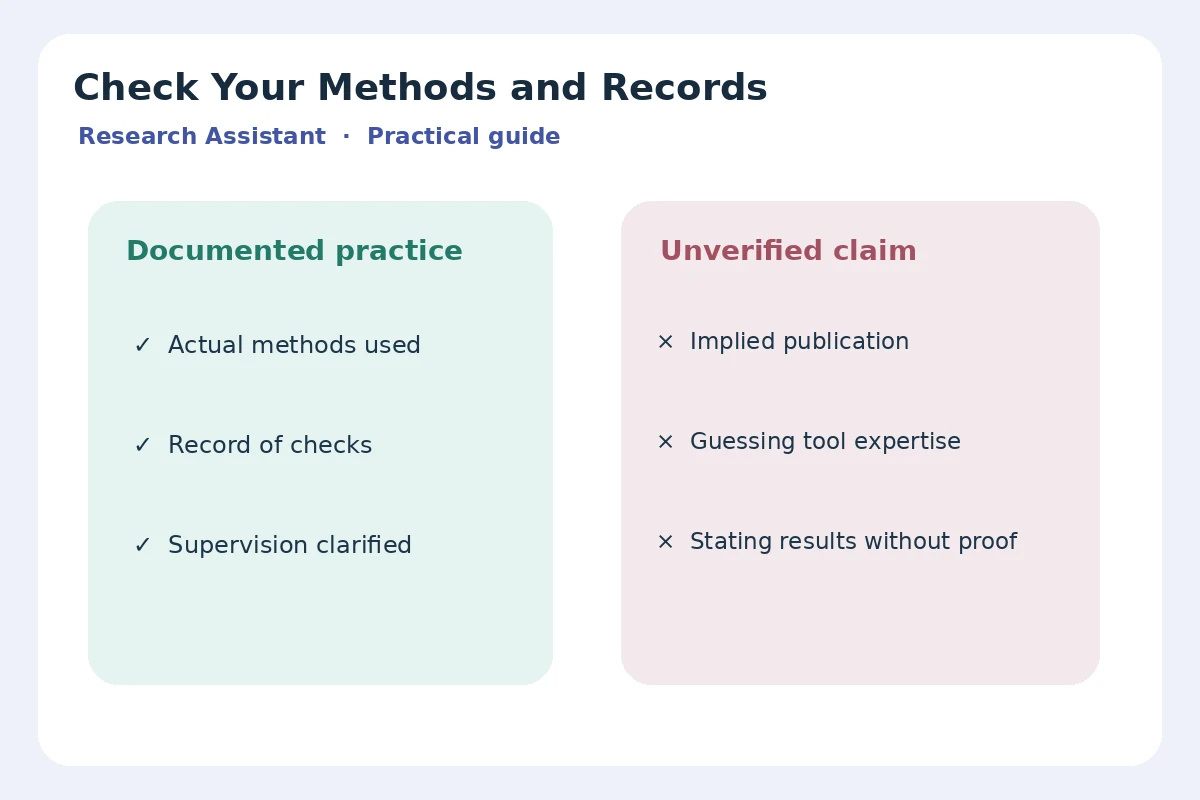
Do not describe yourself as a published researcher because you assisted with a class assignment. Do not imply you performed independent statistical analysis if you merely followed a demonstration. Technical terms need provenance: when did you use the instrument, language, or software, and with what oversight? A letter should never include private participant information. Also avoid asserting that an attractive lab website proves you know the project’s current objectives; read the posted position and the actual public project description.
Before sending, check that the letter and résumé match on dates, lab roles, and methods. If the posting asks for research ethics training, check its exact name and status.
Review the Draft for Clarity and Fit
Check each sentence as if a principal investigator might ask you to explain it. Could you reconstruct the steps of your example? Have you named only methods you actually practiced? Can you distinguish analysis from cleaning, coordination from independent design, and coursework from employment? Keep the greeting and closing concise. A brief statement that you welcome training on an unfamiliar method is stronger than claiming mastery you cannot demonstrate. The final version should make the study-specific fit visible by the end of the first paragraph.
After proofreading, remove any unpublished data and any unsupported claim. Use the principal investigator’s name if it is listed, or a neutral greeting. If the university uses an online portal, keep the opening, one research example, and the close.
How We Research Cover Letter Examples
How We Research: We reviewed Penn’s cover-letter guidance, the relevant occupation description, and additional professional guidance on 2026-10-23. No affiliate relationship is presumed; read the JobAsk affiliate disclosure.
More Resume and Cover Letter Guides
- Paralegal Cover Letter: Show Research, Filing, and Careful Boundaries
- Medical Assistant Cover Letter: Present Training and Patient Support
- Administrative Assistant Cover Letter: Show Reliable Coordination
- Teaching Assistant Cover Letter: Show Classroom Support Without Overclaiming
- Virtual Assistant Cover Letter: Demonstrate Reliable Remote Support
Coursework can be relevant if the methods and your contribution are described accurately. Do not call class exercises paid research appointments.
No. Prioritize tools you actually used in a relevant task, and state whether your exposure was introductory or applied.
You can describe your own permitted activities without exposing confidential information or implying publication or authorship that has not occurred.
The project requirements determine priority, but clear evidence of data checks, documentation, and tool familiarity is often useful.
Use a genuine assignment or volunteer task and explain the question, your method, the supervision, and what you verified.