
Your resume education section should identify what you studied, where you studied it and whether you completed a credential. For a recent graduate or trainee, education may be central to the application; for an experienced worker, a shorter entry may be enough. The essential rule is not to let a program name or expected date imply a degree you have not earned. Use transparent wording and select courses or training only when they strengthen the case for the job.
This guide describes U.S. resume-writing practices, not a hiring guarantee or a universal applicant tracking system rule. All candidate examples are hypothetical and must be replaced by facts from your own work, education or projects.
Start With the Right Resume Evidence
Use the JobAsk resume guides to compare related decisions about sections, skills and document structure. This page addresses a narrower task: a credential-status decision chart for completed, ongoing and discontinued education, paired with placement choices and examples that never turn attendance into a finished degree. Keep each claim traceable to something you really did.
Record What You Earned Before Choosing Wording
For a completed credential, identify the institution, credential name, field or major if applicable, and completion date when useful. For a current program, show that it is in progress and provide an expected completion date only if you have a reasonable current estimate. If a program ended without a degree, describe the coursework or credits completed without naming the credential as earned. These distinctions matter more than elaborate typography.
Start from a personal record: transcript, certificate or school portal. A hypothetical completed entry could read “Associate of Applied Science in Business Technology — Completed 2025.” A hypothetical in-progress entry could read “Bachelor of Science in Biology — In progress; expected 2028.” Only use the dates and credentials that reflect your situation. CareerOneStop provides guidance for completed and unfinished study.
Choose Whether Education Belongs Above Experience
Education commonly comes early when it is the best evidence for a recent graduate, career retraining applicant or student seeking an internship. When several years of directly relevant work show the strongest match, the work history may come first. This is a relevance choice, not a permanent rule. Keep the section name standard and the credential easy to read in either position.
Compare the two strongest facts: recent training in the tools the vacancy requires, or completed workplace tasks that demonstrate the role. Give the stronger evidence the earlier section. Penn Career Services explains that a current student may lead with education, while experience generally takes more prominence later. Do not bury a required professional license inside a long list of unrelated coursework.
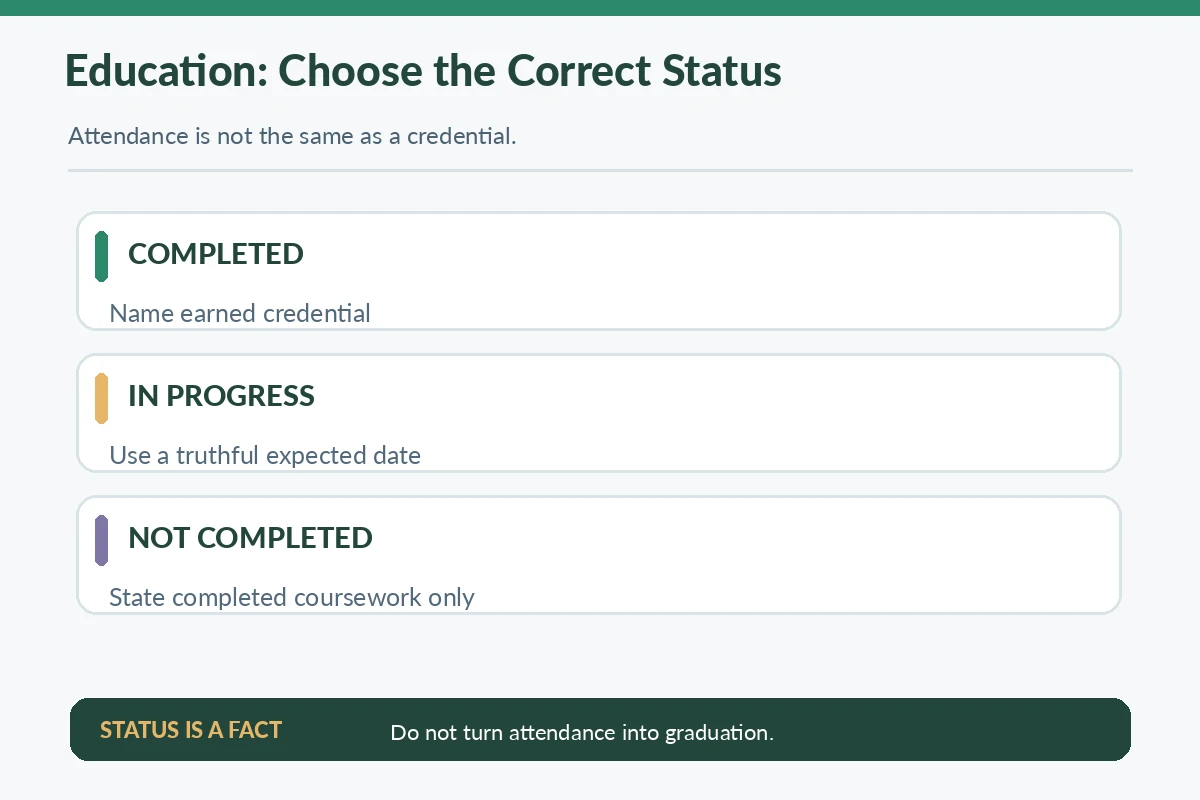
Describe an Unfinished Program Truthfully
Attending a college is not the same as graduating from it. If a candidate completed relevant credits but did not obtain the degree, a transparent hypothetical entry might read: “Coursework in Accounting, Example Community College — 2023–2024; degree not completed.” Another could name the number of credits only if verified. Do not write “B.A., Marketing” without qualification merely because that was the program originally pursued.
A discontinued program can be omitted when unrelated and not required by the application, but do not fabricate a different history to cover dates. For ongoing study, the word expected should not be replaced by awarded. If a school changed the graduation estimate, update it before applying. The goal is for an interviewer to understand your actual training without having to resolve contradictions.
Separate Degrees, Certificates and Licenses
An employer may care about different kinds of learning for different reasons. A degree records completion of an academic program, a course certificate may document completion of training, and a professional license can authorize regulated work subject to current rules. Do not treat them as interchangeable. If the role requires active licensure, record only your actual valid license and relevant jurisdiction, without assuming that a course alone qualifies you to perform the work.
Short workshops or online courses belong on the resume only when the content connects meaningfully to the position. For a help desk role, a completed service-ticket lab may be relevant; a generic webinar unrelated to IT may not. Check issuance and expiration details when a credential has them, and do not claim continuing-education credits that the provider did not award.

Use Coursework and Projects as Evidence
Courses can be valuable when you have little paid experience, especially if they produced a real project. Name the relevant subject and what you created or practiced. A hypothetical student applying for research support might mention a statistics course and a reproducible data-cleaning exercise. It should be clear the work was for a class, not for a commercial client or an employer.
Choose only coursework tied to the vacancy. If an employer needs document control, a course in technical writing with an actual versioned document may provide evidence; a generic course list does not prove the skill on its own. UC Berkeley recommends emphasizing relevant education and activities where they demonstrate desired abilities. A project link may be useful if it is your work, accessible and safe to share.
Handle School Dates, GPA and Honors With Context
Use a consistent date style and avoid pretending an old degree is recent. An optional GPA belongs only when relevant, accurate and consistent with the school’s scale; an employer may have its own rules. Honors and awards should name the actual issuing institution and recognition. Do not invent a dean’s list distinction, a scholarship or a class ranking because examples online include one.
If you changed schools, separate the entries when necessary to avoid implying one institution awarded another institution’s credential. For international study, use the official credential name or an accurate explanation rather than asserting a U.S. equivalency without basis. For an apprenticeship, state whether you completed the program, are an apprentice now or attended only some modules.

Check the Education Claim Against the Posting
A vacancy may specify “required degree,” “preferred coursework,” “current student” or “active certification.” Those are materially different. Compare the exact requirement with your completed credential and supporting records. If you do not satisfy a stated requirement, do not imply compliance through vague wording. Where an employer accepts equivalent experience, describe the experience separately and let the employer assess it.
Before submitting, inspect the school name, program title, dates, spelling and expected status. Confirm that the education entry agrees with forms and professional profiles. A reliable resume helps the employer understand your actual background; it is not an exercise in converting partial training into a finished credential.
How We Research These Resume Recommendations
We reviewed the professional and university career-center sources linked below on 2026-10-27. Their guidance supports general resume organization and writing methods. We also compared this specific intent with prior JobAsk batches to avoid duplicating general resume templates, professional summaries and resume-format pages. The hypothetical examples were written for instruction; no university source verifies a fictional candidate or guarantees employment.
Read the source: CareerOneStop explains reverse chronological education, unfinished studies, expected completion dates and placement.
Read the source: Penn Career Services gives education examples with degrees, expected graduation and relevant academic evidence.
Read the source: UT Dallas describes degree, major, institution and completion or expected completion in education entries.
Read the source: UC Berkeley explains how recent graduates may emphasize education and relevant coursework.
The site does not claim that these sources endorse JobAsk or that any resume is guaranteed an interview or an ATS result. We have not confirmed any paid partnership. See our affiliate disclosure. Follow each employer’s actual instructions for application fields and files.
More Resume and Cover Letter Guides
- Continuing Education on a Resume: List Courses, Workshops, and Real Proof
- Resume Accomplishments Section: Select Outcomes You Can Actually Prove
- Education on a Resume: What to List and Where to Put It
- Resume Work Experience Section: Show Roles, Dates, Duties and Scope
- Resume Contact Section: Make It Reachable Without Oversharing
Yes, if relevant. State coursework or credits honestly without implying that you earned the degree.
Often for a student or recent graduate; otherwise, place the strongest relevant evidence first.
Name the program and institution and use an accurate in-progress status, adding an expected completion date if appropriate.
Include relevant, completed training when it adds meaningful evidence; distinguish it from a degree or professional license.
Not in every resume. Follow application instructions and list only accurate, relevant information.