
A second interview follow-up can make sense if you already sent one polite status request, a meaningful amount of time has passed, and the employer has not asked you to stop contacting them. Send one brief message in the existing email thread, then return your attention to other opportunities. Do not treat silence as permission to send a third or fourth reminder.
This is a status inquiry, not another thank-you email. First identify what you already sent, the response you received, and the decision date the employer actually gave you. Boston University career guidance recommends no more than two status follow-up emails, at least a week apart; that is guidance, not a guarantee that a reply will arrive.
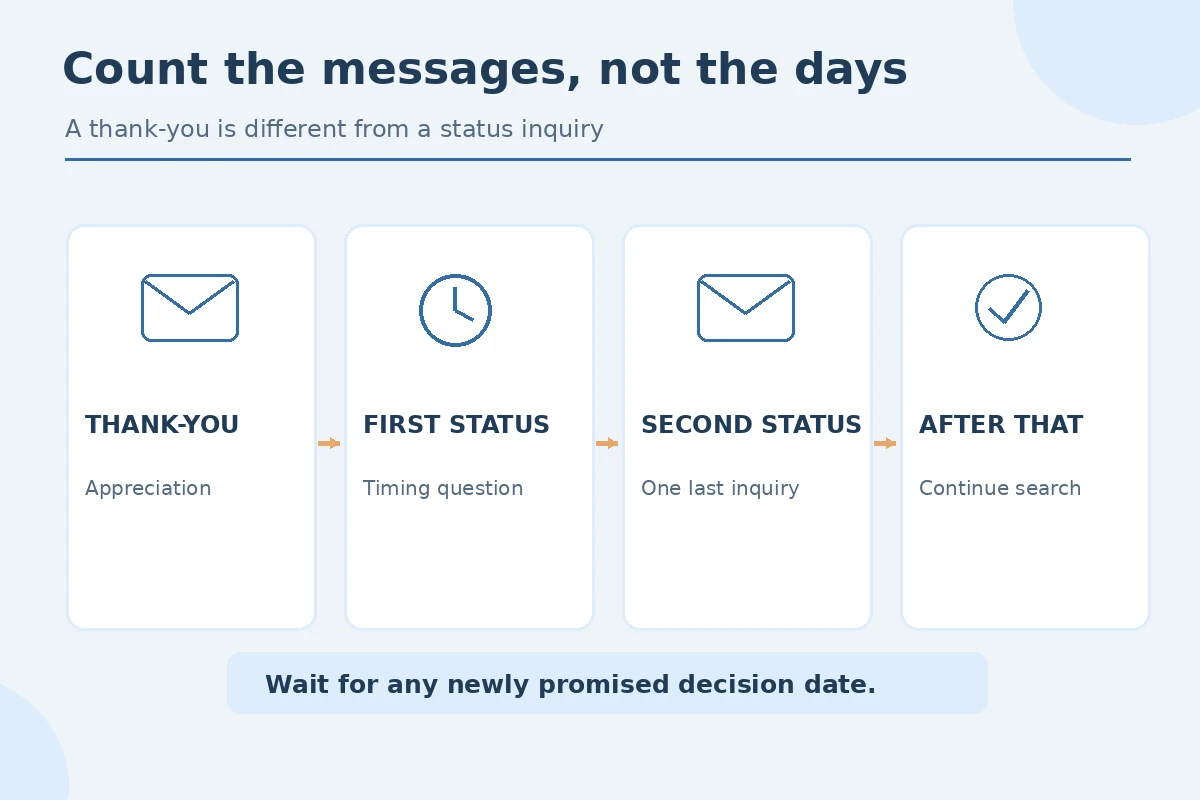
Count status requests before choosing a second email
A post-interview thank-you message and a later status request serve different purposes. If your only message was a thank-you sent the day after the interview, the next inquiry is generally your first status follow-up, not the second. Search your Sent folder for the exact interview thread and record dates rather than relying on memory.
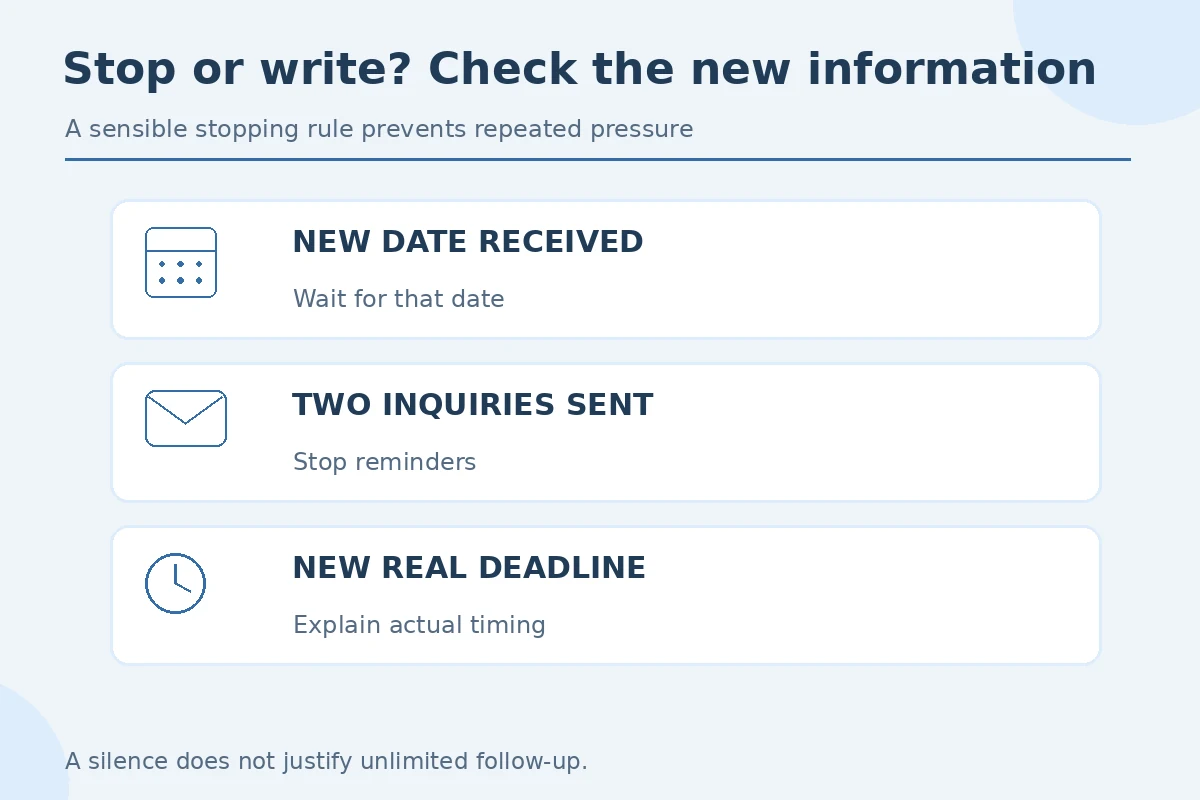
If a recruiter replied with an updated decision date, treat that reply as new information and wait until the revised window passes. If they said the search is closed or you should not contact them again, stop. A second follow-up is useful only when there is a genuine unanswered hiring-status question.
Make a simple timeline instead of guessing
Write down the interview date, the employer’s expected decision window, the first status message, and any response. A reasonable timeline allows for business days and the organization’s stated process. Different employers have different recruiting cycles; avoid universal rules like calling exactly three days after every interview.
When no deadline was given, university career centers offer slightly different waiting ranges, often around one to several weeks. The key decision is whether enough time has passed since your first inquiry and whether any new commitment changes the timing. If you have no time-sensitive update, patience is usually more useful than additional pressure.
Write a second note with one question
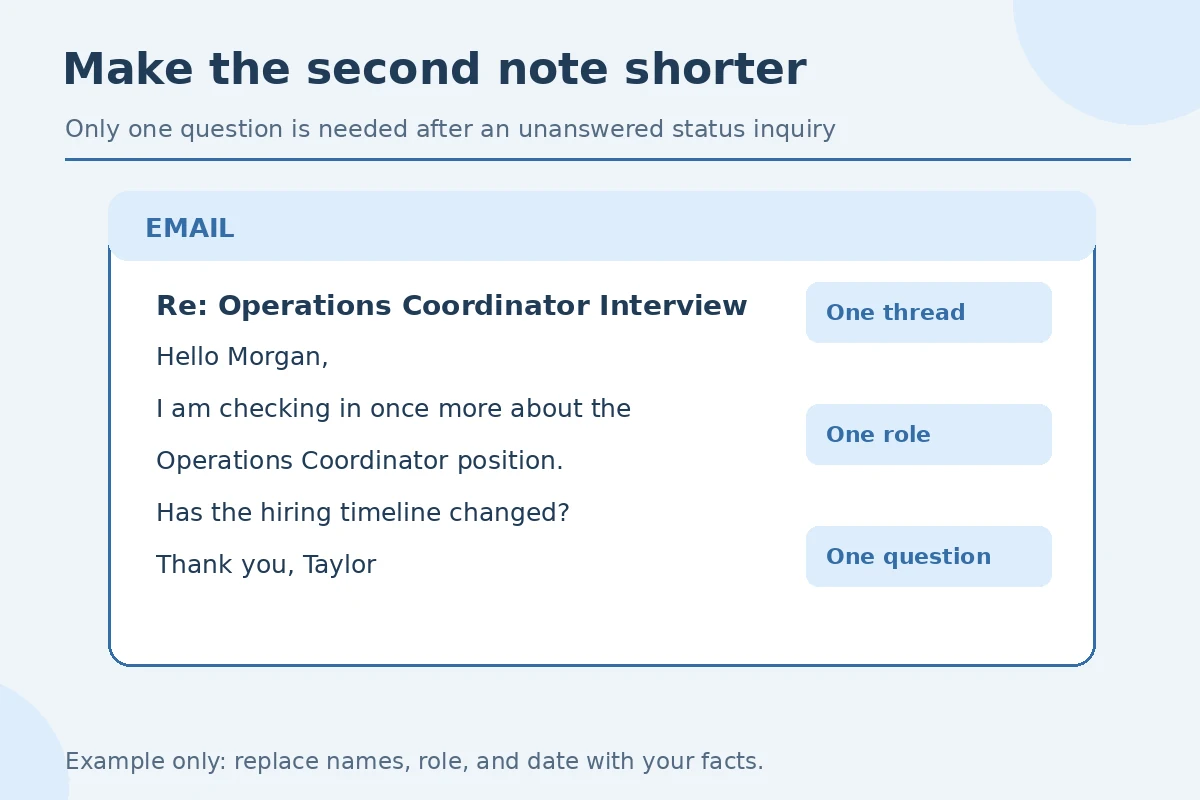
Illustrative email — subject: Re: Operations Coordinator Interview. “Hello Morgan, I hope you are doing well. I am checking in once more about the Operations Coordinator interview on October 12. I remain interested in the role and wanted to ask whether the hiring timeline has changed. Thank you for considering my application. Best, Taylor.” Replace the name, role, and date with your real details.
Keep the message under a short paragraph or two. You do not need to apologize for writing, demand a decision, or attach your resume again. If you already received a reply explaining the delay, acknowledge it rather than acting as if the employer never responded.
Keep the channel and recipient consistent
Reply to the existing conversation with the recruiter or hiring contact who has been coordinating your application. That makes earlier details easy to find. If the employer directed everyone to use a recruiting portal, use that channel instead; do not guess private email addresses or message individual employees on social media.
An email sent to five people does not count as one respectful follow-up just because it is a single draft. Avoid copying interview panelists who never invited you to contact them. If your original contact left the organization, use an official recruiting contact listed by the employer rather than scraping personal addresses.
Know when the follow-up should end
After two unanswered status inquiries, a third usually adds little new information. Boston University recommends a maximum of two, at least a week apart; after that, treat the application as unresolved and keep looking. This does not mean that the job is definitely filled, only that you cannot make a hiring team provide a reply.
Update your tracker with the last message date and mark the opportunity as awaiting employer action. Do not cancel other interviews or decline real offers based on hope alone. If the employer later writes with a substantive update, respond to that new communication rather than restarting an old reminder schedule.
Handle a delayed reply without embarrassment
A recruiter may respond weeks later with an apology, an interview invitation, or a rejection. You do not need to point out the number of times you contacted them. Read the new information, check whether the role still fits, and reply to the actual request. A delayed response is not proof of either interest or rejection.
If you have accepted another position, tell the recruiter promptly that you are withdrawing rather than continuing the process as if you are available. If you are still interested, ask for the concrete next step, schedule, or missing document. Do not promise that you can start immediately unless that is true.
Save a short audit trail for future applications
Keep the job title, employer name, date interviewed, promised timeline, two status messages, and any answer in one private tracker. This prevents the accidental third reminder that happens when messages are split across personal accounts or devices. Include only information you are entitled to keep and avoid uploading interview material with confidential employer details to public tools.
Review this history before each new action. If no information has changed, the right next step is often to prepare for other interviews. The practical purpose of a follow-up is to obtain clarity when possible, not to win by outlasting an employer’s silence.
How We Research Interview Follow-Up Decisions
We reviewed guidance from university career services about post-interview communication, employer timelines, contact preferences, and offer decisions. We distinguish those source recommendations from our practical examples and checklists; specific intervals are guidance rather than rules binding all employers. Every sample message and person in this article is illustrative. None implies that a follow-up improves hiring odds, guarantees a response, or replaces employer instructions.
Source: BU career guidance — Boston University Career Development explains respectful interview follow-ups and suggests no more than two follow-up emails, spaced at least one week apart.
Source: UMBC career guidance — UMBC Career Center recommends waiting until an employer-provided decision date has passed and contacting the organization when another offer needs an answer.
Source: UNLV career guidance — UNLV Career Services provides timing and etiquette for brief, professional interview follow-ups.
For the site’s funding and relationship information, read our affiliate disclosure. The external career-center references are informational citations, not paid endorsements.
More Interview Preparation Guides
For planning purposes, distinguish a thank-you note from a later status request. Count the actual unanswered status inquiries before sending another.
Respect any new employer deadline. Boston University recommends at least a week between status follow-ups and no more than two in total.
Usually not unless the recruiter requested it or there was a genuine file problem. A short status question is enough.
Avoid using a call to bypass the same stopping limit. Use an alternate channel only if the employer specifically directed you to it for an actionable reason.
Not necessarily. There are many possible reasons for silence; continue your search without guessing at an employer’s internal decision.