
Quick answer: A short-term career goal names an action or capability you can develop soon; a long-term goal names a direction that may require several stages. Write the two together, not as unrelated promises. For example, a person interested in operations leadership could aim to learn the team’s inventory handoff process this quarter while exploring a coordination role over the next two years. Both parts need evidence and room to change.
The examples in this guide are hypothetical planning examples—not verified results from a real employee. Match any target to your skills, employer policies, available resources, and life circumstances. A development plan does not guarantee a promotion or job offer.
Separate a Direction From a Milestone
Start by asking what kind of work you want more of: analysis, service, mentoring, technical depth, or ownership. A direction is a preference, not a signed contract for a future title. Your near-term milestone should be something you can demonstrate in your current setting: an approved work sample, a completed training module, or feedback after an assigned task. A title such as manager may depend on openings, performance, organizational needs, and selection decisions outside your control. A skills milestone is closer to your influence and gives you feedback even if the title is not available.
Map Dependencies Before Setting Dates
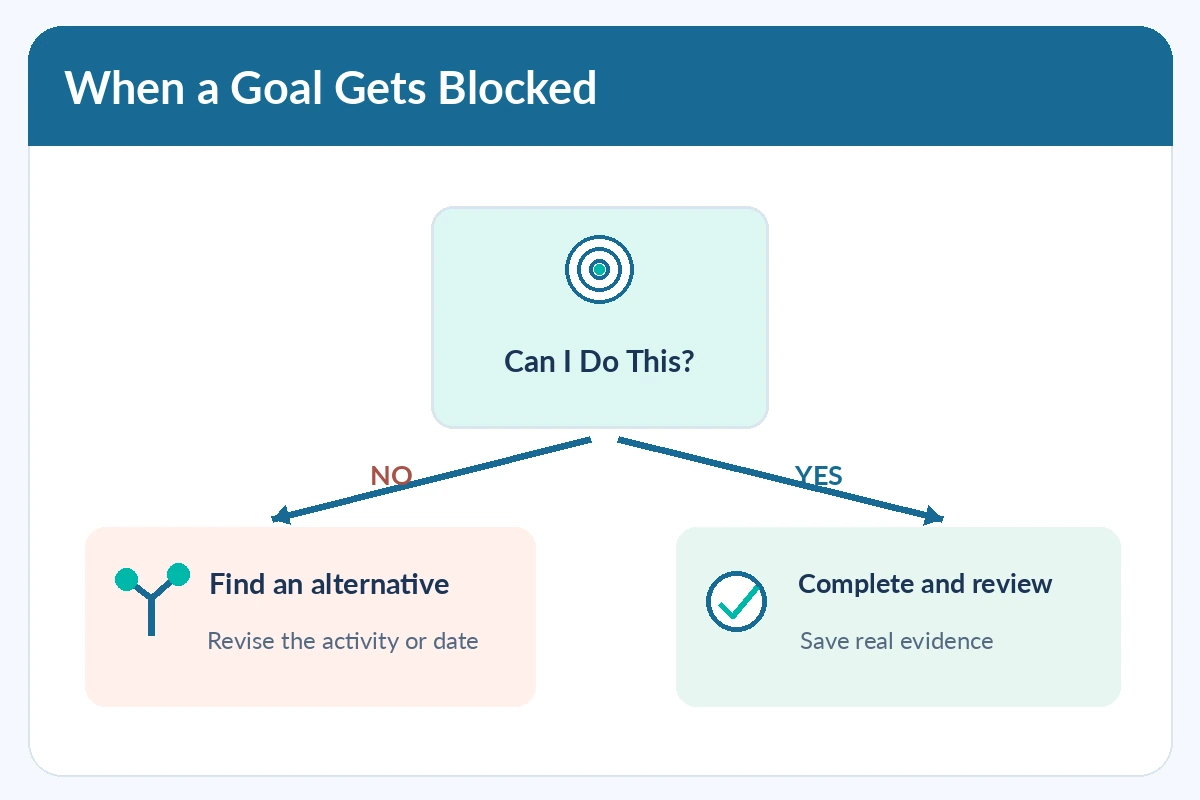
Work backward from a longer goal to the next capability, then to an activity and its required support. If the direction involves leading projects, ask whether you first need to learn scheduling, contribute to an existing project, or document risk updates under a supervisor. A date is not useful if you have no access to the assignment or training. Mark who must approve access and what you will do if the opportunity is unavailable. A two-horizon plan is stronger when it includes an alternative route rather than pretending that promotions happen on a fixed calendar.

Use a Two-Horizon Example With Evidence
Hypothetical example: Long-term direction: become a reliable operations coordinator. In the next 90 days: learn the approved order-tracking workflow, observe one handoff, and produce a supervisor-reviewed checklist for an assigned part of the process. Within the next year: request a chance to coordinate a bounded task if available. Success evidence is the approved checklist, the supervisor’s feedback, and accurate completion of assigned handoffs—not a made-up efficiency percentage or an assertion that a promotion is guaranteed.
Turn a Vague Intention Into a SMART Step
“Improve my career” gives you no basis for a check-in. A useful rewrite says what skill, which activity, what proof, and by when: “By the next quarterly check-in, complete the approved spreadsheet course, apply one technique to a permitted sample task, and ask the reviewer to check accuracy.” The CareerOneStop goal guide explains the SMART pattern. The measure can be a reviewed artifact, not necessarily a numeric business outcome you cannot verify.
Decide What You Can Control
Separate actions you own from outcomes someone else decides. You can schedule learning, ask for feedback, practice a skill, and request a project. You cannot promise a manager will assign you a role or approve a credential. If a goal is blocked by resources, adjust the activity or date, document the obstacle briefly, and keep the longer direction as an option. This prevents an unrealistic deadline from being mistaken for lack of effort.

Review Both Horizons Without Starting Over
Schedule one check-in for the short milestone and a less frequent review of the larger direction. Compare what you planned, the evidence you obtained, and what changed at work or in your interests. Keep a concise log of completed work, feedback, and remaining gaps. OPM’s development-plan guidance describes short- and long-term goals, estimated and actual completion dates, and feedback. An IDP can be useful, but it is not a guarantee of advancement.
Avoid Goals That Depend on Invented Outcomes
Do not write “increase departmental performance by 30%” unless the baseline, measure, assignment, and result are real. Similarly, completing a course does not automatically establish workplace competence; include supervised application and review when appropriate. If you are changing industries, build a low-risk sample task that does not expose employer data. Your plan should make it easier to decide what to learn next—not force you to pretend a result already happened.
Copy This Short Career-Planning Worksheet
Write four lines: “Direction: ___”; “Next capability: ___”; “Action and resource: ___”; “Evidence and check-in date: ___.” Add “Alternative if blocked: ___.” Review the lines with a mentor or supervisor only when that is appropriate to your workplace. A personal planning document can remain private if discussing the long-term direction would be premature. Treat the worksheet as a decision aid, not a requirement imposed by CareerOneStop or your employer.
Choose Milestone Evidence Before You Start
At the start of a goal, decide what a reasonable observer could actually see. For a learning target, that might be a completed practice exercise plus written feedback. For a collaboration target, it could be a documented handoff that an authorized colleague checked. If you want to improve a workflow, record the current approved steps and ask what information you are permitted to collect before proposing a change. Avoid treating attendance at a meeting as proof of leadership. Evidence should be safe to retain, accurate about your contribution, and meaningful to the next decision. Choose the lightest useful record; collecting sensitive records just to prove a goal would undermine the result.
Compare a Stretch Goal With a Risky Promise
A stretch goal describes useful work that is ambitious but feasible with known support. A risky promise depends on unverified conditions: a vacancy opening, a supervisor granting access, a training budget, or another team supplying data by a fixed deadline. You can express interest in these opportunities, but write a contingency. For example, if a cross-functional assignment is unavailable, offer to study a public case, discuss a permitted example with a mentor, and return to the request at the next planning conversation. This makes the goal resilient. It also distinguishes effort from institutional decisions, which is especially important when a development goal appears in a formal appraisal.
How We Research Career Goal Guidance
This guide draws on the listed primary or professional sources for its core approach, including CareerOneStop, OPM, NACE. The worked examples are instructional and labeled as hypothetical; they are not reported employee outcomes. Employer expectations, licensure rules, access permissions, and feedback procedures must be checked in the applicable setting. See our affiliate disclosure; none of the links in this guide is marked as an approved affiliate referral.
Explore Related Career Guides
- Long-Term Career Goals: Choose a Direction You Can Actually Test
- Career Goals After Graduation: Turn Coursework Into a First-Year Plan
- Career Goals Examples: Write Specific Plans You Can Actually Review
- Customer Service Career Goals: Grow Toward Quality, Training, or Lead Work
- Career Advancement Goals Without a Promotion: Grow Your Scope
A short-term goal targets a near action or skill with evidence; a long-term goal describes a broader direction that may need several steps.
No. Technical expertise, better work practices, a lateral move, and improved collaboration are legitimate career directions.
Choose a check-in tied to the activity, such as a month or quarter; review the longer direction when your interests or opportunities change.
Label any target as a proposed target and distinguish it from past performance. Never claim a result that has not happened.
Ask what approved alternatives could demonstrate the same skill, or change the date while retaining a realistic longer-term direction.