
A reliable social worker resume format begins with verified qualifications, relevant experience and readable evidence, not a decorative template. A social worker resume should let a reviewer answer three questions quickly: which role you are eligible for, what you have done, and who supervised work that required oversight. Use a simple one-column layout with your contact information, a precise professional heading, verified credentials, relevant experience, education, and selected skills. This is a more useful organizing principle than choosing a decorative design first. A clinical vacancy and a case management support opening may have very different thresholds, even when their advertisements use similar language.
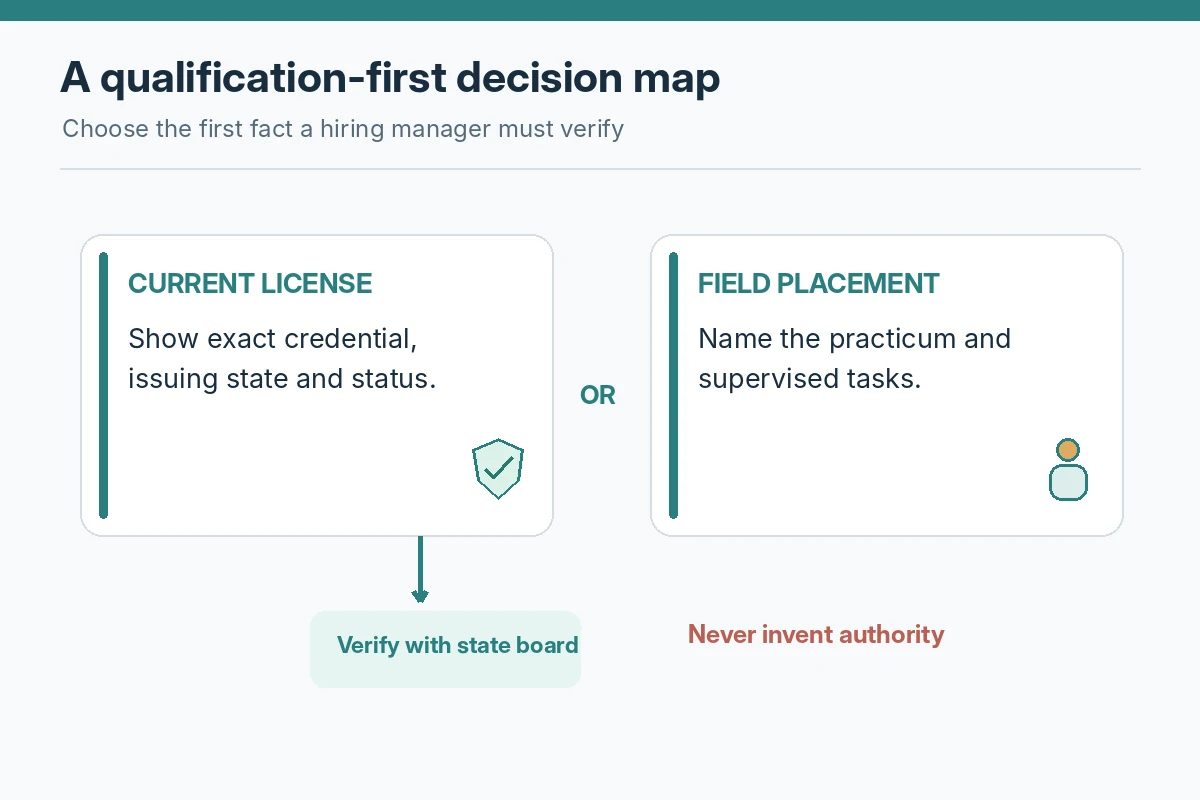
Put the credential decision above the experience list
For a licensed candidate, the top area can state the credential using the exact official abbreviation, issuing state and status if those details are relevant to the application. For an unlicensed graduate, the degree and supervised practice should be visible without an invented title. The Bureau of Labor Statistics distinguishes clinical social work licensing from other social work paths, with requirements varying by state. Read the local licensing board and actual job posting before deciding which line goes first.
Give supervised field education its own truthful label
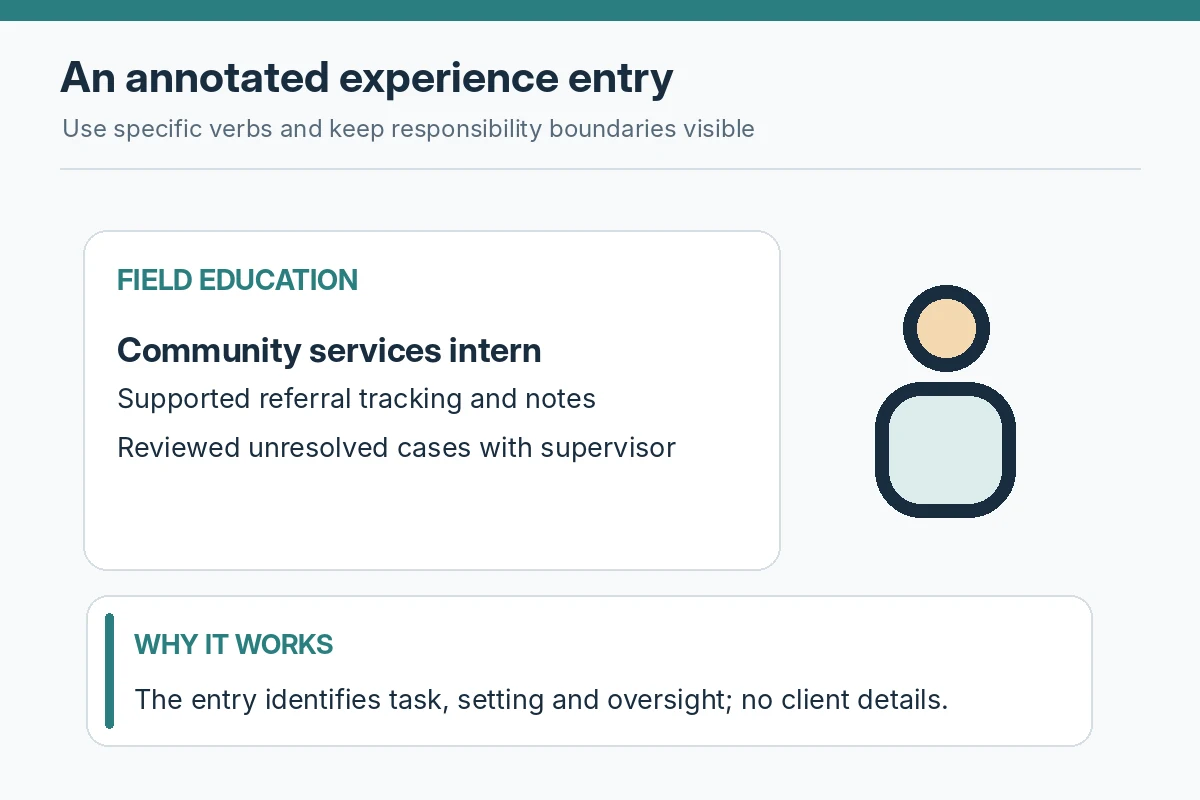
Field placements can show substantial professional preparation, yet they are not interchangeable with unsupervised employment. Put a supervised practicum under Field Education or Relevant Experience with the actual host organization and dates, then describe your role in plain language. If you observed assessments, assisted with referrals or documented meetings under review, those distinctions matter. Do not turn a classroom simulation into a client encounter or translate a student placement into a licensed clinician job title.
A good field education entry names the setting, population at a safe level of generality, supervised workflow, and the output you personally supported. For example, a clearly fictional candidate might write: “Assisted with community resource referrals, recorded follow-up status in the approved system, and discussed unresolved cases during supervisor review.” That describes actions without inventing diagnosis, independent treatment, clinical authority or identifiable case details. The reader can also ask the placement coordinator which documentation may be disclosed.
Order casework achievements without exposing clients
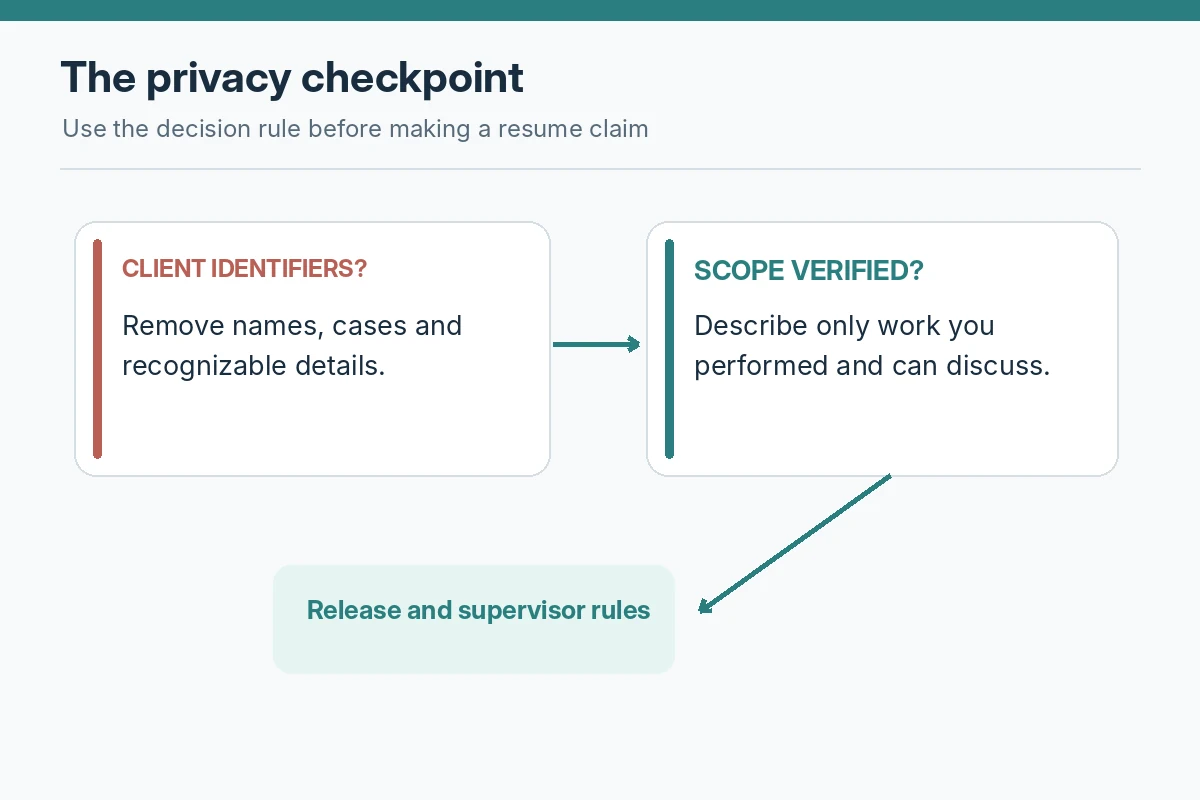
Your resume is not a case file. Do not include a client name, a family circumstance that permits reidentification, a sensitive record screenshot, or a quotation taken from a protected encounter. Even an impressive success story should be summarized at the workflow level. A safe bullet may refer to maintaining referral records, coordinating approved appointment reminders, or escalating service barriers. It should avoid a detailed individual timeline that a client or colleague could recognize.
Keep ownership and outcomes separate. If an interdisciplinary team designed a plan, do not say you independently created and approved it. If your contribution was updating records or communicating next steps, state that contribution. For numbers, check their accuracy and release permissions; sometimes a precise count is inappropriate. One believable description of repeatable professional conduct usually says more than a dramatic, unverifiable impact claim. This also helps hiring managers ask follow-up questions without pressuring you to disclose protected information.
Write bullets around action, context, and review
A resume bullet becomes useful when the reader can picture the task and its limits. Start with a concrete verb: documented, coordinated, scheduled, referred, tracked, prepared, or reviewed. Add the context, such as a school-based support team or community outreach program. Then state the tangible output: completed referral logs, accessible resource sheets, accurate handoffs, or timely supervisor escalations. Avoid adjectives like compassionate and organized unless accompanied by evidence of how you worked.
Compare the fictional weak line “Managed cases and delivered therapy” with the accurate alternative “Tracked assigned referrals and prepared case updates for a licensed social worker’s review.” The latter is less grandiose but more credible for a trainee. Experienced, authorized clinicians can describe interventions within their actual licensure and workplace responsibilities. If you moved among teams or programs, show the dates and scope separately rather than compressing different authorities under one broad job title.
Fit education and clinical preparation into readable sections
List your degree using the university’s award wording and the actual award or expected date. If the role requests accredited social work education, check the posting and the program’s records rather than assuming all related degrees are identical. Put targeted field placements, relevant coursework or training after more important qualifications. A current practitioner generally needs less coursework detail than a new graduate who must demonstrate preparation without substantial paid experience.
Certifications and mandatory training can have different issuers, expiration rules and practical meaning. Do not group an online participation badge with a state professional license in a way that implies equal status. Show licenses under Licensure, separate optional certificates under Training if relevant, and make the status legible. Omit personal license numbers unless explicitly required by a secure application procedure. An employer can verify credentials through appropriate channels without a public document carrying unnecessary identifiers.
Adapt section order to clinical or community openings
For a role with an explicit license requirement, credentials and qualifying supervised experience should appear before tangential service work. For a nonclinical outreach position, the most useful opening evidence may be community partnerships, referral tracking, accessibility, or coordination of services. Compare the actual vacancy verbs with your own records; copy neither the employer’s claims nor your school’s learning objectives verbatim if you cannot show corresponding activity.
Keep standard section labels such as Professional Experience, Field Education, Licensure, Education, and Skills. This is especially important when the application uploads a resume and separately asks you to enter dates and titles. The work history in both places must agree. A two-page resume may be reasonable if work, field placements, and licenses justify the space; do not stretch brief material by adding empty blocks, photographs, or a dramatic skills-meter graphic.
Review the resume as a recruiter and supervisor would
Read the first half-page and identify your eligibility, latest role, and strongest relevant proof. Then check every date against records; confirm job titles and remove unsupported independent-practice language. Have a trusted reader unfamiliar with your workplace identify where your exact contribution is unclear. A license status mistake is more consequential than a decorative inconsistency, so prioritize accuracy over design choices.
Export in the format requested by the employer and open the actual saved file. Check that headings survive, line wraps do not hide credentials, hyperlinks point to the intended destinations, and the text can be selected. If an online application requires separate entry of education or license details, fill those fields accurately rather than assuming the attached resume will substitute. Keep a private master copy, and tailor a clean version for each substantially different clinical or community role.
How We Research social work resume requirements
We separate general resume-layout advice from occupation-specific requirements. CareerOneStop explains readable formatting; the Bureau of Labor Statistics describes social work field education and state-variable licensing; and University of Pennsylvania career guidance explains how to organize experience and education. These sources inform the structure, but a state board and the actual employer determine eligibility and required documents. Check BLS social worker qualifications, CareerOneStop formatting guidance, and Penn resume guidance against your situation.
This is general job-search information, not licensing or clinical advice. Examples above are fictional and do not imply a guaranteed interview or hiring result. For funding and recommendation disclosures, see the JobAsk affiliate disclosure.
More Resume and Cover Letter Guides
If the credential is current, properly issued, and relevant, you can include its exact designation after your name or in a prominent credentials line. Confirm the preferred form with the issuer and the posting; never use a license abbreviation you have not earned.
List it under Relevant Experience or Field Education with the agency, placement dates, level of supervision, and duties you actually performed. It is legitimate experience but should not be labeled an independent licensed position.
Use a count only if it is accurate, permitted by your employer or placement, nonidentifying, and material to the vacancy. A description of referral tracking, documentation, or interdisciplinary coordination can be stronger than a risky statistic.
Often yes. Clinical roles may prioritize valid licensure, supervised experience and authorized interventions; community roles may prioritize resource coordination, outreach and program knowledge. Match the actual role without implying identical legal authority.
State the true status and any verifiable expected date without presenting it as already issued. If a posting requires current licensure, verify its eligibility rules before applying.