
Quick answer. For “Tell me about a time you solved a difficult problem,” tell one real story that exposes your reasoning. Set up the actual constraint, describe what you investigated, identify the option you chose and why, and explain what happened afterward. It is better to show a modest, well-reasoned solution than to claim you magically fixed a major organizational problem. This guide is for US job seekers preparing a truthful answer, not a prediction of any specific employer’s assessment.
Pick A Problem With A Real Decision Point
The strongest story is not necessarily the crisis with the most dramatic ending. It is a situation in which you had to work out what was wrong, compare possible responses or adapt when the first idea did not work. Draw from job tasks, coursework, volunteer coordination or independent projects. A missed handoff, inconsistent records or unclear requirements can provide enough substance if you genuinely helped solve it. Avoid sharing trade secrets, protected personal data or clients’ identities. For the fuller picture, see our guide “STAR Interview Method”.
Write two candidate stories in a notebook. For each, name the actual problem separately from its symptoms. “People kept asking the same question” is an observed symptom; “the instructions lacked a clear owner” is a possible explanation requiring verification. What did you check before deciding? A careful answer shows you noticed uncertainty, gathered relevant information and kept track of what you could not know. Resist announcing an unsupported root cause as a proven fact.
Explain How You Compared Options
A useful problem-solving answer can extend the conventional STAR sequence with a short decision trace: constraints, evidence, options, action, and observed result. Describe the constraint that made the situation difficult, such as a deadline or conflicting requirements. Then state one or two paths you considered, the reason you chose one, and what you did to test whether it helped. The interviewer should be able to follow the logic without knowing your previous company’s internal systems.
Sometimes the safest solution is escalation rather than individual heroics. If you lacked approval to change a procedure, you could report the issue with documented examples and suggest a limited test. That may demonstrate sound judgment better than claiming you personally overrode the process. Identify which decision was yours and which was made by a supervisor or team. Accountability does not require pretending to have authority you did not have.

Study Two Hypothetical Problem-Solving Stories
Hypothetical example — support work: “At a community event, attendees were getting two different check-in instructions. My responsibility was to help them reach the right station. I compared the printed notice with the organizer’s latest message, confirmed the current route with the coordinator and put a corrected sign at the entrance with permission. Volunteers then used the same instructions. I learned to verify a source before repeating it.” This is an invented teaching scenario, not an actual hiring testimonial.
Hypothetical example — technical project: “During a class project, a report changed whenever the input file was sorted differently. I tested the same small sample under two sort orders, isolated a formula referencing row position and changed the method to use a stable identifier. I documented the assumption and asked a classmate to reproduce the test. The sample then returned consistent results.” Substitute your real investigation; do not claim to have run tests or used tools you have never used.
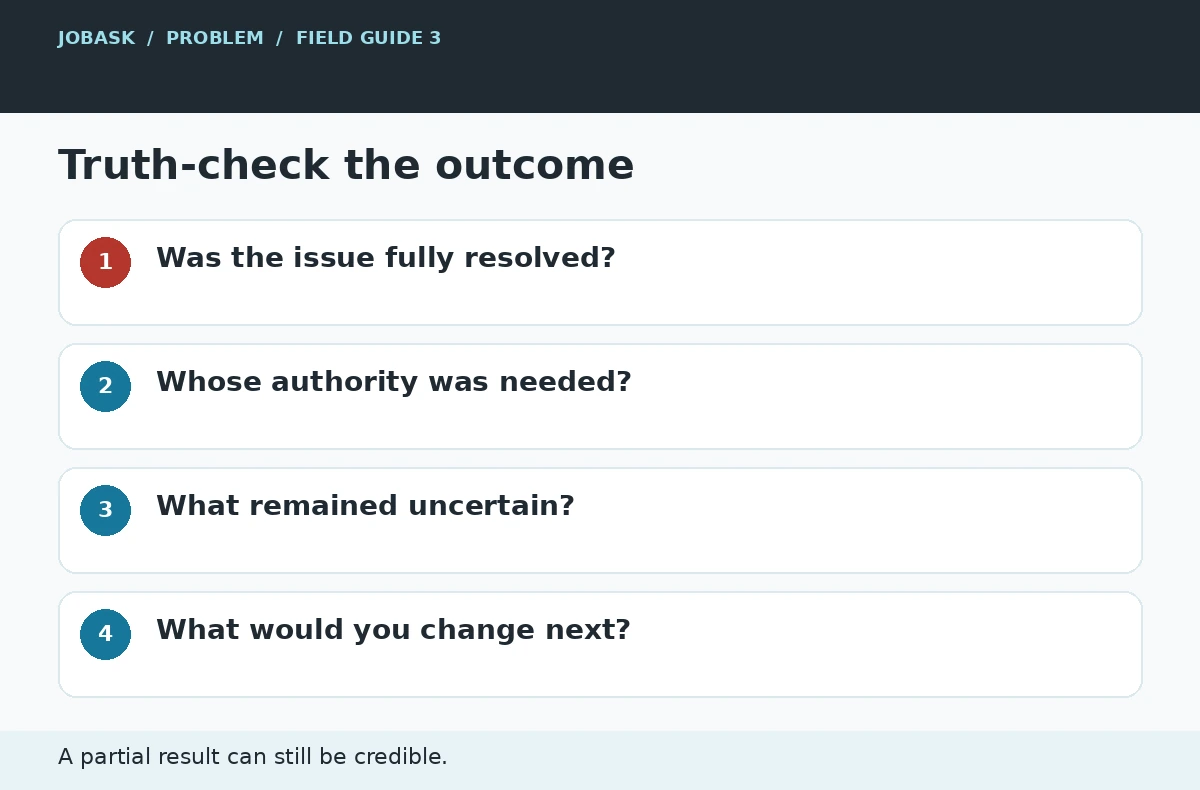
These stories reveal a deliberate sequence: notice, check, choose, confirm. Neither requires a spectacular figure. If the difficulty was only partly resolved, say so: perhaps the immediate process became clearer, but a longer-term software issue remained. The answer is still usable if you describe the boundary of your contribution and what you recommended next. Our work under pressure interview answer guide goes into more detail.

Separate Symptoms, Causes, And Outcomes
In a weak response the setup takes most of the time: the speaker describes meetings, frustrations and deadlines, then ends with “we worked hard and fixed it.” A more informative response explains what evidence distinguished one possible cause from another. What would have happened if you chose the wrong remedy? Which assumption did you test? Even in a service role, you can discuss how you ruled out an outdated instruction or asked someone with the right authority to confirm a change.
Avoid claiming that your action alone caused a business-wide improvement unless you have evidence. A useful outcome statement can be “The corrected version was adopted for that event,” provided that is true. If you learned your initial hypothesis was mistaken, acknowledge the revision and why it changed your approach. The question tests your ability to describe thoughtful behavior, not your ability to manufacture a flawless victory.
| Evidence stage | Ask yourself | Answer should reveal |
|---|---|---|
| Symptom | What did I observe? | Concrete, bounded problem |
| Investigation | What did I check? | Information rather than guesses |
| Decision | Why this option? | Reasoning and constraints |
| Outcome | What changed afterward? | Observed result, including limits |
Practice The Logic Rather Than Memorizing Lines
Create a five-box note: observed issue, information checked, choice, action, and outcome. Give each box one factual sentence. During rehearsal, remove jargon that a new interviewer would need defined. Ask a practice listener to repeat back why you selected the solution. If they cannot, you may have narrated the activity without identifying the decision. A small number of accurate details beats a long technical inventory.
Prepare for follow-ups such as “What alternatives did you reject?”, “Who approved the fix?”, “What would you do differently?” and “How did you know it was resolved?” Answer these questions from real memory. If you cannot recall a detail, say what you can verify instead of improvising. For a question asking how you would solve a future problem, describe a proposed method rather than misrepresenting it as a past event. For the fuller picture, see our time management interview questions guide.
Make A Final Answer You Can Verify
Before rehearsing, circle every statement that names a person, tool, result, award or deadline. Can you justify each from your real history? If a sentence would require you to invent a meeting, metric, supervisor endorsement or company policy, delete or rewrite it. Treat the hypothetical passages above as teaching devices only. Rehearsing a truthful outline is more useful than memorizing a polished story that cannot survive a natural follow-up question.
Keep a short private note of the facts behind your answer: your role, the context, the steps you took, the result you actually observed and one honest limitation. Avoid sensitive customer, colleague or employer information. Review the open position before the interview so the final connection remains relevant, but never add achievements that did not happen. You can be prepared and still acknowledge uncertainty when an interviewer asks something you do not know. To go further, our greatest achievement interview answer guide shows how to choose a story you can prove.
How We Research These Interview Answers
We differentiated this article from the general STAR method and broad behavioral question pages in the initial queue: its central tool is the decision-trace, not a repeat list of interview questions. The diagram is an original practice device, not a formal assessment used by employers.
Sources, Hypothetical Examples, And Disclosure
References reviewed October 20, 2026: careercenter.ucdavis.edu (Lists examples of problems and solutions and explains the situation-action-results structure.) ce.colorado.edu (Describes a challenging-problem behavioral question and STAR framework.) www.fit.edu (Lists problem-solving and decision-making prompts with behavior-based examples.). The cited institutions support structuring concrete accounts of problem solving. The proposed decision-trace worksheet is JobAsk editorial guidance. All sample people, situations and outcomes are hypothetical. These pages inform interview preparation and do not imply a hiring outcome.
JobAsk provides general informational guidance, not employer-approved interview scripts. No affiliate relationship or paid recommendation is asserted here. Read our affiliate disclosure before following commercial recommendations elsewhere on the site. There are no affiliate product links in this article.
More Interview Preparation Guides
- Difficult Stakeholder Interview Answer: Clarify Needs and Document Trade-Offs
- Difficult Decision Interview Answer: Compare Options and Explain the Trade-Off
- Difficult Customer Interview Answer: Listen, Act, and Set Boundaries
- Teamwork Interview Answer: Show Your Part in a Shared Result
- Career Goals Interview Answer: Explain Your Next Step and Plan
An issue that required investigation, a choice between competing options or adjustment to a real constraint can count, even if it was not a major emergency.
Yes. Choose one with real actions and an outcome you can describe. Show how the reasoning connects to the role.
STAR is a helpful organizational tool, but add the reason for your decisions so the answer demonstrates problem solving rather than just recounting events.
Describe your analysis, recommendation, actions and the other person’s authorization accurately. Do not claim ownership of their decision.
Yes, if you state what improved, what remained open and what you learned. Do not rename a partial fix a complete resolution.