
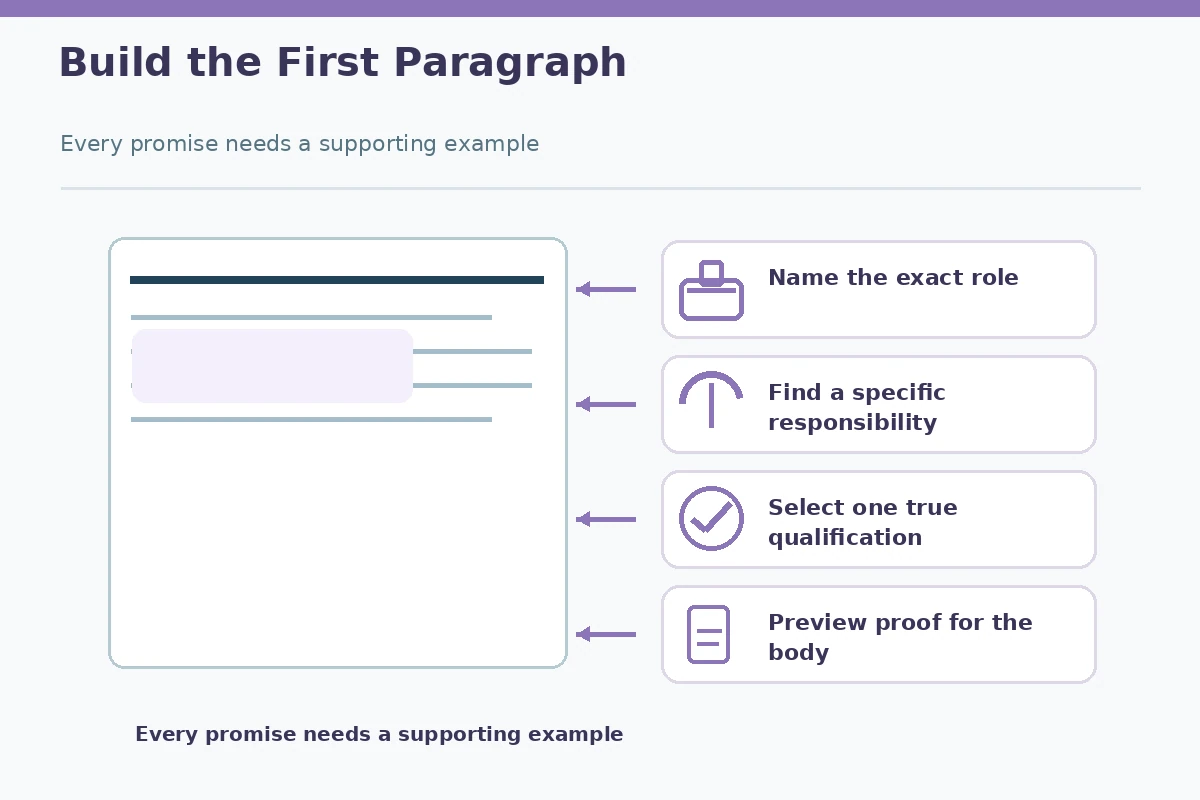
A strong cover letter opening names the job, gives one genuine reason for this employer or role, and previews a qualification the letter will support. It does not need a dramatic quote or an invented success story. Write the paragraph after you have examined the vacancy and chosen your evidence; otherwise, an impressive first line may promise more than the later paragraphs can prove.
Start With the Vacancy and Your Evidence
Before drafting, read the exact posting and write down what the reader needs to know: the role, one real requirement, and a specific example you can explain. MIT career guidance recommends researching the employer and matching the role to demonstrated experience rather than relying on generic praise. The following examples are explicitly hypothetical; adjust each one to your documented circumstances and never treat them as a real employer or applicant record.
Lead With the Job and One Concrete Connection
State the role as the employer names it. Add a fact you can verify from the posting, such as responsibility for customer scheduling, product documentation or research coordination. Avoid beginning with the same universal sentence for every application. “I have always been passionate about excellence” tells the reader neither which position you want nor what you could contribute.
The UC San Diego guide recommends using a role-specific detail that would not make sense if the company name were swapped. A hypothetical opening might be: “I am applying for the clinic scheduling assistant position because the posting emphasizes accurate appointment changes, a task I supported in a community volunteer role.” The candidate must replace this with true experience; the example does not demonstrate medical credentialing or access to protected records.
Separate Employer Research From Unsupported Praise
Research one relevant fact from the employer’s own public job description or service explanation. You can be interested in a team’s stated service area without pretending to know its internal culture. If the listing highlights accessibility checks or documentation, write about those tasks. Claims such as “your organization is the best in the country” need evidence and usually add little to a candidate’s fit argument.
A useful test is to replace the company name with a competitor’s. If the opening still works unchanged, it may be too generic. Replace the flattery with a duty or mission detail actually relevant to the job. Do not invent employee conversations, referrals or recruiting events. When a real contact encouraged you to apply, mention the person only with permission and accurate context.
Preview One Skill the Body Can Actually Prove
Choose one primary skill supported by a specific experience. If the job needs careful records and you really checked inventory lists, the first paragraph can preview accuracy and follow-through. The next paragraph then describes the evidence: what you checked, which discrepancy you found, and whom you notified. Without that supporting story, “exceptional accuracy” is only a self-assessment.
Do not cram six keywords into the opening. Use natural language that mirrors the task where relevant. For a hypothetical student applying to a communications internship, the opener could mention editing a club newsletter, then the body can show their exact editing contribution. A class project does not become client marketing work simply because the same skill might apply in a paid role.
Compare a Generic Opening With a Specific One
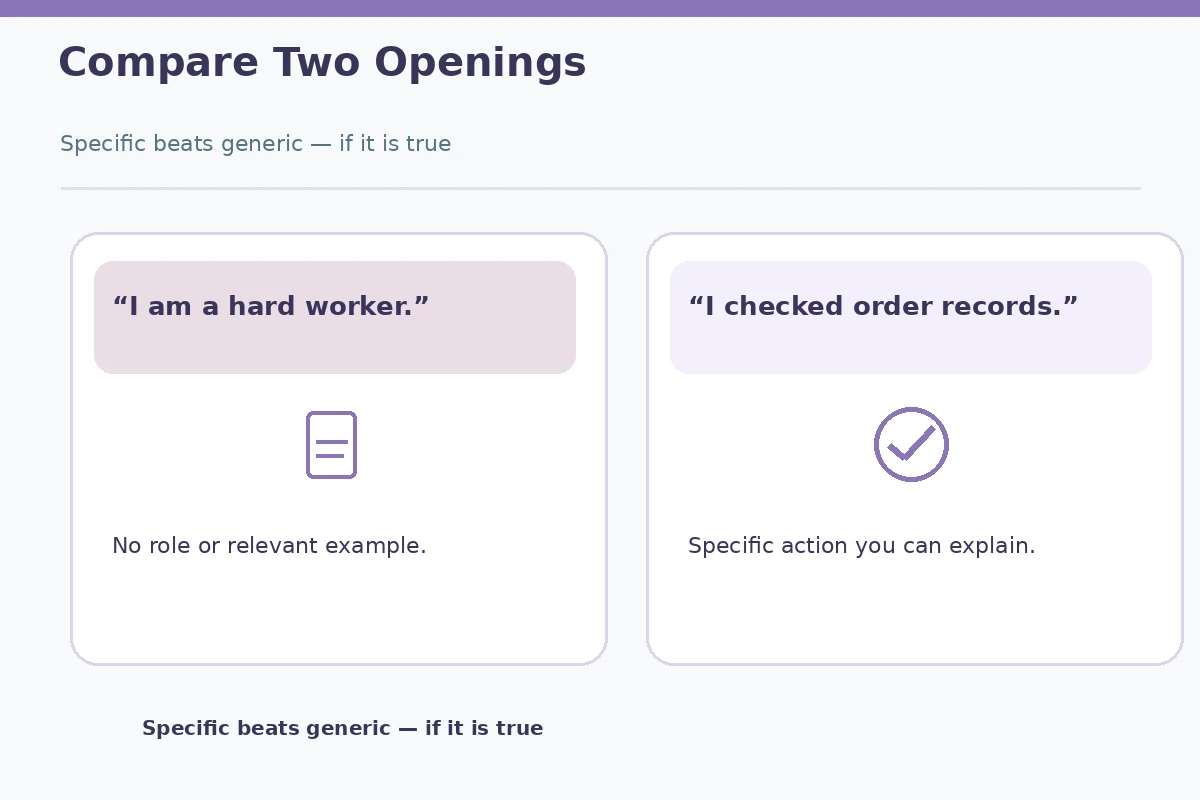
Generic version: “Dear Hiring Manager, I am a hardworking team player with a passion for opportunities at your company.” This has no named role, distinctive reason or checkable example. It might be sincere but gives the reader little information to evaluate. A stronger hypothetical rewrite could be: “I am applying for the records assistant role; my previous volunteer work involved organizing intake forms and checking missing fields before a coordinator reviewed them.”
Notice what the rewrite does not say: it does not claim the applicant managed the department, approved records or improved productivity by a fictional percentage. It establishes the advertised task and a limited example. Use the side-by-side comparison below to find missing components in your own opener: position, employer relevance, evidence and honest scope.
Handle a Referral or Career Change Without Overloading
If you have permission to mention a real referral, place that connection near the beginning and then return to job fit. A referral alone does not establish qualifications. Similarly, a career changer can write one short explanation of direction and one skill preview rather than dedicating the whole opening to the story of leaving a prior industry. The cover letter’s first job is to make the reader understand the application.
For a candidate returning after time away from paid work, a concise opening can focus on the current role and demonstrated capability. If a career break needs explanation, use a separate brief sentence later. Avoid disclosing private health or family information merely to make the first paragraph more dramatic. This article concerns the opening itself; a separate career-break guide can help with longer timeline questions.
Edit for Plain English and Appropriate Confidence
Read each sentence aloud and ask whether it sounds like something you could say in an interview. Replace vague descriptors with tasks and remove pompous phrases. “I checked shipping records for mismatched item numbers” gives a clearer preview than “I leveraged my unparalleled logistical acumen.” Confidence comes from accuracy and specificity, not intensity. The Colorado Boulder cover-letter resource connects the opening’s thesis to the skills later explained in the letter.
Keep the first paragraph short enough that it does not become the entire letter. Three focused elements usually suffice: which job, why this employer or task, and what related evidence you bring. The exact sentence count can vary. Do not use a rigid word-count formula if the posting asks for a special format. A concise email application might require a different opening from a separate formal letter.

Audit the Opening Against the Rest of the Letter
Underline the main qualification promised in the opener and find the paragraph that supports it. If no paragraph does, either add a true example or remove the claim. Compare the exact role title, organization name and responsibilities with the posting one last time. Check any referral name and specific employer claim. Never imply a conversation, certification or result occurred if you cannot explain it.
Finally, ensure the opening does not merely repeat your resume heading and that the document finishes with a respectful closing. A clear opening helps the reader decide whether to continue, but it cannot guarantee an interview. The rest of the letter and application must deliver on its promise with accurate experience and compliance with the employer’s actual submission instructions.
How We Research Cover Letter Guidance
We reviewed publicly accessible university career-center materials and, where relevant, official software instructions on 2026-10-27. We checked for distinct intent against available earlier JobAsk batches, including the general cover-letter and email-application articles. Our workflow does not reveal private WordPress drafts and cannot guarantee slug availability or an employer’s response. Scenarios are hypothetical, not documented candidate success stories; revise examples against your own history and the actual application instructions.
Source: career.ucsd.edu. The first paragraph should name the exact position, give a specific reason and preview qualifications.
Source: careercenter.ucdavis.edu. Career guidance explains the opening as introduction, role interest and a concise fit statement.
Source: www.colorado.edu. A strong opening connects the position, employer interest and a short thesis of candidate fit.
Source: capd.mit.edu. Researching employer needs informs a specific, truthful opening pitch.
These career centers and software providers do not endorse JobAsk or promise application outcomes. No affiliate agreement is implied. Review our affiliate disclosure. Follow the employer’s own submission rules and verify any professional or licensing requirement separately.
More Resume and Cover Letter Guides
- How to Write a Cover Letter That Connects Your Experience to the Role
- Internship Cover Letter: Connect Coursework and Projects to the Role
- Cover Letters for Multiple Jobs at One Company: Make Each Version Specific
- Resume Objective vs. Summary: Choose the Right Opening for Your Experience
- Resume Objective: When to Use One and Write a Job-Specific Statement
Usually name the job and add a genuine role-specific reason; support the claim with evidence in the body.
That is not necessary when the application already supplies your name; prioritize the role and your fit.
Yes, when the connection is real, relevant and the person has agreed to be mentioned.
Not automatically. A precise and truthful opening is more useful than a dramatic unsupported claim.
Replace the employer name; if the paragraph still fits any job, add a verified duty or more specific evidence.