
Turn schoolwork, service activities, and real availability into a specific student resume objective without inventing paid experience. A good opening identifies a plausible role, uses evidence you can explain, and leaves room for the rest of your resume. The examples below are hypothetical; adapt them to your actual experience and the requirements of each employer.
Name a Real First-Job Target at the Top
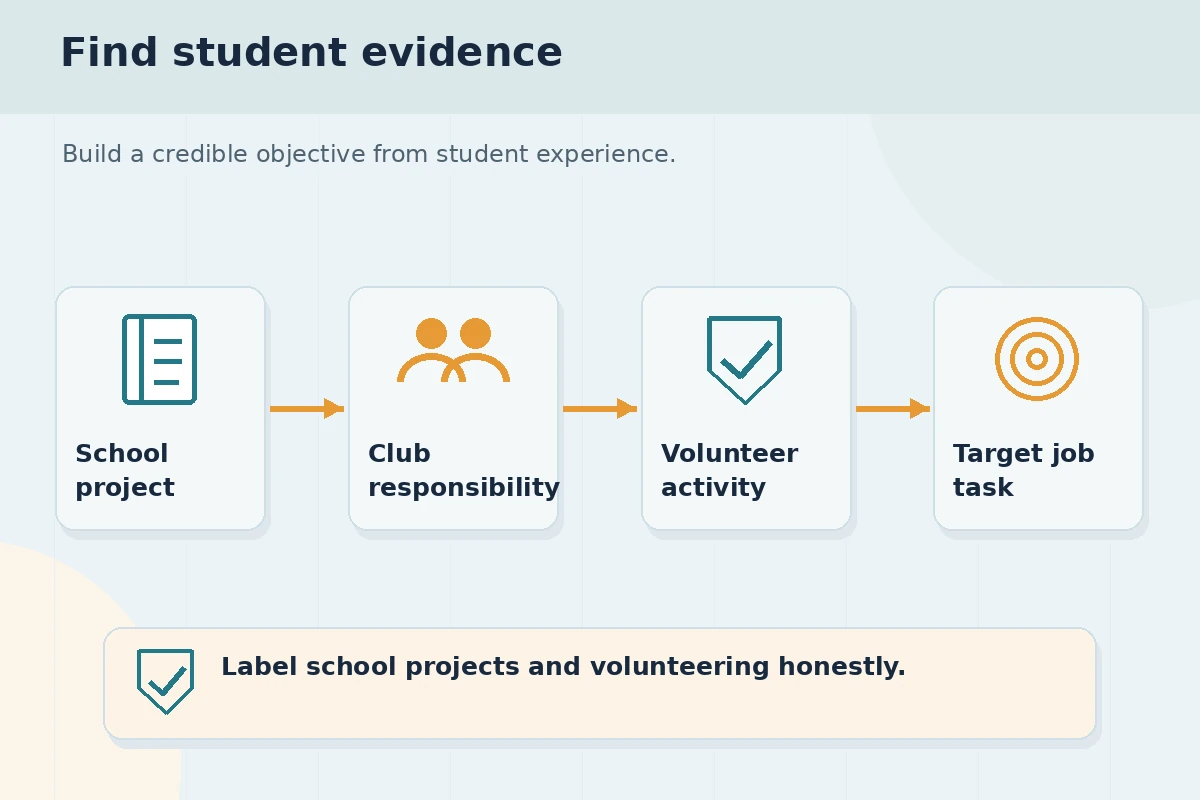
A student objective works when it identifies the job you are applying for and points to one or two real abilities that a reader can verify. You do not need paid employment to describe a school project, student organization responsibility, or volunteer activity. The goal is not to sound like an experienced professional. It is to show how a beginner has practiced something relevant to the opening.
For example, a hypothetical student applying for library page work might mention organizing a classroom book collection and maintaining a checkout list for a school club. That supports basic organization, not professional library systems expertise. If the activity did not happen, do not copy the sentence; find a truthful example from your own life.
Match Activities to the Tasks in the Posting
Read the job posting for the actual duties: greeting customers, stocking shelves, preparing materials, following instructions, or keeping records. Make a short list of experiences that resemble those duties. Helping run a club event might demonstrate setup and scheduling. Lab work might demonstrate following a procedure and documenting observations. Tutoring classmates might demonstrate explaining ideas patiently. None of these automatically substitutes for a credential expressly required by the employer.
NACE’s career readiness competencies identify communication, teamwork, critical thinking, professionalism, and technology through observable behaviors. This is a helpful vocabulary for translating school experiences into evidence, provided you name what you actually did rather than merely reciting a list of competencies.
Use Coursework as Evidence Rather Than a Credential Claim
Relevant coursework can be appropriate when it shows exposure to actual tasks in the posting. If you learned spreadsheet formulas in class, write that you practiced those functions in coursework, not that you managed business reporting. If you built a class website, describe your own contribution instead of implying you were employed by a client. Name only tools you can use and answer questions about.
CareerOneStop’s education guidance explains that recent graduates or people with recent training can place education earlier in the resume, depending on what is most relevant. Use that flexibility so a brief objective leads into real courses, activities, and project descriptions with dates and context.
Write a First-Job Objective With a Specific Example
A hypothetical retail version is: “High school student seeking a weekend store associate role; bringing experience greeting visitors and organizing materials at school events.” A hypothetical tutoring version is: “College student seeking peer tutoring work; able to explain algebra topics clearly through study-group practice.” Both statements require the named activities to be true and actual schedule availability to be confirmed.
For a general office assistant role, a truthful objective might mention preparing meeting notes for a student club and coordinating classroom schedules. Avoid describing occasional class participation as formal supervisory work. If you have no directly matched activity, keep the objective honest: name the job, your relevant course or demonstrated habit, and your willingness to learn the employer’s procedures without promising skills you do not have.

Separate Volunteering, Activities, Projects, and Paid Jobs
Organize resume sections by the nature of the work. Volunteer service belongs under Volunteer Experience, projects under Projects, and a paid job under Work Experience. A reader should never have to guess whether “community event coordinator” meant a paid employee, a student officer, or one afternoon of volunteer setup. Clear labels make a small amount of experience more credible.
In the objective itself, you can briefly name the setting if it matters: “through student club events” or “from school robotics projects.” Below the opening, include what you actually completed, your part in the team, and tools or materials used. CareerOneStop recommends connecting work descriptions to relevant tasks and real outcomes; the same principle improves student projects.
Handle Availability and Age Carefully
An objective can mention a genuine schedule fit when the posting emphasizes weekends or after-school hours. However, availability changes with classes, transportation, and other commitments. Confirm what you can consistently work before claiming “open availability.” Keep personal details such as your full birth date, social security number, and unnecessary home-address information off a public resume.
Do not assert that a student automatically qualifies for a position. Age-related rules, permits, and allowable duties may vary with jurisdiction and the work involved. When a posting states a condition, verify it rather than using a generic objective to imply you can perform any shift or use restricted equipment. A resume introduces your fit; it does not override eligibility requirements.
Replace Empty Enthusiasm With One Observable Action
Weak: “Hardworking student who will do anything and is great with people.” It is broad and may promise unsafe or unauthorized work. Stronger hypothetical wording: “Student seeking an entry-level front-desk role; practiced visitor sign-in and event materials tracking while volunteering at community meetings.” This shows an actual type of task and states the work context accurately.
Another weak version claims “expert communication and leadership skills” without details. Replace it with a description of how you handled a group handoff or explained a project. Strong words are useful only when attached to an example someone could ask about. If there is no relevant proof yet, a short objective followed by specific coursework is better than dramatic language.

Check the First Screen and Exported File
Keep the objective to one or two readable sentences under your name and contact details. Make sure the following section provides evidence rather than repeating the objective. Proofread the job title, class names, dates, and project details. Ask a teacher, career center adviser, or trusted adult to read the file for clarity if that support is available to you.
Finally, follow the employer’s requested submission format and reopen the exported document. Confirm that headings and dates are readable, no text is cut off, and your name appears correctly. A strong first-job objective does not guarantee an interview; it helps the employer understand the direction of an otherwise short resume.
How We Research Resume Objective Advice
We reviewed the primary career guidance and occupational task descriptions linked below on October 27, 2026. The suggested objective formulas are editorial examples, not quotations from employers or guarantees of screening results. Each sample is hypothetical and should be used only when the named task, training, and work setting genuinely apply to the reader.
cloudfront.careeronestop.org — CareerOneStop describes how recent graduates and applicants with limited experience may foreground relevant education and training.
naceweb.org — NACE defines observable career readiness behaviors that may be developed in coursework and student activities.
cloudfront.careeronestop.org — CareerOneStop advises using specific tasks and authentic accomplishments rather than generic claims.
We do not claim any employer endorsement, hiring outcome, or applicant-tracking-system guarantee. This is general resume guidance rather than legal, credentialing, or safety authorization advice. See our affiliate disclosure.
More Resume and Cover Letter Guides
- Resume Objective: When to Use One and Write a Job-Specific Statement
- Teacher Assistant Resume Objective: Show Classroom Support and Supervised Scope
- Delivery Driver Resume Objective: Show Route Reliability and Safe Handoffs
- High School Student Resume Format: Turn Activities Into Job Evidence
- Resume Objective vs. Summary: Choose the Right Opening for Your Experience
Yes. Use an accurate target role and evidence from education, volunteering, or projects.
Usually reserve grades for Education when they are relevant and worth including; use the objective for target and fit.
They can demonstrate learned skills, but label them as coursework or projects, not paid employment.
Only when the schedule is a major hiring factor and your stated availability is accurate.
Replace personality adjectives with a task you performed, where you did it, and the role you seek.