
Quick answer. When you receive a job offer but have not decided, send a brief acknowledgment thanking the employer, expressing genuine appreciation and confirming when you will respond. Ask for the written offer or decision deadline if needed. Avoid “I accept,” “I look forward to starting,” or other phrases that may suggest a final commitment before you have made one. Examples and roles in this guide are hypothetical. Always follow your real offer and the employer’s official instructions.
Separate Thanks from an Acceptance Decision
An offer acknowledgment and an acceptance email have different jobs. The first confirms receipt and keeps communication open; the second clearly communicates a final yes. A candidate may be grateful for an offer while still reviewing a work arrangement, benefits information, location or personal constraints. Gratitude is not a promise to take the position. Write the email so that someone unfamiliar with the conversation can accurately identify your status. That requires specific wording, not elaborate emotional language.
Boston University presents an initial offer-reply example that thanks the employer and commits to a later response. Maryland advises thoughtful review and attention to the actual deadline. Their guidance supports acknowledging the offer without prematurely finalizing it. Do not copy an acceptance email when you intend only to acknowledge receipt. In particular, avoid confirming a start date as “my start date” if the offer is still under consideration and not agreed.
Write a Short Acknowledgment with a Response Date
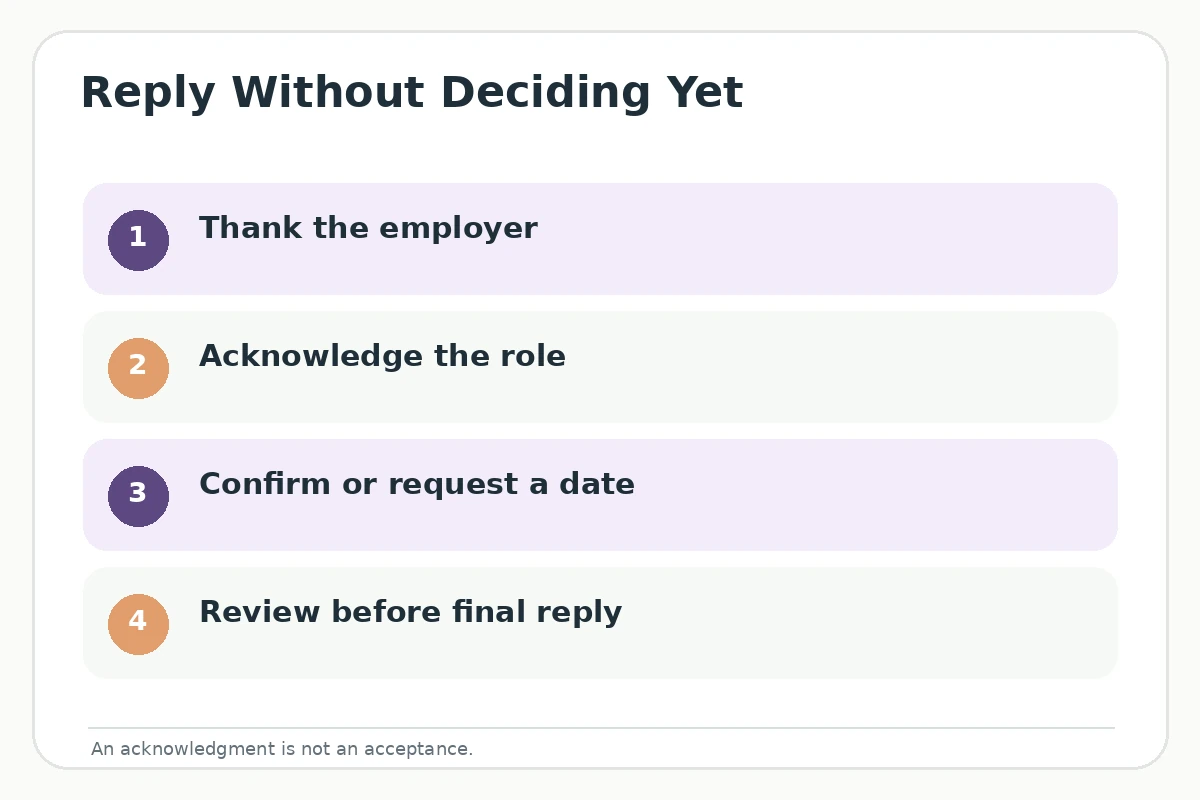
A useful acknowledgment has four pieces: a thank you, the exact role being offered, a statement that you are reviewing the information, and a specific reply plan. The deadline might already appear in the letter or need to be requested. If the employer has not given a date, ask when they need a decision, or suggest a reasonable proposed date for discussion. Do not promise you will reply on a date you cannot honor. A calm, direct note is more useful than an elaborate template with generic excitement.
Hypothetical email: “Subject: Thank You for the Operations Assistant Offer. Hello [Name], Thank you for offering me the Operations Assistant position. I appreciate your time and the opportunity to learn about the team. I am reviewing the written details and plan to respond by [agreed date]. Please let me know if there is anything else I should consider before then. Best, [Your Name].” This is fictional and deliberately contains no acceptance. Replace the date with one that matches the actual deadline.
Ask for Missing Information Without Delaying Quietly
If the letter does not explain a material detail, raise it promptly. You might need clarification about the work location, reporting arrangement, starting schedule, benefits document, response deadline, or whether a discussed change appears in the written version. Be specific about the information you need and whom you are asking. This is not a demand for a complete new explanation of the entire recruitment process. Keep the question grounded in the actual offer and avoid asking the recruiter to confirm facts they have already supplied clearly.
Hypothetical addition: “Could you confirm whether the work location listed in the letter is the final arrangement?” This asks for one factual clarification. It does not claim that remote work or relocation was promised. The University of Minnesota Duluth recommends reviewing written offer details and documenting any changes before accepting. Keep the question and the thank-you in the same thread if that is how the employer communicates, so the context is easy to follow. Our walkthrough on how to accept a job offer by phone and confirm the details in writing sets out each step.

Request More Time Only When You Need It
If you cannot make an informed decision by the stated deadline, request a new date as early as practical. Name the date you are asking for and explain the reason briefly, without oversharing personal information. An extension is a request, not an entitlement. The employer may accept, suggest another date, or decline. Continue working from the existing deadline unless a different deadline is actually confirmed. Maryland and Michigan career centers explain that asking for time can be part of an appropriate, transparent process.
Hypothetical request: “Thank you for the offer. I would appreciate a little more time to review the details. Would it be possible to respond by [proposed date] instead of [current deadline]?” Avoid implying that the request was approved before you hear back. If timing affects other interviews or commitments, focus on the decision requirement rather than misrepresenting outside offers. A professional acknowledgment preserves room to decide without misleading the employer about your intentions. For the basics, see our guide: How Long to Consider a Job Offer.
| Phrase | What it communicates | Use when |
|---|---|---|
| Thank you for the offer | Acknowledgment | You have not decided |
| I am reviewing the details | Decision still open | Review is in progress |
| May I respond by [date]? | Deadline request | Timing needs confirmation |
| I accept the position | Final acceptance | You truly decided yes |
Choose Language That Matches Your Actual Status
Wording matters more than whether your note looks formal. “Thank you for the opportunity; I am reviewing the offer” signals consideration. “I would like to accept” or “I am excited to join the team on Monday” may sound like final commitment. If you are still deciding, express interest through statements about the role or conversations rather than commitments to arrive, work or sign. A plain subject such as “Thank You for the Offer — [Role]” helps the recipient locate the conversation without labeling it an acceptance.
Do not use a thank-you email as a substitute for reviewing conditions, workplace expectations or the documents you were asked to sign. Once you are ready, send a separate unequivocal acceptance or decline in the specified channel. If the employer requests an immediate answer by phone, you can remain courteous while making clear that you need to review the details first. The purpose of the acknowledgment is communication accuracy, not creating uncertainty about your eventual decision.
Make a Final Accuracy and Timing Review
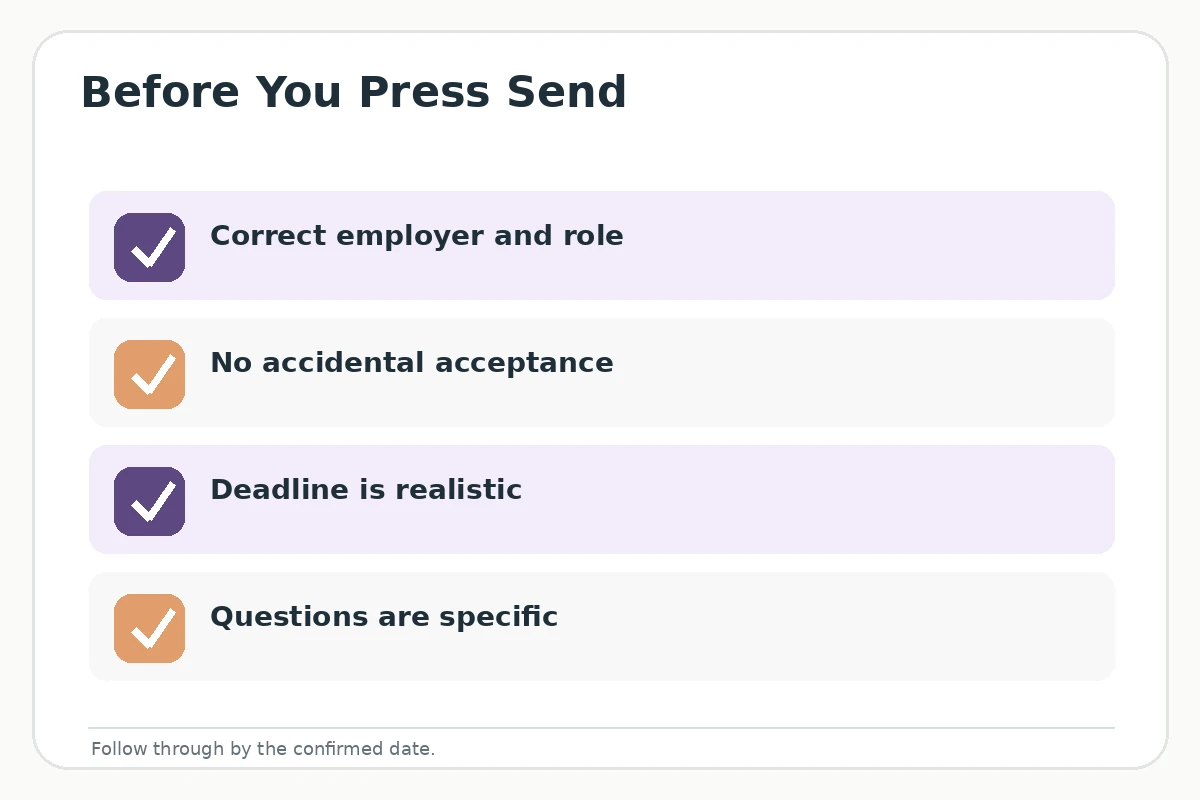
Before sending, compare the recipient’s name, job title, employer name and dates against the actual correspondence. If a previous conversation used an informal title but the official offer uses a different one, choose the confirmed description or ask which is correct. Ensure your response plan is explicit, realistic and respectful of the original deadline. If your email promises a date that passes, update the contact promptly rather than waiting for a reminder. An acknowledgment is useful only when the follow-up happens.
Keep the email short enough to be read quickly, and keep the actual offer record available for your own review. The final editing test is to underline every phrase that might signal a decision. If any such phrase appears when you have not decided, rewrite it. The same care applies if you later choose to accept: switch to direct acceptance wording rather than leaving the recruiter guessing whether “thank you” meant “yes.” Our walkthrough on how to accept an internship offer sets out each step.
How to Check Your Own Offer Details
The example names, roles, dates and messages in this article are hypothetical teaching examples, not real job offers or success stories. Replace every bracket with information from your own current offer. Do not invent a compensation figure, manager contact, employment condition or promised start date. Where signed terms or jurisdiction-specific rights are relevant, review the actual documents and seek a qualified professional rather than treating a public template as legal advice. Our walkthrough on how to email a signed job offer letter clearly and securely sets out each step.
For a final check, compare the recipient, position title, offer version, response deadline and requested next steps against the employer’s latest verified instructions. A helpful phrase in a general career-center guide is not proof that a specific company follows the same process. Keep private records securely, avoid unverified requests for financial data, and make a written statement only when you can defend its accuracy.
How We Research Job Offer Communication
We compared official university guidance for receiving offers and requesting review time, especially the distinction between an initial acknowledgment and a final yes. Boston University provides a sample initial response; Maryland, Minnesota Duluth and Michigan cover deadlines and clarification. The phrase matrix is editorial guidance, not a representation of a particular employer’s communications policy.
Reviewed Sources and Affiliate Disclosure
Public sources reviewed October 20, 2026: Boston University Center for Career Development — Distinguishes verbal from written offers, outlines offer details, and provides an initial reply template.; University of Maryland Career Center — Recommends carefully reviewing an offer, respecting its deadline, and confirming accepted role, start date and key terms.; University of Minnesota Duluth Career Center — Recommends asking for written offer details, reviewing terms and documenting agreed changes.; University of Michigan Career Center — Describes asking for time to consider an offer, discussing uncertainties and reaching clarity before a decision.; UC Berkeley Career Engagement — Discusses expressing appreciation and asking for a specific response deadline before deciding.. These resources describe general professional communication, not private hiring rules, a guarantee of an offer, or a legal conclusion about any signed agreement.
This article does not claim an employer endorsement or an approved affiliate partnership. This guide contains no affiliate links. See the JobAsk affiliate disclosure for site-wide policy.
Related Guides
- Follow-Up Email After a Job Application: Check Status Without Pestering
- Thank You Email After an Interview: Brief, Personal Examples
- Decline a Job Offer by Email: Clear Templates and a Decision Checklist
- How to Accept a Job Offer by Email After Checking the Details
- Questions to Ask Before Accepting a Job Offer and How to Email Them
A thank-you note is not necessarily a final acceptance, but wording and circumstances matter. State clearly that you are reviewing the offer if you have not decided; this is not legal advice.
Yes. Combine sincere appreciation with a specific proposed response date. Treat an extension as pending until the employer agrees.
Avoid that statement if you are still deciding. Say you appreciated meeting the team or learning about the role instead.
Not unless you are asking a targeted clarification. The initial note can simply acknowledge the offer and indicate when you will respond.
Use the organization’s stated acceptance channel and send a clear final confirmation of the role and agreed details; do not assume an earlier acknowledgment completed that step.