
Quick answer: When an interviewer explicitly requests three strengths and three weaknesses, prepare six different claims: three abilities that match the job, each with a brief truthful example, and three genuine areas you are improving, each with a concrete action already begun. Do not turn one habit into six synonyms. This is a method for the six-item question, not a claim that every employer wants six traits. All examples below are hypothetical.
Check What the Interviewer Actually Requested
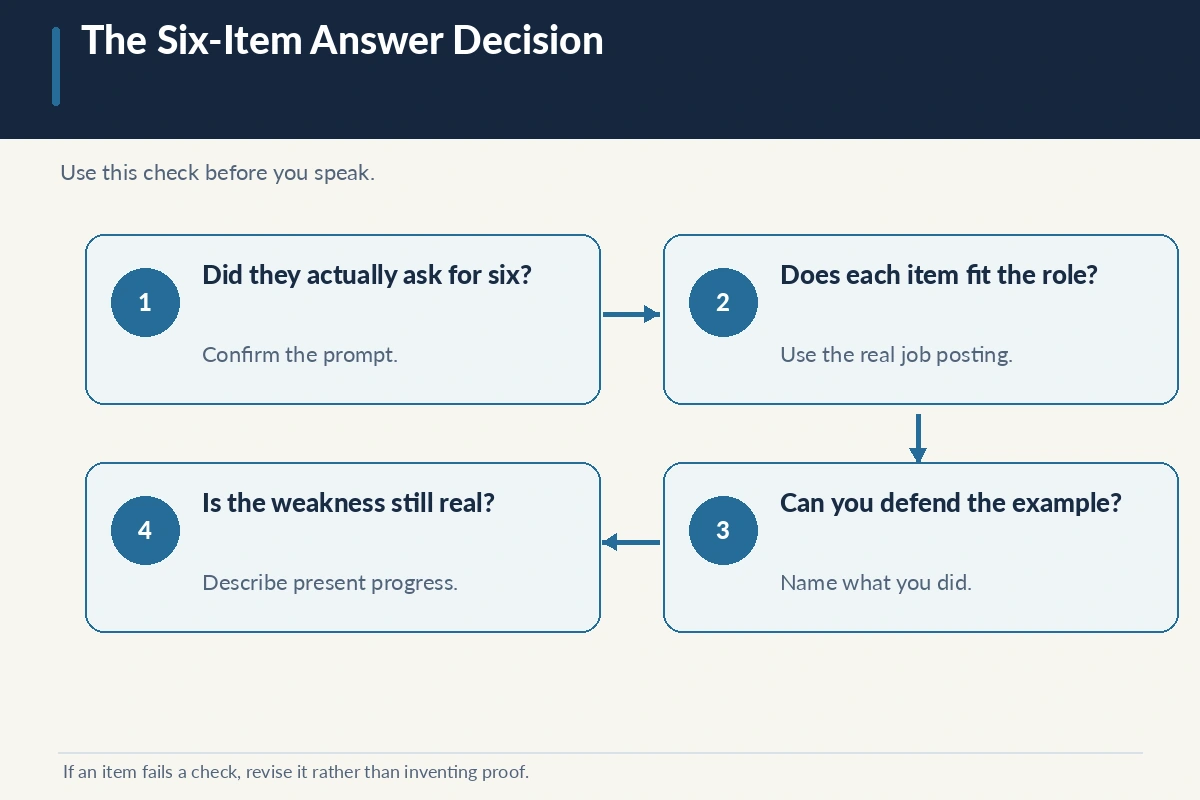
Listen for the number and type of items. “What are your strengths and weaknesses?” might invite one or two of each, while “Name three of each” is a different instruction. Before launching a long memorized answer, confirm if the question was unclear: “Would you like three strengths and three areas I am developing?” Being exact is more useful than burying the interviewer in an inventory of adjectives.
A six-item answer should still prioritize relevance. Read the actual posting and underline work that requires communication, accuracy, teamwork, or another competency. The U.S. Office of Personnel Management describes job-related behavior and defined competencies as important to structured interviews. That is an assessment-design principle, not a promise that an individual employer will score your answer by a particular formula.
Pick Three Strengths That Do Different Work
Avoid choosing “organized,” “detail-oriented,” and “careful” as separate strengths when the same anecdote supports all three. Instead build distinct categories: a technical or task strength, a collaboration strength, and a dependable execution strength. A person applying for office support might draw on document checking, respectful clarification with colleagues, and reliable assignment tracking. All must match their own experience.
Make each proof one real event rather than a sweeping label. A hypothetical student could say, “For a class presentation, I checked the references against the reading list before our group submitted the slides.” If the student only edited formatting, they should not claim they verified the research. Use the NACE competencies as a vocabulary guide, not as achievements to copy into an answer.

Choose Three Real Weaknesses With Separate Repairs
Select three manageable development areas that actually exist for you, do not misrepresent a critical job requirement, and are not three versions of being “too dedicated.” Possible categories include clarifying priorities earlier, making written updates more concise, and becoming more fluent with a specific nonessential feature of a tool. They are options for reflection, not a universal list of acceptable admissions.
For each weakness, write what happened, what you have already tried, and what remains to improve. If you only plan to start a course next week, say it is planned; never convert an intention into completed training. The useful contrast is between “I sometimes struggle with concise notes” and “I review my notes against a three-point outline before sharing them, although I am still practicing.” The second is credible only if true.
Complete a Six-Slot Evidence Worksheet
Create a page with three strength rows and three improvement rows. For strengths, record “role task | ability | witnessed example.” For weaknesses, record “real limitation | current safeguard | observation.” A safeguard could be asking for a second review, using a priority list, or practicing a specific skill; never imply a safeguard eliminated all mistakes when it did not.
Before you rehearse, check two columns: “Can I explain what I personally did?” and “Could the listener ask a follow-up that I can answer?” If the answer is no, remove the claim. Do not use confidential customer, coworker, student, or patient details to make a story sound persuasive. The point of the worksheet is honesty under follow-up pressure, not maximal polish.

Make the Answer Understandable Without Racing
You can offer a brief first pass and invite follow-ups: “My strengths are checking work carefully, organizing handoffs, and explaining a process in simple language. For example…” Give the shortest relevant proof for each. Then mark the weaknesses with their improvements. Pause between the two groups so the listener can distinguish what you do well from what you are learning.
If the interview time is constrained, ask whether the interviewer prefers full examples or a compact summary. Do not infer a standard number of seconds or claim that a particular answer length will impress a hiring panel. In a recorded or written interview, follow the instructions supplied with that assessment. A clear six-point structure helps you adapt without swapping out the facts.
Prepare for Questions About One of the Six
An interviewer may ask, “Which weakness has affected your work recently?” Do not dodge toward the safest-sounding item. Briefly explain the genuine context, your action, and a bounded outcome. The OPM guidance describes situation or task, action, and result as useful components in behavioral questions. It does not require you to perform a scripted STAR recital for every adjective.
Another interviewer may ask whether a strength is actually essential for their particular vacancy. Connect it to an identified responsibility rather than inventing a performance rating. If the experience came from a class project, say “class project.” If another person approved the final decision, give them credit. A precise, limited answer creates fewer contradictions when later examples are requested.
Run a Final Relevance and Honesty Check
Read the six items aloud and flag duplicate meanings, unsupported outcomes, fake transformations, excessive personal disclosures, and abilities that would be central gaps for the target role. Replace them with examples you could explain naturally. You do not need spectacular wins. A documented correction, useful checklist, or more reliable handoff may make a stronger impression than an invented percentage improvement.
Bring a one-page practice card for rehearsal, not a requirement to recite six sentences verbatim. After practicing, reduce each item to keywords so your answer remains conversational. This page specializes in the three plus three format; for the general one-strength/one-weakness framework, see JobAsk’s existing strengths and weaknesses guide.
How We Research and Check Examples
We reviewed OPM structured interview guidance OPM structured interview guidance NACE career-readiness framework on October 28, 2026 and compared this focused question with existing JobAsk strengths-and-weaknesses coverage. The interview examples are original and hypothetical; the sources support general competencies and occupation descriptions, not any invented applicant story or hiring prediction. Career advice is not a substitute for role-specific requirements. Our informational links do not establish paid relationships; see the affiliate disclosure.
More Interview Preparation Guides
- IT Support Interview Strengths and Weaknesses: Triage, Notes, and Escalation
- Nursing Interview Strengths and Weaknesses: Safety, Examples, and Growth
- Internship Interview Strengths and Weaknesses: Projects and Learning
- Teacher Interview Strengths and Weaknesses: Lesson Evidence and Reflection
- Retail Sales Interview Strengths and Weaknesses: Listening and Trust
No. Give six only when the actual prompt asks for three of each. For a shorter question, select the most relevant and support it truthfully.
Yes, if you describe genuinely distinct contributions. Do not claim three capabilities from one event when you cannot point to separate actions.
Yes, if each is authentic and you explain what you have done so far. Do not claim complete improvement without evidence.
Do not misrepresent your ability to do required work. Consider whether you meet the actual requirements and be candid about relevant limits when asked.
Practice keywords and examples rather than performing a rigid speech. Keep facts stable while tailoring the amount of detail to the question.