
A veterinary assistant resume objective should connect the clinic or shelter role you want with animal care tasks you can honestly prove. Lead with actual feeding, cleaning, observation, scheduling or handling experience, and distinguish it from veterinary treatment you have not been trained or authorized to perform. For an entry-level applicant, two focused sentences are stronger than claims about a lifelong passion for animals. The objective is a short promise of relevant support, followed immediately by experience and training details that let the employer check it.
Choose a Clinic-Facing Objective Instead of a Generic Love of Animals
Begin by identifying the setting in the announcement. A companion-animal clinic may emphasize exam-room readiness, boarding records, cleaning protocols and communication with pet owners. An animal shelter may ask for kennel care, behavior observation, adoption support or intake notes. A laboratory animal facility has a different workflow and may require specific training. A useful objective states the setting, one or two credible work activities, and what you are seeking to learn under supervision. The employer does not need a paragraph about how much you love pets.
The first sentence can name the exact position: “Seeking an entry-level veterinary assistant role supporting daily animal care and organized clinic routines.” The second should contain evidence: “Shelter volunteer experience with feeding schedules, sanitation and observation notes; ready to learn clinic-specific procedures under staff direction.” This is a hypothetical example for someone who truly performed those tasks. If you only cared for family pets, use that modest background honestly or emphasize customer service and a relevant course rather than inventing shelter experience.
Translate Shelter, Kennel and Reception Work Into Evidence
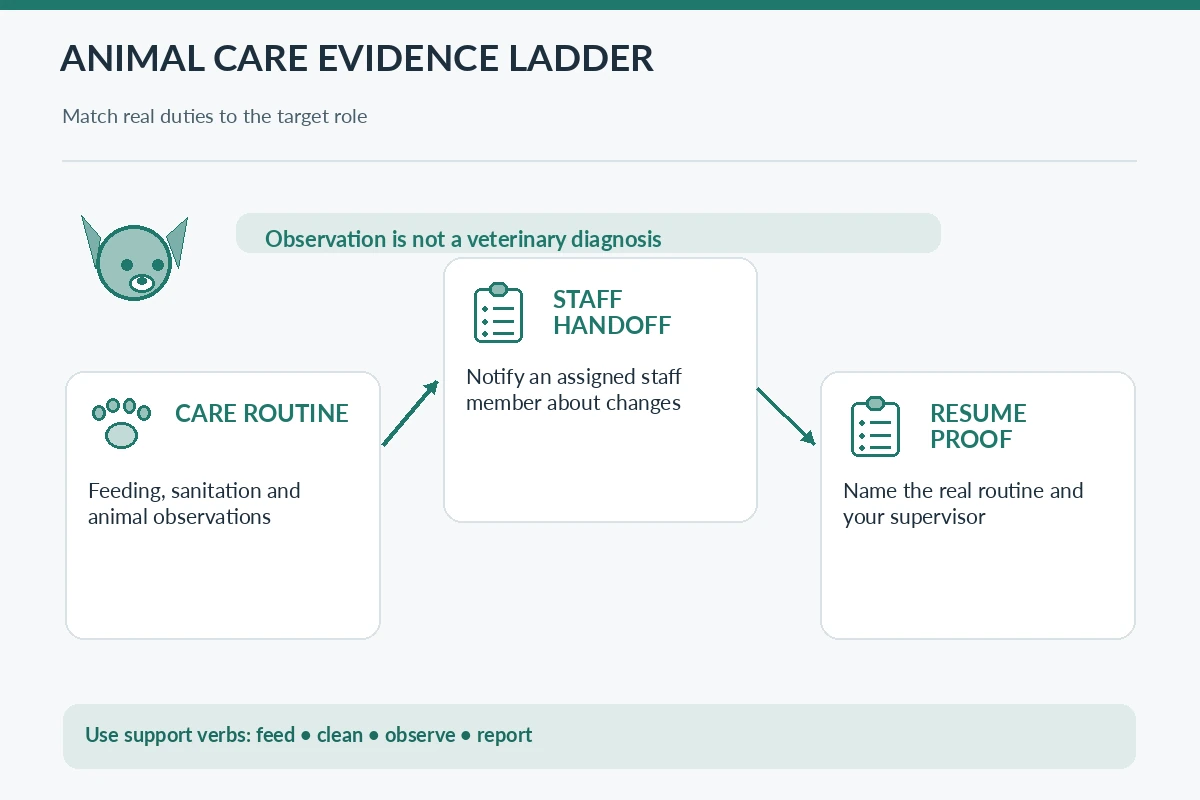
Build an evidence inventory with three columns: activity completed, environment, and proof. Feeding a prescribed shelter diet, recording behavior changes for staff, restocking clean supplies, maintaining kennel schedules, or checking guests in at a boarding facility each provides different evidence. Note dates, frequency, tools used and who supervised the task. The objective should reflect only the strongest two items. Put the details in the Experience section so the employer sees your responsibility instead of an adjective.
For example, a hypothetical applicant might have signed off on sanitation checklists during weekend shelter shifts and notified a coordinator when an animal would not eat. An honest resume bullet could say “Completed assigned feeding and cleaning checklist; reported changes in animal behavior to the shelter coordinator.” Do not rewrite that as “diagnosed illness” or “managed veterinary patients.” Documenting observations is valuable precisely because it respects the difference between support work and clinical judgment. Use that boundary in the objective if the position is a training role.
Describe Clinical Training Without Borrowing a Licensed Scope
O*NET includes varied veterinary assistant duties, but a national occupational description is not a personal license or approval to perform every listed task. What an assistant may do depends on workplace rules, local requirements and supervision. If you completed a course, say “completed coursework in animal handling and infection-control basics” only if you did. If a credential is in progress, identify it accurately and avoid calling yourself certified before issuance. State where practical experience stops and supervised learning starts.
The difference matters particularly for anesthesia, medications, radiographs and specimen collection. Applicants should never claim to prescribe, independently assess or administer treatments without truthful supporting credentials and permitted duties. A safer entry-level objective is “Animal care volunteer seeking supervised veterinary assistant training, offering documented husbandry routines and careful observation.” A candidate with actual clinic experience may mention their verified support duties instead. The objective should not make legal promises about what every state permits.
Make Two Examples Match Different Backgrounds
For a kennel attendant moving toward a clinic, a hypothetical objective is: “Kennel attendant seeking a veterinary assistant position, bringing documented cleaning schedules, animal intake notes and clear handoffs to supervising staff.” For a career changer from retail: “Customer service associate seeking an entry-level veterinary assistant role, offering accurate appointment handling, supply checks and recent animal-care volunteer experience.” Use the second line only if the volunteer work is real. Neither example claims an independent medical role.
A school project may also be legitimate evidence, but use the exact activity: preparing a husbandry presentation is not the same as caring for an animal in a busy clinic. A practical test is to underline every noun and verb in your objective, then locate a resume entry that substantiates each one. Can you show a schedule, describe a cleaning protocol learned on site, or name the supervisor who assigned the task? If not, replace the claim with a smaller truthful one. The recruiter should be able to match the opening to the rest of the page.

Put the Strongest Proof Where It Can Be Checked
After the objective, use Experience, Volunteer Experience, Training and Skills in an order that fits your actual background. If you spent six months volunteering at a rescue, list the organization and dates and describe assigned duties. If the only relevant preparation is a completed class and consistent general customer service, put those facts near the top. Do not insert a fictitious “clinic assistant” job title for informal work. Identify personal pet care as independent care, not employment by a veterinary practice.
Technical keywords should come from the real job description, but only if truthful: kennel sanitation, animal restraint assistance, appointment scheduling, stock rotation and record entry are not interchangeable. If the advertisement asks for experience with a specific veterinary system and you have not used it, do not list it as proficient. You could emphasize transferable documentation and willingness to train. No objective line can substitute for required training, references or an employer’s screening process.
Run a Last Animal-Care Accuracy Review
Read the objective from the viewpoint of a veterinarian or clinic manager. Does it identify the role you want, name a credible care or support strength, and make supervision boundaries clear? Replace vague phrases such as “expert animal healer” with specific actions you truly performed. Check dates, course status, organization names and the spelling of any credential. Never include identifying animal health records or pet-owner details as proof. The goal is a readable claim that will survive normal follow-up questions.
Finally compare the opening to the actual clinic posting. If the job is mostly appointment coordination, a paragraph centered on handling equipment may miss the core duties. If it is shelter care, documentation and humane routines may matter more than office software. Keep the objective to one to three sentences and place credible evidence below it. Tailoring means selecting the relevant truth, not inventing a new professional history for every employer.
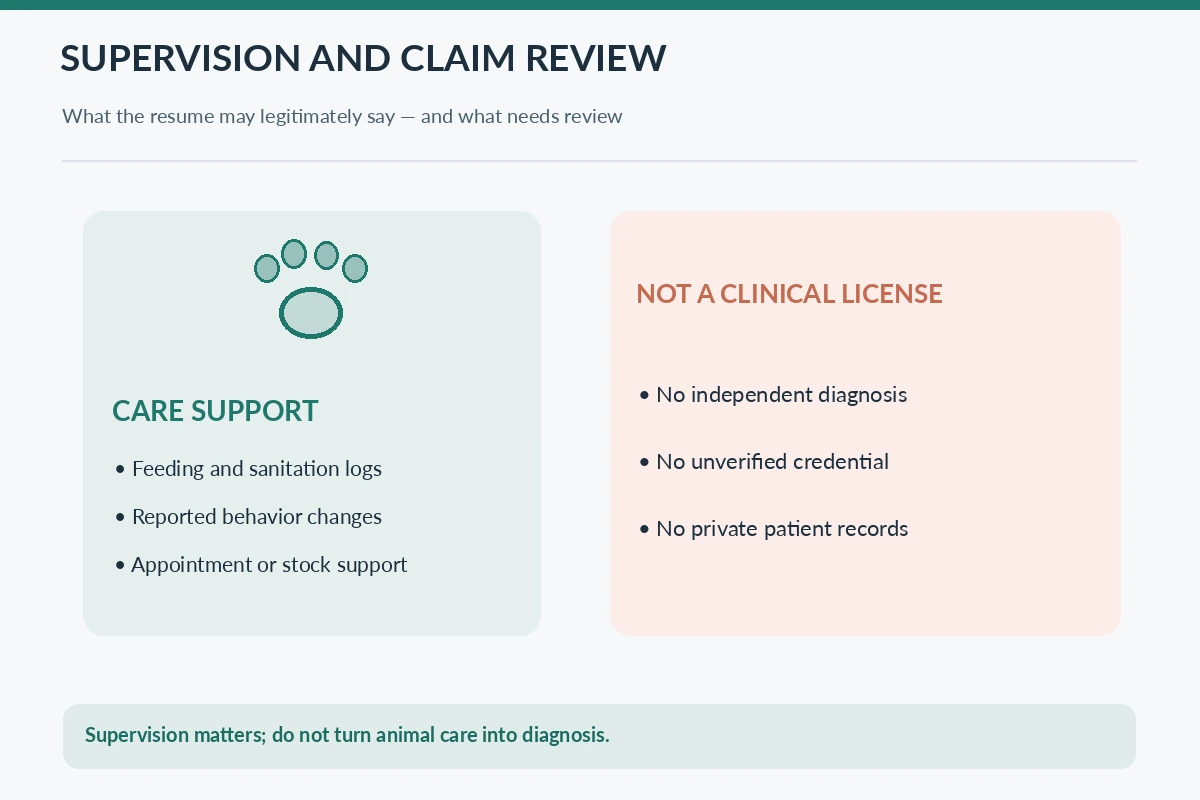
| Activity | Possible evidence | Boundary to confirm |
|---|---|---|
| Shelter care | Assigned routines | Name dates and supervisor |
| Clinic support | Records and supplies | List actual systems |
| Clinical procedures | Training and authorization | Never assume independent scope |
How We Research and Verify These Objectives
We compared CareerOneStop guidance on targeted resume objectives with Harvard resume guidance and occupational descriptions from O*NET and, where relevant, the U.S. Bureau of Labor Statistics. All sample objectives and resume statements here are explicitly hypothetical. They are not employer endorsements, actual candidate results or promises of an interview. Facts and source pages were reviewed on 2026-11-05. Requirements vary by posting, employer and jurisdiction. Please consult the exact vacancy and licensing authority where applicable. Our affiliate disclosure explains the site policy.
Research sources: CareerOneStop resume advice — CareerOneStop explains that a tailored objective may help someone with little direct experience and should highlight actual education, skills, and professional interests.; Harvard resume guidance — Harvard career guidance emphasizes relevant evidence, clear language, accurate action verbs and a readable resume.; O*NET occupation profile — O*NET describes animal care, monitoring, cleaning, records and veterinary-assistant tasks, including work under relevant professional supervision.; BLS occupation guidance — BLS distinguishes veterinary assistants and laboratory animal caretakers from other veterinary occupations and describes supervised support work.. These sources identify common duties and resume principles; they do not certify the accuracy of any individual applicant’s experience.
More Resume and Cover Letter Guides
Yes. Identify the entry-level role and cite actual shelter, kennel, pet-care, coursework or customer-service evidence. Label informal or volunteer work accurately and make supervised learning explicit.
Only if you actually performed authorized duties with suitable training and supervision. Otherwise describe observations, handling assistance or routine care instead of suggesting clinical authority.
It can be if you name the tasks, dates and organizational setting. Feeding, cleaning, notes and staff handoffs are stronger than an unsupported claim that you are excellent with animals.
No. List completed credentials accurately and distinguish training in progress from an awarded qualification. Verify the employer’s stated requirements.
Usually one to three concise sentences. Include the target role, one or two provable strengths and the scope of training you seek, then let the experience section carry details.