
Quick answer: A credible work-from-home data annotation role identifies what you label, which instructions govern the labels, how disagreements are reviewed, and how payment works. Treat vague “optimization” tasks, recruiter-only messaging, and any requirement to deposit money to withdraw earnings as stop signs—not ordinary onboarding.
Start With a Real Labeling Task, Not an Earnings Promise
Data annotation is the deliberate creation or review of labels used in datasets. Depending on the project, a worker may tag objects in an image, identify a category in text, or compare proposed labels with an instruction guide. A real opportunity should describe the material, the annotation tool, the expected output, and who reviews ambiguous cases. An ad that only promises simple clicks and quick returns does not answer the basic question: what information is being made more accurate?
Ask for a sample of the written labeling rules before accepting a large assignment. For example, “mark only the visible traffic sign, not the pole” is an instruction that can be checked. “Make the system rank higher by tapping approve” is not an equivalent data-labeling specification. NIST publishes detailed annotation guidelines for research evaluation; an employer’s actual guide may be different, but it should still make the intended categories and exceptions clear. Do not claim that a NIST document certifies any commercial employer.
Compare the Labeling Workflow and Quality Review
A useful screening question is, “What happens when two reviewers disagree?” Legitimate production work may use calibration samples, a reviewer queue, or escalation to someone responsible for the rules. None of these controls alone proves an offer is genuine, but they reveal whether the organization has a process beyond giving workers arbitrary scores. Ask whether quality results are explained and whether corrections can be submitted through a documented channel.
A hypothetical image task might say: “Draw a box around every visible delivery vehicle; use the ‘partially blocked’ tag if the vehicle is obscured.” The worker should review edge cases and record uncertainty rather than guessing. For text annotation, confirm whether excerpts may contain names or personal details and how those records must be handled. Do not download unknown sample files to a personal device or upload source material to outside tools unless the data owner explicitly authorizes it.

Verify the Employer and Its Hiring Channel
Locate the employer’s own careers page, check the stated legal entity, and compare the recruiter’s address with a verified channel. A third-party staffing firm can be legitimate, but it should identify whom it represents, what job type it is recruiting for, and how candidate data will be used. A logo pasted into a message or a messaging-app profile does not independently verify an organization. Record the posting URL and date so you can compare later instructions with the advertised terms.
The FTC warns that fake remote recruiters may lure people into a task dashboard, show invented earnings, and then demand a deposit before withdrawal. That is materially different from an employer explaining a project fee or an approved invoice process. Never send cryptocurrency, gift cards, or an upfront “unlock” payment to obtain work or access supposed wages. When a task platform has no verifiable owner or contact information, stop before providing identification or bank details.

Read the Pay Method Before Completing a Test
Do not assume that per-item work pays like hourly employment. Request the exact unit of payment, expected review cycle, accepted-versus-rejected item rules, invoice schedule, and any limits on available assignments. If an assessment is required, ask whether it is paid, how long it takes, and what the test data will be used for. A short skill evaluation can be reasonable; a request for days of unrestricted production with no terms is a reason to investigate further.
Build a conservative worksheet with columns for assigned items, completed items, accepted items, review time, and applicable fee terms—without inserting imaginary earning rates. You are comparing the offer’s real conditions, not calculating a promised salary. If an ad says “unlimited work,” ask whether tasks are actually guaranteed, how shortages are handled, and whether you may decline unsuitable data without penalty. Save written conditions before starting.
Show Evidence Without Sharing Restricted Datasets
For an application, a small self-created practice exercise can show attention to consistency. Use a public-domain or otherwise authorized sample and write your own short instruction sheet, then annotate it and explain two ambiguous cases. Label it clearly as an independent practice project. Never present a private client dataset, purchased test answers, or proprietary screenshots as your portfolio; you may be violating confidentiality and misrepresenting ownership.
A truthful resume bullet might read: “Created a practice labeling guide for 30 self-selected public images and documented exception cases.” Use the number only if it is your own verified count. If you have never worked on a paid annotation project, do not invent a platform, quality score, client, or production volume. Hiring teams should be able to distinguish independent skill preparation from actual employment.
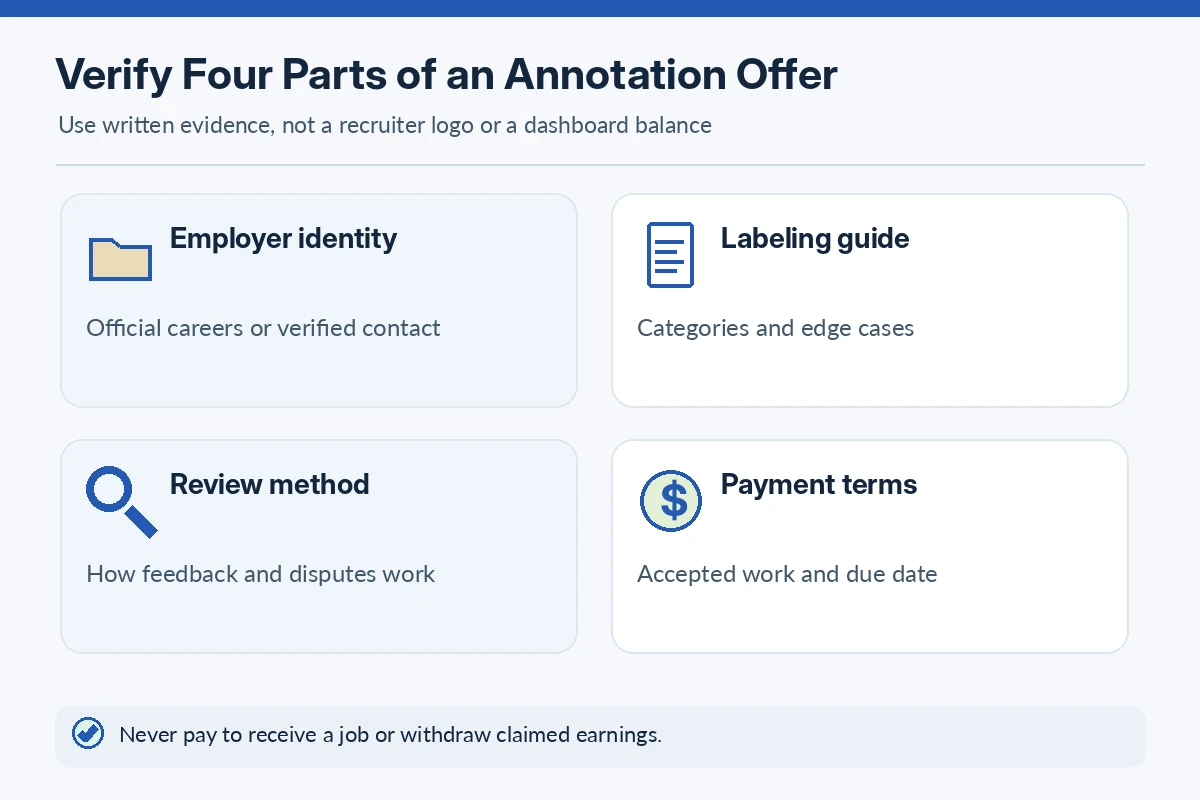
Use a Four-Question Go or No-Go Screen
Before applying, write down four answers: who is hiring, what the deliverable is, what instructions and reviews exist, and when payment is due. If one answer remains uncertain, ask one targeted question and retain the response. If the organization cannot identify itself, the task has no meaningful objective, or you must send money to unlock earnings, do not continue. A vague task name should trigger verification rather than a guess about the role.
After acceptance, keep a private log of agreed deliverables, revisions, and payment records. Follow the organization’s security requirements for any supplied content; avoid saving sensitive records on unapproved personal cloud drives. If a recruiter becomes evasive about data handling or asks you to move payments to unrelated accounts, preserve evidence and reconsider the arrangement. This kind of routine documentation is a practical protection, not a guarantee against fraud.
How We Research and Check Remote Job Claims
How We Research: We checked the primary occupational, institutional and government guidance linked here on October 29, 2026, then compared the article intent with existing JobAsk coverage and the original production plan. These sources explain duties or safeguards; none verifies that a particular vacancy is live, that a third-party recruiter is legitimate, or that a reader will be hired. Illustrative situations in this article are hypothetical. Source 1: www.nist.gov. Source 2: consumer.ftc.gov. Source 3: consumer.ftc.gov. Read our affiliate disclosure for transparency; no paid product recommendation or affiliate partnership is represented here.
Related Job Search Guides
- Overnight Work-From-Home Jobs: Compare Shifts and Coverage Rules
- Work From Home With No Experience: Verify Roles and Build Proof
- Work-From-Home Chat Support Jobs: Verify Text Duties and Shift Requirements
- Part-Time Work From Home: Check Hours, Tasks, and Job Legitimacy
- Work-From-Home Transcription Jobs: Compare Audio Tasks and Pay Terms
Some projects may offer beginner-friendly instructions, but eligibility, training, and quality thresholds are set by each employer. Ask for actual task rules rather than accepting a blanket promise.
No. Annotation assigns defined labels to information. FTC task-scam warnings describe fake earnings for repetitive clicks followed by demands for deposits.
Do not pay a recruiter or platform to unlock employment or withdraw supposed earnings. The FTC identifies these demands as warning signs of scams.
Only when you own or are explicitly authorized to share it. A clearly marked independent practice exercise is safer than disclosing a client dataset.
Ask who writes the labeling guide, how ambiguous items are handled, how feedback is delivered, and how accepted work is counted.