
When asked about working independently, describe how you take an assigned task from a clear goal to a checked result without losing communication or stepping beyond your authority. A strong answer names how you set priorities, tracked progress, checked quality and alerted someone when a decision required permission. Working independently does not mean never asking questions. It means making appropriate progress, keeping the right people informed and recognizing your limits. For interviews, select one real task you handled with minimal day-to-day direction, then explain both what you decided yourself and what you escalated.
Clarify what independent work means in the target role
A remote administrative assistant, a lab technician and a retail stock associate may all work independently, but their decisions differ. The assistant may organize a calendar within agreed rules, while a technician must follow approved methods and report abnormal results. The stock associate may restock assigned locations but not change safety procedures or approve inventory write-offs. Read the job posting for the actual freedom given to the role before you decide which example to tell.
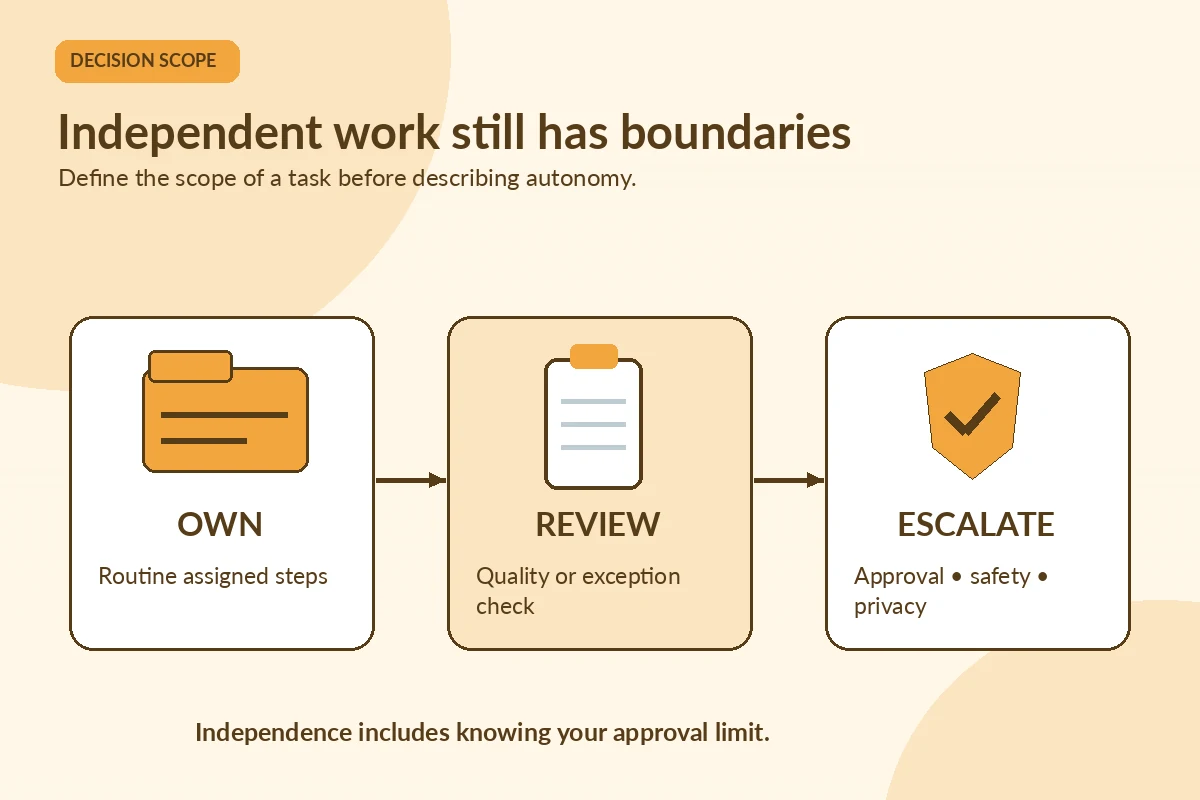
Distinguish three layers: work you can complete alone, work that needs a checkpoint and work that requires explicit authorization. If you do not know where a task falls, that uncertainty itself may warrant a question. NACE’s career-readiness competencies stress initiative as well as appropriate guidance, accountability and sound judgment. Your answer should demonstrate that balance rather than presenting isolation as a virtue.
Use a task-to-checkpoint story that proves ownership
Choose a specific assignment with a deadline, deliverable and defined scope. Describe how you broke the assignment into steps, identified the first risk and communicated expected progress. OPM recommends interview examples that cover situation or task, action and result. For independence, the informative action may be the plan you built or the record you used to self-check—not the number of hours you spent alone at a computer.
Illustrative example: “During a student-organized registration event, I was assigned to reconcile the count sheets. I sorted entries by event period, flagged two unclear fields for the coordinator and checked my totals against the original sheets before handing over the summary.” This scenario is fictional and not an employer outcome. It demonstrates responsibility for a bounded task and a deliberate escalation without pretending to have managed the event or authorized data corrections.
Describe a realistic system for priorities and progress
Start by naming the deliverable and the deadline, then list the few checkpoints that prevent wasted effort. An independent writer might verify source rules before drafting and request an editorial review before publication. An office assistant might confirm instructions, process routine records, and flag exceptions in a shared log. Do not claim that every independent assignment needs the same digital tool; a notebook, checklist or approved workplace system may be enough.
Tell the interviewer what you communicated and when. “I updated my lead when the source information was incomplete and proposed a review time” is more useful than “I never had to bother anyone.” Also avoid claiming you used a specific software platform unless you actually did. The employer can teach a platform; your transferable skill is keeping goals, decisions, questions and completed work visible to the right people.
Show the difference between initiative and unauthorized action
Strong independence includes a stop point. If an invoice has inconsistent details, a junior employee might collect evidence and route it for review rather than changing approved terms. If a customer requests an exception, the employee may explain the next step but not promise an override. If a patient-related task requires licensure or a supervisor’s approval, independent initiative cannot replace that authority. Make this boundary clear in your example.
One useful wording is: “I handle routine steps in the documented process, and I escalate when the situation changes the approval, privacy or safety requirements.” That is practical even for experienced professionals. Independence is not a substitute for training or emergency procedures. If the interviewer gives you a hypothetical scenario, ask clarifying questions before promising a decision outside the stated role.

Answer when you had little supervision but needed help
No one gets every task right without support. A good example may include reaching a point where you lacked information. Explain how you prepared a precise question, what you tried within your scope and how you prevented delay. “I identified the missing order number, checked the approved reference source and sent the discrepancy to the reviewer” shows initiative, not dependence. The goal is to minimize confusion and unnecessary rework.
Do not exaggerate independence by deleting collaborators from the story. You may have set up the task sequence, while a supervisor made the final decision. Say so. This division of responsibility often makes your answer more credible than a claim that you handled everything end to end. If the result was delayed, discuss the actual lesson and the new checkpoint you would introduce next time.
Tailor the independent-work example to early-career candidates
If you have not held paid work, use a course project, volunteering or a personal project that you genuinely completed. Specify who gave the assignment and how success was assessed. A student who scheduled interviews for a class project might explain consent, a clear calendar and a report submitted for instructor feedback. Do not invent real clients, claim institutional approval you did not have or disclose private participants’ details.
For career changers, show how the skill transfers but keep domain differences visible. An experienced retail shift lead may know how to prioritize tasks without constant reminders, yet still need training in a new office’s security or accounting procedures. That combination of confidence and respect for rules is more persuasive than saying you can learn any system instantly or operate without guidance.

Practice four follow-up questions and audit the result
An interviewer may ask how you handle ambiguous instructions, conflicting deadlines, unexpected errors or a manager who is unavailable. Practice a short answer to each: clarify the outcome, prioritize within your authority, record what happened and escalate time-sensitive issues. You do not need a different invented success story for every variation; one real assignment can illustrate several habits if you discuss a different part of the process honestly.
Before the interview, check the chronology: what was assigned, what you personally decided, where you checked your work and who approved the final deliverable. Rehearse aloud until the process is understandable without internal jargon. If a question touches safety, privacy, financial approval or professional scope, make your boundaries explicit. The best independent worker is not invisible; their progress and judgment are easy to trust.
Compare the claim with a concrete example
Use this editorial comparison to distinguish a work-related behavior from a slogan or unsupported promise. The rows are teaching examples, not actual applicant records or hiring results. Replace them with details you can verify from your own tasks, workplace procedures and interview invitation.
| Within your scope | Checkpoint | Escalate when |
|---|---|---|
| Sequence routine steps | Confirm deadline and priorities | Instructions conflict |
| Self-check data or work | Compare against approved source | A discrepancy needs approval |
| Prepare a handoff | Document what was completed | Safety, privacy or access is at issue |
How We Research Common Interview Questions
We consulted the interview, hiring and workplace-competency resources linked below on November 6, 2026; checked the supplied JobAsk WordPress title inventory for overlapping search intent; and reviewed public search results for each topic. The article examples are fictional practice scenarios, not statements about real applicants or employer outcomes. Hiring criteria and job duties differ by employer. See the JobAsk affiliate disclosure.
Primary research and supporting references checked November 6, 2026: www.opm.gov — OPM explains how job-related structured interview questions elicit situation, actions and results.; www.naceweb.org — NACE defines professionalism, teamwork, communication and critical-thinking behaviors relevant to workplace questions.; cloudfront.careeronestop.org — CareerOneStop recommends researching the role, practicing aloud, and drawing on real-life examples..
More Interview Preparation Guides
No. It means moving assigned work forward responsibly, checking what you can, and escalating issues that exceed your information or authority.
Use one completed project and clarify your own role, checkpoints and feedback from an instructor or teammate. Avoid claiming nonexistent clients or results.
Say what you noticed, how you checked or reported it, who approved the correction and what would prevent a repeat.
Avoid an absolute claim. Explain where you can operate autonomously and which reviews, training or approvals remain necessary.
Choose one bounded task, your practical system, a meaningful checkpoint and the real result. Keep enough detail for a follow-up without reciting the entire project.