
For most private-sector U.S. job applications, start with a clear contact header, a relevant skills or experience section, dated positions, and education you can document. Do not automatically carry over a passport photo, birth date, marital status, nationality, or ID number from a CV used in another country. Tufts University and the University of Denver describe those as information U.S. resumes commonly omit. However, the job posting controls required application fields, and an academic CV may serve a different purpose.
Decide whether the employer wants a resume or an academic CV
A job advertisement using the word “resume” generally calls for a targeted history of qualifications for that role, not a full biography. A longer scholarly CV may still be appropriate for research and faculty opportunities. Make the selection from the employer’s written instructions and the actual work being assessed. When an application portal explicitly requests a particular file or structured history, complete that requirement rather than trying to fit everything into a generic document.
A useful way to decide is to write down the position’s three main work activities and ask which items in your history actually demonstrate those activities. For an operations assistant, vendor coordination and record accuracy may matter more than a full list of academic awards. For a research assistantship, methods, presentations, or supervised laboratory experience may be central. Your layout should make that choice visible within seconds, without hiding less relevant but necessary employment dates.
Create a U.S. contact header without sensitive personal identifiers
Place a name, professional email, reliable contact method, and appropriate location information at the top. A professional portfolio or profile link may help if it directly supports the application and is accessible without a login. Avoid inserting passport numbers, family details, national ID numbers or a photograph into the resume solely because they appeared in a document you used abroad. The University of Denver specifically cautions against such sensitive elements in U.S. resume templates.
Do not mistake a resume’s content for a complete explanation of work authorization. A hiring process may ask separate questions about authorization or sponsorship; those questions should be answered truthfully using the employer’s official forms. The resume is not the place to guess at immigration legal requirements or make claims about status you do not have. For case-specific authorization questions, use an appropriate qualified adviser rather than treating a resume template as legal guidance.

Translate unfamiliar institutions instead of changing their identity
Keep the real school name, city or country, degree as awarded and dates. If a U.S. employer may not recognize the institution, add short factual context such as its university status or what subject you studied. Do not silently convert a foreign degree to a U.S. degree, invent an equivalency, or replace the institution with a U.S. school. If credential evaluation is required, refer to the assessment actually provided and the employer’s requested documentation.
For an employer based outside the United States, retain its legal or recognizable public name. A compact explanatory phrase such as “regional consumer-goods distributor” may help a recruiter understand scale, provided it is true. This is better than changing “Operations Coordinator” into “Director” merely because a title sounds unfamiliar. Translate the work into specific verbs and processes, and describe which decisions belonged to a supervisor or another team.
Choose section order based on evidence rather than country of origin
A candidate with recent relevant work usually benefits from putting Experience near the top, while an applicant whose strongest evidence is a recent academic project may put Education and Projects ahead of older unrelated roles. Both structures can be appropriate. Make each section explicit and use dates consistently across all positions. Do not obscure overlapping roles or change dates to produce a neater timeline.
If you have experience in multiple countries, show the location on each entry when it clarifies your history. You can use one date style across the whole resume, for example “Jan 2023 – Aug 2024,” so U.S. readers do not have to interpret ambiguous numeric dates. Be especially careful with month/day conventions when converting records. A blank or shortened date can make a sound career story harder to understand than an accurately labeled overseas role.
Write example bullets that a U.S. reader can interpret
Imagine a hypothetical candidate who coordinated stock reports for a distributor in another country. Instead of “Handled MIS for branches,” a clearer, truthful bullet might read: “Compiled weekly inventory reports for three branch teams, checked missing entries, and sent discrepancies to the operations lead.” The figure and duties must be replaced with the candidate’s real facts. The goal is explanatory language, not a promise that American employers prefer a particular buzzword.
Before finalizing any bullet, ask three questions: What did I personally do? What document, procedure or outcome can I accurately describe? What authority did I actually have? Those questions prevent a translation from becoming an overstatement. If you assisted on a project, write “assisted” and explain the contribution; do not claim to have led the entire project because you translated the original title or used a U.S. job title as inspiration.

Control formatting when converting an old CV file
Begin with one readable column and descriptive headings such as Experience, Education and Skills. Keep consistent indentation, spacing and punctuation. Watch for international CV templates that place critical dates inside decorative sidebars, text boxes, or page backgrounds. Some application processes may struggle with complicated layouts, so review the exported text and the actual final file rather than assuming a template is universally accepted by every applicant tracking system.
Copy the resume into a plain-text view to see whether names, titles and employment dates appear in a logical order, then inspect a PDF or other file type specified by the employer. Confirm every link points to a public portfolio item you are authorized to share. The objective is readability for a person and reliable extraction where applicable; no honest template can guarantee a numerical ATS score, interview invitation, or an employer’s parsing outcome.
Tailor one resume to the U.S. posting without erasing your past
Compare the exact job posting with your truthful duties: customer communication, workflow documentation, analysis, service or tools. Select two or three experiences that show the strongest fit and give them more space. Keep the original employer names and titles and avoid borrowing credential terminology you have not earned. If a technical qualification is required, state whether it has been completed rather than implying pending training is a current certification.
A sample decision: an applicant has one recent internship in the United States and two relevant positions abroad. There is no reason to suppress the overseas roles if they supply the best evidence. A better structure is to describe all three clearly, keep dates intact, and explain uncommon terms only where they could prevent understanding. If the application also asks for a complete job history, supply it in the portal rather than treating a short resume as a substitute.
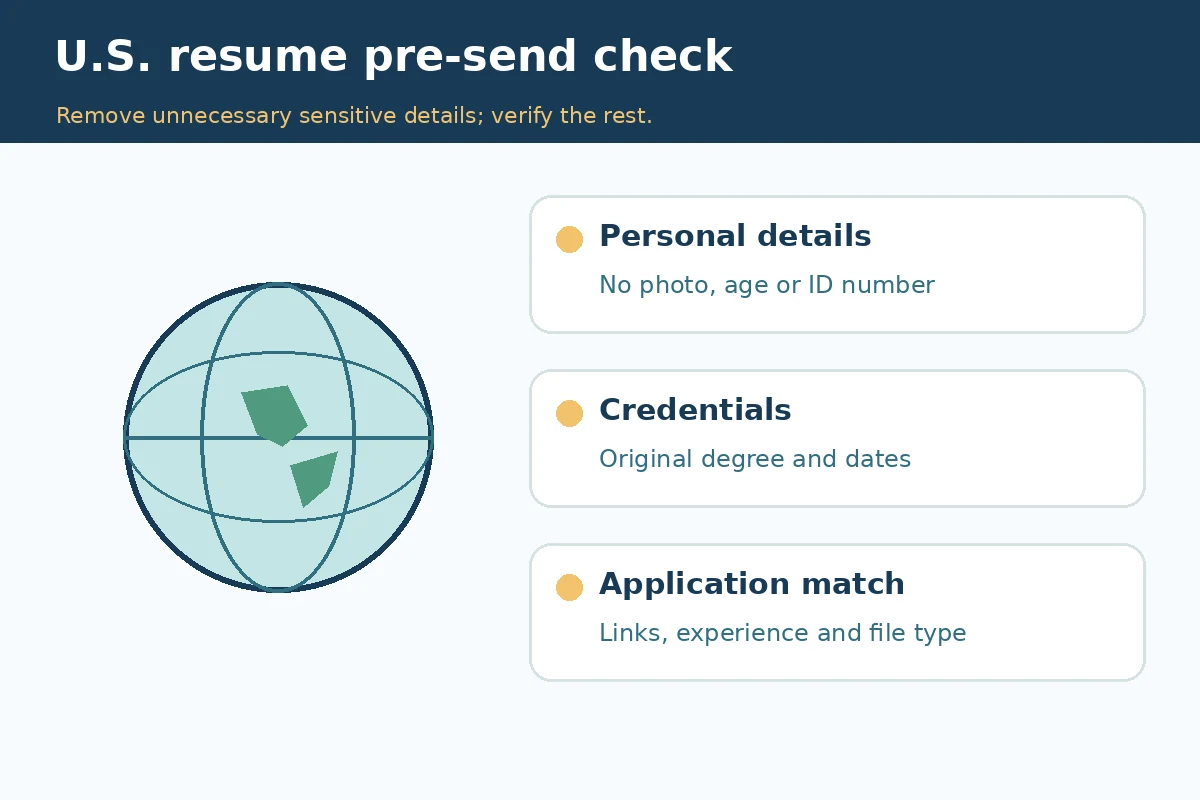
Run a final accuracy and privacy review
Read the employer’s application instructions for file type, page length and any required supporting documents. Check the resume on a small screen and at normal zoom, and send a test copy only through authorized channels. Verify contact details, timezone if relevant for interviews, country-specific phone formatting, degree wording, links and date consistency. Ask a trusted reader unfamiliar with your background what the first half page communicates.
Finally, compare the resume to your actual evidence: contracts, certificates, employer records, project descriptions or supervisor-approved examples. Do not upload confidential client documents as work samples. When details belong in an application form or screening conversation, keep them there rather than forcing them into the resume header. A U.S.-style format should help employers understand you without misrepresenting who employed you, where you studied or what you achieved.
How We Research Resume Format Guidance
This guide compares firsthand university career-center advice and occupational or medical education sources with a reader-facing layout and factual-claim audit. University samples are examples for their audiences, not binding employer requirements. All resume lines and portfolio descriptions above are hypothetical and must be replaced with the applicant’s real credentials, dates and duties. We do not infer hiring decisions, universal applicant-tracking-system outcomes, licensing rules or work authorization from a resume template. Confirm the current application requirements with the employer, school or relevant authority.
Sources reviewed November 10, 2026: careers.tufts.edu (Tufts University explains U.S. resumes normally omit photos and personal demographic details and describe unfamiliar institutions in context.) career.du.edu (The University of Denver offers U.S. resume guidance for international students, including clear layout and personal-data cautions.) careercenter.georgetown.edu (Georgetown career guidance recommends consistent concise formatting, verified descriptions, and a document tailored to the posting.). These sources explain the recommended format and occupational scope, not an individual employer’s application process or result. Review our affiliate disclosure. This informational guide does not imply paid endorsement or approved affiliate partnerships.
More Resume and Cover Letter Guides
Usually not for typical U.S. private-sector applications. University career advisers commonly recommend leaving out the photograph and unrelated personal details; follow any legitimate, role-specific application instructions.
For many U.S. employers the terms may imply different documents. Read the posting; academic and medical CVs can be longer and more comprehensive than a targeted job resume.
Explain the work in familiar terms but do not promote yourself by changing your actual position. Preserve a truthful title or provide a clearly identified explanatory translation.
Use the real institution, qualification and graduation information. If a credential evaluation is required, provide an evaluation you actually obtained rather than assuming equivalency.
No. Answer authorization questions accurately through the employer’s authorized process. A resume template does not determine immigration eligibility or replace individual advice.