
Quick answer. Include the role and employer you are applying to, a genuine reason for interest, one or two relevant examples that demonstrate fit, accurate contact information, and a professional closing. Keep the substance specific and true. A cover letter should add context to your resume rather than simply turn its bullet points into sentences. All sample applicants, roles and outcomes below are hypothetical unless explicitly identified as general guidance; no letter guarantees hiring.
Start With the Role and Why It Fits Your Interests
Your opening should identify the actual role, the organization and the reason you are writing. If the listing has a reference number that the application asks you to include, reproduce it accurately. State one specific point of interest that you can connect to the work, such as a named responsibility in the posting or a publicly described service of the employer. Avoid praising a company for an award, program or culture you have not verified. Your enthusiasm should be plausible and related to the advertised position, not a paragraph of vague compliments that could be sent to any organization.
For a conventional letter, include an accurate name, email address and usable phone number in the heading or signature as appropriate for the submission method. A full home address is not always necessary; follow the employer’s instructions and share only information that helps them identify or contact you. CareerOneStop and UC Davis outline common letter sections, while also giving different examples of layout. This page is about deciding what each section should communicate; for detailed margins and document styling, keep the separate JobAsk cover-letter format guide distinct. If you want the full process, read how to address a cover letter without a name.
Choose Two Job Requirements You Can Demonstrate
Highlight the job posting’s most important duties or qualifications. Make a small list of requirements you can back up with evidence from employment, coursework, volunteering, training or projects. Pick one or two that matter to the role. A cover letter is generally too short to explain every line of a posting, and claiming to meet requirements you do not actually have undermines the rest of the message. If you lack a specific qualification, do not imply that experience in a loosely related activity gives you a credential. Explain the applicable experience honestly and let the employer assess the fit.
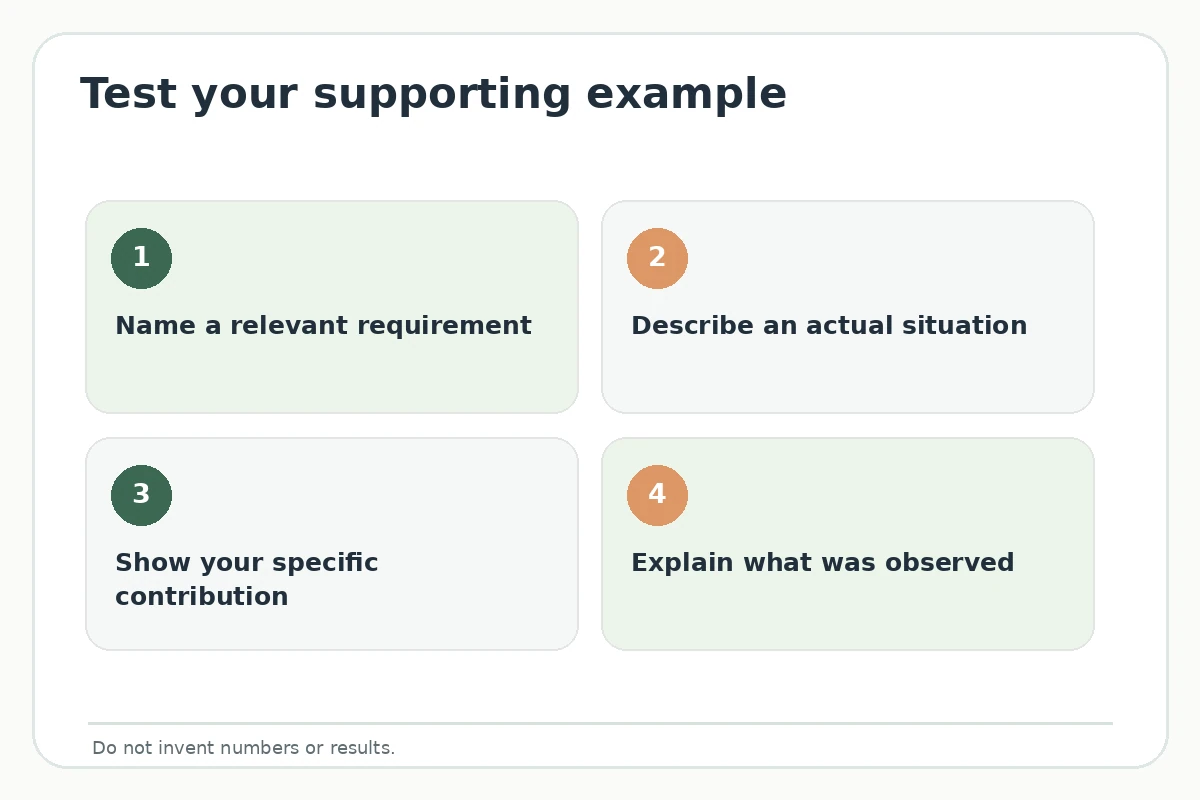
A useful paragraph combines a requirement, a real situation, what you personally did and what can be observed about the result. For example, a scheduling requirement might be supported by a school event you coordinated, but you must label it as school activity rather than professional office experience. Penn Career Services and Notre Dame both emphasize telling a brief, position-specific story that illustrates relevant skills. Merely writing “I am organized and detail-oriented” is not the same as explaining how you organized information in an actual task. Choose the example whose relevance needs the least speculative interpretation.

Explain the Context Your Resume Leaves Out
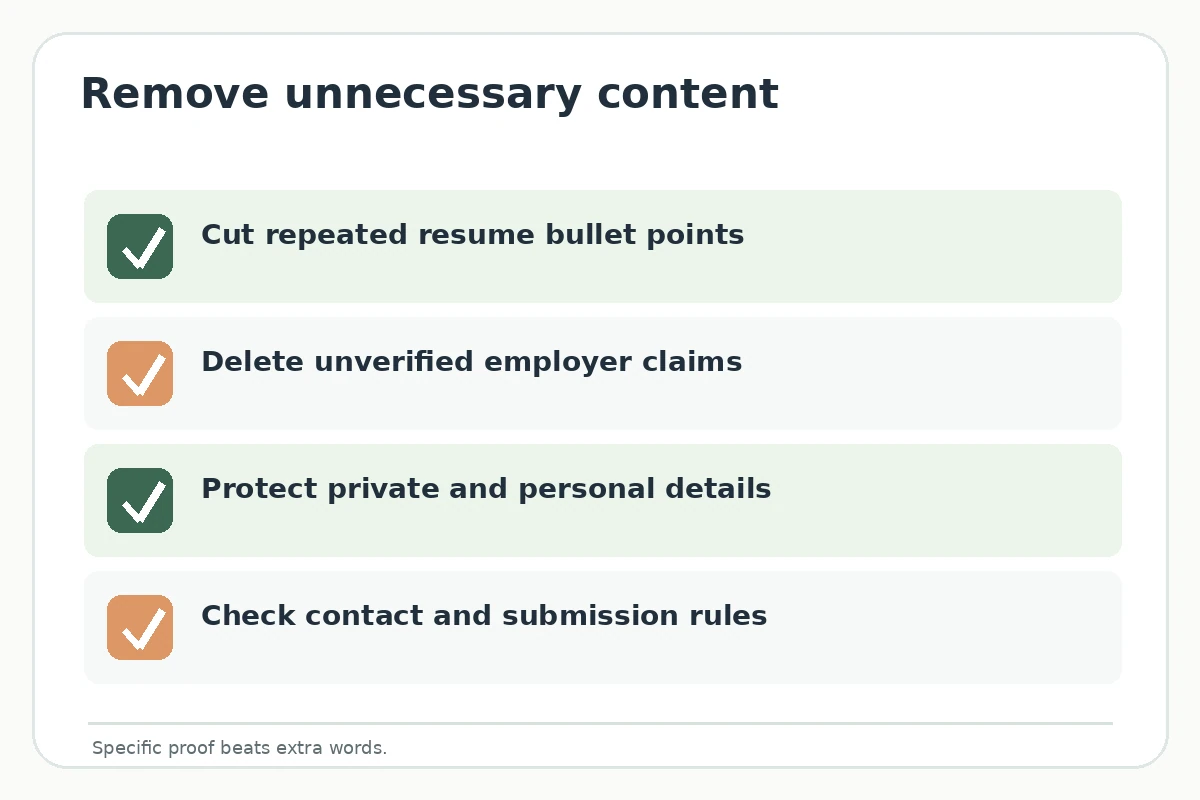
Your resume lists roles, dates and results in compact form. Your cover letter may explain why one particular project prepares you for this job, why the employer’s work interests you, or how a transition connects two kinds of experience. Do not reproduce three resume bullets verbatim. Expand one relevant achievement into a short explanation of your decision or contribution. Stay within information you are comfortable sharing; avoid exposing private customer records, coworkers’ personal data, internal business materials or unapproved client details. If a result has no precise metric, an accurate descriptive outcome is sufficient. Our part-time job cover letter guide adds more detail on this.
Hypothetical comparison: resume bullet: “Coordinated volunteer event check-in.” Cover letter evidence: “While helping coordinate a community event, I noticed visitors were receiving inconsistent directions. I created a single check-in list and confirmed it with the volunteer lead so our team could use the same process.” This fictional example illustrates context, action and collaboration without claiming a measured improvement or a hiring outcome. A real applicant should only use similar wording if those actions occurred. The purpose is to add a relevant explanation, not to turn an ordinary activity into a fabricated business success. Our walkthrough on how to tailor a cover letter to a job posting without copying it sets out each step.
Include a Real Connection and a Simple Closing
Explain why this employer and role are relevant to your goals, using a verifiable feature such as its stated service area or the responsibilities in the posted description. Then close with appreciation for the reader’s consideration and readiness to discuss your relevant experience. Do not promise that you will definitely call or visit unless doing so is appropriate and consistent with instructions. A plain “Thank you for considering my application. I would welcome the opportunity to discuss how my experience fits the role” is enough when true to your intentions.
Keep the relationship between content and format clear. An attached letter may need a greeting, date and conventional closing, whereas an email-body application can place contact information in the signature. The University of Texas at Austin advises a different layout when a letter is submitted within an email rather than as a standalone document. Follow the submission method required by the employer; do not add unrelated attachments or repeat the same message in multiple fields unless instructed. The content checklist is complete only after you confirm the portal’s actual requests.
| Content element | Include when | Exclude or revise when |
|---|---|---|
| Role and employer | Confirmed from posting | Copied from another application |
| Specific contribution | Supported by real example | Only a vague personal adjective |
| Interest in employer | Grounded in verified information | Unverified praise or promises |
| Contact and closing | Accurate and useful | Excess personal information |
Remove Claims That Do Not Help the Reader Decide
Read each sentence and ask what question it answers: why this role, which requirement, what evidence, or what next step? Delete filler such as “I am the perfect candidate” unless you replace it with a supported explanation of fit. Remove personal information the employer has not asked for, generic slogans, fabricated statistics and guesses about its internal systems. Never imply an organization has offered you a job or that a cover letter passes a proprietary screening test. Our internal position cover letter guide adds more detail on this.
Finally, check that the letter is readable in the employer’s requested format and that contact information matches your resume. Do not confuse more content with stronger content: CareerOneStop describes concise cover letters and Penn recommends a brief nonacademic document. A one-page target is a general convention, not permission to shrink the text until it is hard to read. The final test is whether a stranger can identify the role you seek and understand two credible reasons you could contribute, without needing to decode unnecessary filler. Our walkthrough on how to end a cover letter with a clear, professional closing sets out each step.
How to Check the Letter for Accuracy
Every example in this article is hypothetical. It is not a real applicant success story, a quote from a recruiter, a hiring result, or proof of what any employer privately rewards. Replace fictional roles, experience and outcomes with your own facts. Do not publish employer-confidential information, invent impact percentages or claim a certification you have not earned. Application instructions and relevant eligibility requirements override generic templates.
A final review should check the organization, exact opening, personal dates, duties described, contact details and claims of experience. Ask a trusted reader to identify the strongest role-to-evidence connection. If a statement could not be explained in an interview, revise it. Neither a source checklist nor a document-format validation substitutes for reviewing your actual application and the employer’s current instructions.
How We Research Cover Letters
Compared public searches for cover-letter components against official CareerOneStop guidance, Penn and UC Davis sections, and Notre Dame/UT Austin advice. This is a content-selection audit, distinct from the previously queued cover-letter format and opening/closing pages.
Reviewed Sources and Affiliate Disclosure
Public sources reviewed October 20, 2026: CareerOneStop, U.S. Department of Labor — Explains when a cover letter may be relevant and how to organize a heading, greeting, introduction, specific evidence and closing; suggests a job-title recipient when a name is not available.; University of Pennsylvania Career Services — Recommends a role-specific letter with relevant examples, accurate contact details and a respectful greeting such as Dear Hiring Committee where the contact is unknown.; UC Davis Internship and Career Center — Describes the difference between a resume and a cover letter and lists sections including contact information, greeting and role-specific evidence.; University of Notre Dame Undergraduate Career Services — Explains that the cover letter bridges resume facts and job requirements, and emphasizes specific rather than generic writing.; University of Texas at Austin College of Natural Sciences Career Services — Distinguishes email-body cover letters from attached letters and advises following the submission instructions and avoiding exaggerated claims.. These pages support general cover-letter writing conventions; they do not document a particular employer’s private assessment, a promise of advancement, or the fictional teaching examples here.
This article does not claim an approved affiliate partnership, paid employer endorsement or a verified job placement. Reference links are informational and are not affiliate referral URLs. See the JobAsk affiliate disclosure for the site-wide policy.
More Resume and Cover Letter Guides
- Short Cover Letter Examples: Keep the Job Match Without Empty Filler
- How to Start a Cover Letter with a Specific, Credible Opening
- Social Media Marketing Cover Letter: Connect Content to Evidence
- Awards and Achievements on a Resume: What to Include and Where
- Resume Sections: Choose What to Include and What to Move Up
No. It should select relevant facts and add context about how those experiences connect to the role.
Usually yes when applying to a specific employer; make sure it is the correct name for this application.
Only when the employer expressly requests that information, and follow the exact instructions.
Yes, when relevant, honestly described and not misrepresented as paid professional experience.
One or two specific and well-chosen examples often make the letter clearer than a long list of unsupported claims.