
An architecture graduate resume should establish what kind of design work you can contribute now. Put your official degree and graduation status in clear view, then summarize studio or internship work through specific drawings, models, research, and documentation. Link each promising project to a portfolio case study that shows your role, not only a beautiful final rendering. An architecture degree does not automatically make a person a licensed architect in the United States; professional titles and experience claims must match the individual’s actual status and the rules of the relevant jurisdiction.
The following examples are hypothetical writing models, not a record of any actual applicant. Replace tools, roles, dates, outputs, awards, and measurements with evidence from your own coursework or employment. Never use a credential, title, or result that you cannot explain and verify.
Identify the role before choosing a project
Some entry-level architecture listings emphasize production drawings and BIM coordination; others ask for conceptual modeling, site analysis, material research, or presentation support. Read the specific responsibilities, then rank your projects by the work you can defend. An appealing studio concept should not lead your resume merely because it has the most polished image if another project better demonstrates coordination and detailed documentation. Write a one-line project inventory: setting, problem, tools you operated, files you produced, feedback you received, and which parts were completed by teammates.
State your degree without implying registration
Use the school’s official name for your degree, such as Bachelor of Architecture or Master of Architecture, only when it accurately matches the award. Say “expected” with the date if it is not finished. A portfolio section titled “Selected Architecture Projects” or an experience entry for an “Architectural Design Intern” may describe your genuine study or job role; do not substitute “Licensed Architect” or claim signing authority without that credential. NCARB and state boards distinguish education, supervised experience, examinations, and registration; check your jurisdiction when describing licensure progress.
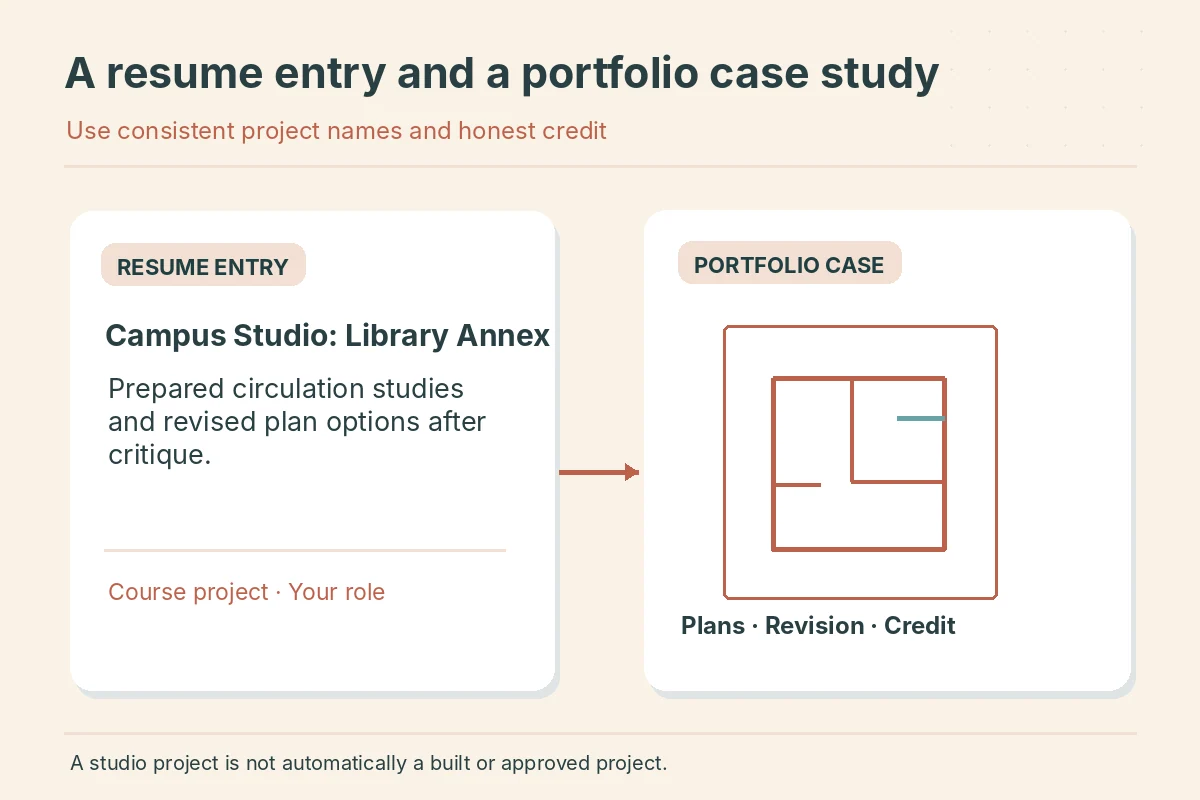
Convert studio work into a useful resume entry
A studio case study has many components: brief, program, site constraints, alternatives, drawings, reviews, and revisions. Two resume bullets should extract the most relevant activities rather than repeat the entire narrative. For example, a hypothetical graduate might say, “Developed two model iterations for a campus adaptive-reuse studio and revised circulation diagrams after critique.” Use the actual number only when supported by the files. If a professor or teammate determined the final design, state your involvement precisely rather than saying you independently approved a building scheme.
Connect the portfolio link to the correct artifact
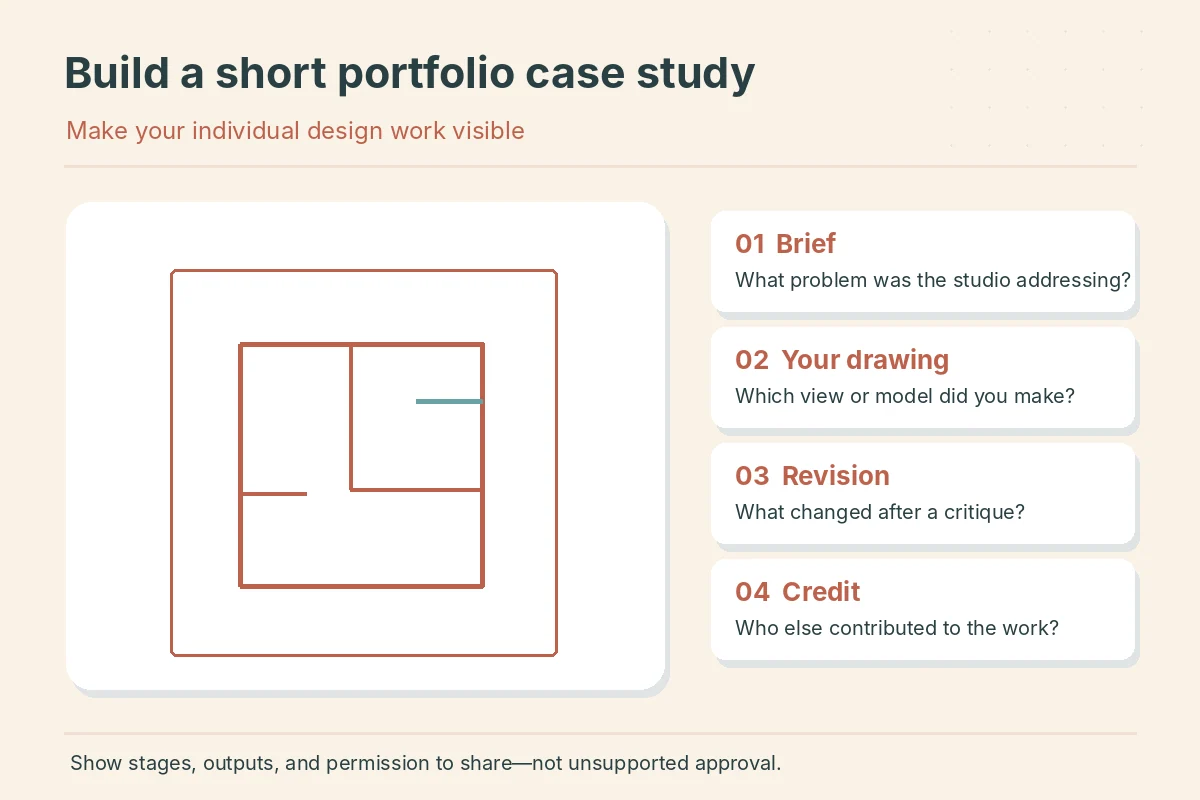
Use a stable portfolio link near your contact details and, when useful, a short project name that matches the portfolio contents. Each case study can show a site diagram, an annotated plan, a model photograph, or a materials study, with clear captions about the stage and your role. A studio critique is not a client approval, and an academic building proposal is not a constructed project. If a firm’s work appears in your portfolio, follow the firm’s permission and confidentiality requirements; do not publish protected plans merely because you helped prepare them.
| Portfolio artifact | Resume evidence | Important boundary |
|---|---|---|
| Site analysis diagrams | Mapped access and documented constraints | Not an approved site plan |
| Studio model | Built study model for critique | Not a constructed building |
| Internship drawings | Revised sheets under staff review | Not licensed sign-off |

Describe drawings and software by actual use
Architectural software skills matter when linked to output: producing elevations in a drafting program, organizing model views, preparing a presentation board, or examining options in a parametric study. An introductory course alone does not establish professional fluency. Distinguish the program you used directly from a workflow you observed. If you label a file “construction documents,” make sure the phrase correctly reflects the work stage and your position; student drawing sets usually should be described as academic documentation, not signed documents ready for permits.
Separate internship activity from AXP reporting
If you worked under an architect or in an adjacent design role, provide the employer, position, dates, and tasks you actually did. Qualifying experience for the Architectural Experience Program is subject to NCARB setting, reporting, and supervision rules; a resume bullet is not itself an approved experience record. Do not translate time spent on a course studio into formal AXP hours without verifying eligibility. The most useful employment bullet shows a real task, such as revising a drawing after review, and names the handoff without suggesting the student carried professional signing authority.
Use early roles and non-design work strategically
A graduate may have a campus shop job, community design competition, exhibit installation, or customer-service role in addition to studio projects. Those experiences can demonstrate careful specifications, handling materials, feedback, or coordination. Keep only what improves fit for the application. Membership in a student architecture group is not the same as leading an event; name what you scheduled, built, or presented. If the job requests a separate portfolio PDF, follow its size and file naming instructions rather than attaching an oversized board collection without invitation.
Two realistic before-and-after bullet examples
These examples illustrate a change in precision, not a claim about any real applicant. Do not paste the improved version unless the action, context, and scope match work you completed.
Before: Designed a commercial building. After: Prepared circulation studies for an academic mixed-use studio and revised two diagram sets after critique.
Before: Approved architectural construction documents. After: Updated drawing views for senior staff review during a supervised office placement.
Check print clarity and professional boundaries
Read the one-page resume beside the portfolio on a normal laptop: project names, dates, location, tool names, and contributions should match. Drawings must be legible at their presentation size and should include useful credit where appropriate. Use a simple resume layout rather than treating the resume as another elaborate studio board. Before applying, verify the recruiting organization, review the state licensure language if you discuss it, and open the portfolio link in a private window. That check is more valuable than claims of being guaranteed to pass a screening system.
How We Research and Verify Examples
We reviewed BLS occupational guidance and NCARB experience requirements alongside university resume practices. Studio and internship examples are hypothetical, and licensure details need local board confirmation.
Primary sources used in this guide: www.bls.gov — BLS describes the work, education and supervised training involved in architecture and identifies licensure requirements.; www.ncarb.org — NCARB sets documented experience and supervisor requirements and notes jurisdiction-specific rules.; careerservices.upenn.edu — Penn resume guidance supports concise, role-relevant work examples, exact degree names, and portfolio links.. Source pages were reviewed on November 15, 2026.
JobAsk explains its approach to commercial relationships and reader trust in its affiliate disclosure. This is independent career information, not a placement guarantee or a claim of affiliate approval.
More Resume and Cover Letter Guides
Architect is a regulated professional title in U.S. jurisdictions. Describe the real academic qualification and role; check the relevant board before using a title that implies licensure.
Yes, when the application welcomes it and your case studies are accessible. Show the work and credit that belong to you, including how each project was reviewed.
They count as meaningful academic projects, not as paid firm employment. Label the project context honestly.
Do not assume academic studio time automatically qualifies. NCARB rules and supervised experience settings govern what may be reported.
Choose a small relevant selection that demonstrates different skills and can be explained clearly; follow any employer-specific portfolio instructions.