
A graduate certificate belongs on a U.S. resume when it is relevant to the job and accurately identifies what your school awarded. Write the official certificate name, the university or college, and a verified completion date; do not rename it as a master’s degree. If you are still enrolled, label the program in progress and use an expected completion date only when supported by your school’s plan. Placement in Education or Certifications depends on the job description and the document’s purpose—not on a universal rule that one heading is always correct.
Confirm exactly what the certificate represents
Begin with the academic record or formal award notice, not with a marketing description on a program page. A graduate certificate can contain graduate-level coursework without granting a graduate degree. Some programs are credit-bearing; others are noncredit professional education. Copy the issuer’s name, official award title, and completion status. Do not use “Master of” or initials such as M.S. unless a separate degree was actually conferred. If your college awards an institutional certificate rather than a professional license, keep those distinctions visible so a recruiter can verify the qualification.
Check the job posting for the actual education threshold. A completed certificate may demonstrate additional study, but it generally does not substitute automatically for a required degree. For a regulated role, an employer or licensing board may need other records. An applicant who took three graduate courses and stopped before finishing should not list the completed certificate; they can instead describe documented coursework if it is relevant. If an institution later changes the program name, use the title on your record and explain the newer label only if doing so prevents confusion.

Choose Education or Certifications using the reader’s question
Use Education when the certificate is awarded by a college, carries a defined academic curriculum, and explains your recent educational preparation. A job seeker switching from operations to analytics might put a completed university graduate certificate above older unrelated coursework. Use Certifications or Professional Development when a short credential should sit beside licenses and provider-issued qualifications. The heading is an organizational choice; the reader still needs the exact issuer and the award. Avoid burying a job-critical certificate inside a crowded skills list without any verification details.
Imagine two applicants: one has a completed graduate certificate in applied statistics from a university; the other completed an employer workshop on dashboard design. Those may both be useful, but they are not the same kind of award. The first can appear under Education with a program title and conferral month. The second fits better under Training or Professional Development. If you hold both a bachelor’s degree and a later graduate certificate, do not merge them into a fictional combined degree. Give each its own line so education checks can match institutional records.

Write a compact entry that can be verified
A hypothetical completed entry reads: “Graduate Certificate in Applied Data Analysis — Example State University, City, ST | Completed May 2026.” A separate line might say “Relevant study: data visualization, experimental design, and quality checks,” but only if those topics appear in your actual coursework. The example school is fictional and the date is illustrative, not an institution to cite. An in-progress version could read “Graduate Certificate in Project Analytics — Example University | In progress; expected December 2027.” If the anticipated date is uncertain, remove it rather than pretending to know it.
Keep degree abbreviations and award status clear across your resume, application form, and professional profile. If the applicant tracking form asks for highest completed degree, answer based on degrees actually earned and use a separate field for the certificate when available. Do not select a master’s degree solely because the certificate involved graduate-level coursework. If the portal has no suitable field, include the certificate in your resume file and follow the employer’s documented instructions for supplementary qualifications. Your entry should remain truthful without needing a recruiter to interpret promotional wording.
Link academic learning to one real piece of evidence
One or two applied examples can make the certificate useful beyond its title. Describe a capstone, case study, project, or supervised assessment that you actually completed and are permitted to disclose. A truthful project statement might be: “Compared two forecasting methods on a provided class dataset and documented assumptions.” Do not claim that the project improved an employer’s revenue or saved money unless that outcome was real and measurable. If the certificate covered several unrelated modules, choose only the ones connected to the vacancy rather than filling half a page with course names.
Show exactly which tools you used and what your role was. “Reviewed sample records for missing fields” means something different from “approved production reports.” For a compliance-oriented certificate, be especially careful to distinguish instruction about a regulated procedure from permission to perform it independently. You can make your evidence stronger by naming the problem, the method, and the review step, without fabricating percentages or clients. When project details are confidential or include other students’ records, describe a generic process or create a new fictional example for a portfolio.
| Check | What to verify |
|---|---|
| Award type | Graduate certificate, not a degree |
| Issuer | Awarding school or official provider |
| Status | Completed vs. in progress |
| Proof | Institutional record and relevant work |
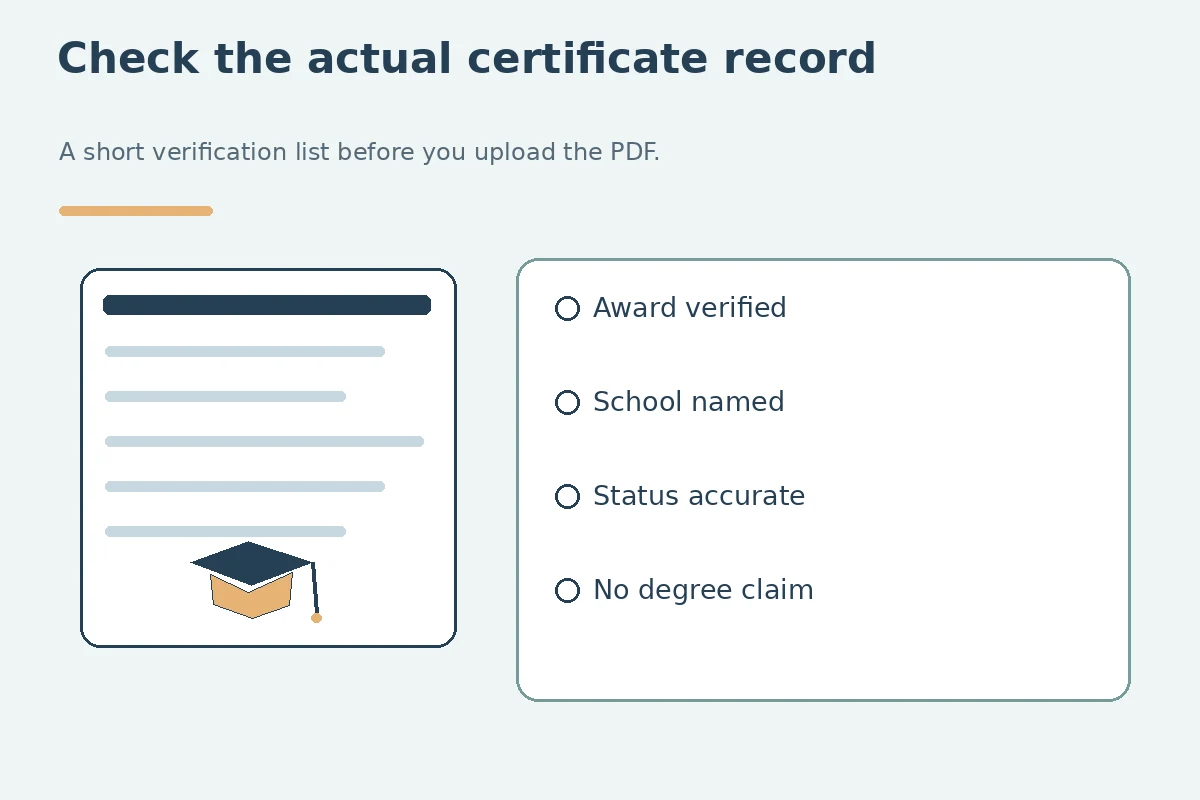
Check the final submission against official records
Before sending, compare the resume entry with your completion letter and transcript. Verify spelling, school location, graduation month, and whether the certificate was awarded by the university or by a separate continuing education provider. An education-verification service may contact the awarding body; a small mismatch can slow the process. In federal applications, separate transcript requirements can apply when education is used to establish qualifications. NIST illustrates that a diploma or resume statement by itself may be insufficient when a vacancy specifically requires transcripts. Follow the specific announcement rather than treating that rule as universal for private employers.
Finally, preview the PDF and the online application. Keep the certificate label next to its issuer, avoid a page break between the two lines, and remove old “expected” wording once the award is completed. A working checklist is: official title, issuing institution, accurate status, supporting date, optional relevant courses, and consistency with the application. If a recruiter asks whether the certificate is a degree, respond plainly: it is a graduate certificate, and any other degree you hold is listed separately. Clarity is more persuasive than a larger-sounding but incorrect credential.
How We Research Resume Education Guidance
We compared U.S. career-center guidance on resume education and professional or government requirements relevant to this specific topic. Sources reviewed: Cos; American; Princeton; NIST. Examples and institutions identified as illustrative are fictional; no candidate, school, employer decision, or hiring outcome is asserted. Always verify actual records and role-specific conditions before submitting an application. Review our affiliate disclosure. This article does not claim a paid referral or partnership.
More Resume and Cover Letter Guides
No. Graduate-level coursework does not by itself confer a master’s degree; use the award title shown by the institution.
Yes, when it is recent and highly relevant, provided each entry remains clearly labeled.
Describe the ongoing program as in progress if enrolled; do not claim the certificate was awarded.
Usually not. Select a small number directly connected to the target job and actually completed.
Only when an employer or application instructions require it; follow role-specific documentation requirements.