
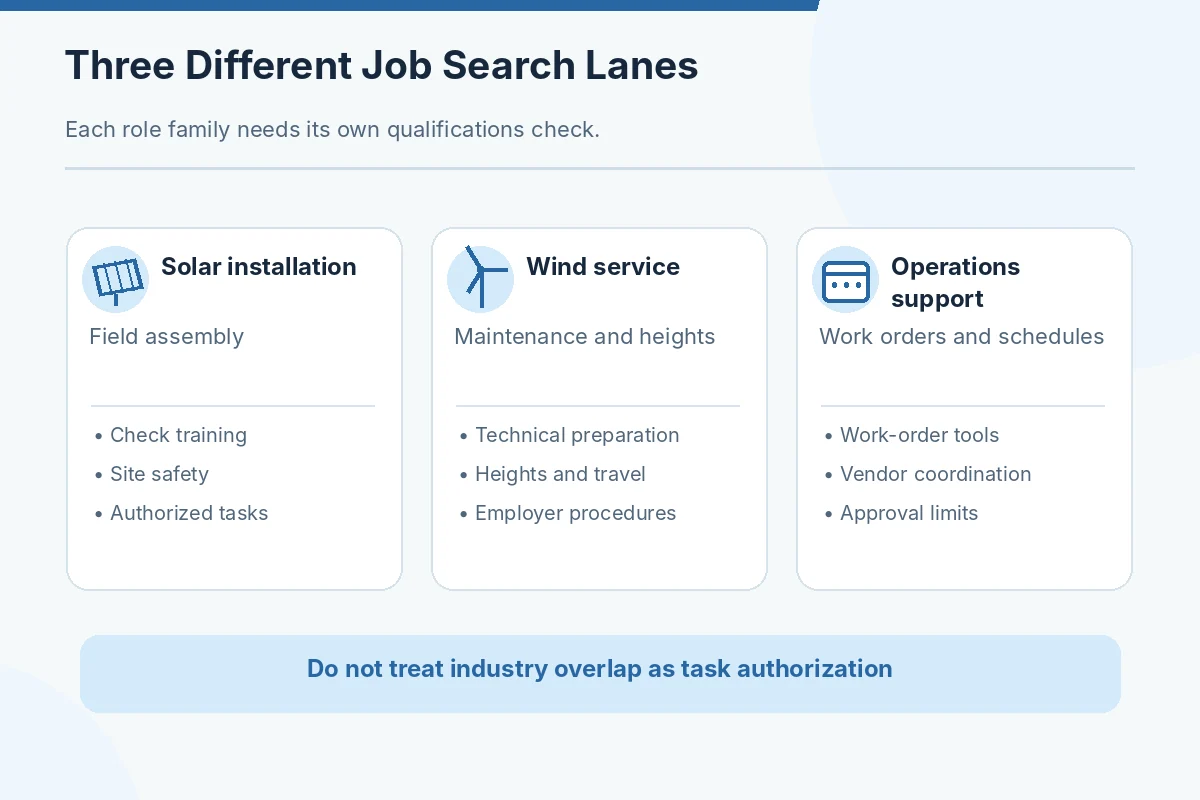
Renewable energy jobs for career changers are not all installation or engineering roles. Search separately for field occupations such as solar photovoltaic installation and wind turbine service, and for employer-defined office or operations support jobs that coordinate documents, procurement, scheduling, or customer requests. The BLS describes different typical education, working conditions, and training for wind and solar workers; those details cannot be exchanged between occupations. Start by choosing a work setting, then verify the actual duties and prerequisites of each opening rather than assuming a fast-growing industry offers an easy shortcut into any role.
Start with two different kinds of work
Make a field-work list and an office or coordination list. The first may include equipment installation, inspections, maintenance, safety protocols, travel, and physical conditions. The second may include schedules, inventory records, work orders, purchasing support, or customer communication. Some job titles blur these functions, so the employer posting matters more than the department name. A career changer with office administration experience should not treat technical maintenance as a natural extension of calendar scheduling. Likewise, previous hands-on repair work does not establish competence with specific electrical systems or heights.
Understand solar installer duties before applying
The BLS describes solar photovoltaic installers as assembling and setting up systems that convert sunlight into electricity and performing related installation tasks. The occupation involves job-site work and may require particular training and employer safety procedures. In a posting, check whether the person is expected to install, inspect, maintain, lead crews, or work alongside appropriately licensed personnel. Avoid assuming that a short online course authorizes electrical work or that an entry job permits independent decisions on system design. Requirements can vary by state, employer, task, and worksite.
Read wind technician requirements as a separate path
Wind turbine service technicians maintain and repair turbines; the BLS describes work outdoors, in confined spaces and at heights, with typical postsecondary nondegree preparation and long-term on-the-job training. Those facts make a wind technician search materially different from a generic “green jobs” search. Check the employer’s actual training, travel, rescue, physical, and shift expectations before applying. Prior experience with machinery may help you explain maintenance habits, but it does not by itself prove turbine-specific authorization or readiness to work in elevated equipment.

Explore support roles without inventing a new occupation
Energy companies also use ordinary business functions such as scheduling, documents, vendors, customer support, and inventory. Their precise job titles and duties differ; a coordinator might support field teams without ever installing equipment. Search by a known task plus the employer’s industry, such as “work order scheduling solar” or “procurement assistant wind.” Do not claim that every renewable energy company offers trainee office jobs. Find an actual vacancy and check whether it requires industry knowledge, software experience, technical qualifications, or a shift arrangement you can meet.
Compare field conditions with your actual preferences
A field route may mean working outdoors, commuting to changing sites, climbing, handling tools, responding to weather, or following detailed hazard controls. An office route may require tight deadlines, customer communication, software use, and documentation accuracy. Neither route is automatically easier. Review essential functions and employer safety requirements rather than relying on lifestyle marketing or generic industry enthusiasm. If you are unsure whether a listed duty is supervised, ask the hiring team; do not treat missing information as permission to perform restricted tasks independently.
| Route or question | What to compare | Important boundary |
|---|---|---|
| Solar PV installation | Field assembly and site procedures | Verify job-site training and applicable approvals |
| Wind turbine service | Inspection, maintenance, heights and travel | Verify technical preparation and safety training |
| Energy operations support | Schedules, work orders, records and vendors | Verify exact employer-defined scope and tools |
Read occupational statistics without treating them as job offers
BLS projections and typical education describe occupations across the economy, not openings at a specific company. An occupation’s growth rate does not establish a local vacancy, a guaranteed starting salary, or admission to training. Use the Occupational Outlook Handbook to compare duties and preparation, then confirm current opportunities directly with employers in your region. Do not quote an occupational median as the rate a recruiter has offered you. Track the posting’s actual schedule, location, prerequisites, and stated pay only when it is documented.
Convert prior experience into appropriate evidence
A career changer from warehouse work may demonstrate accurate inventory counts, delivery handoffs, or incident reporting for support functions. A mechanic might describe logged maintenance procedures and tool familiarity while openly acknowledging missing turbine-specific training. An administrator might show calendar coordination and supplier documentation. Keep evidence at its real level; handling a generic tool or spreadsheet does not confer approval power over electrical systems, construction drawings, or safety inspections. Clear differentiation is more credible than claiming broad “green energy expertise” without documented work.
Build a three-column employer search table
Use columns for “Field technical,” “Office and coordination,” and “Learning needed.” For every real vacancy, record location, essential tasks, recognized credentials, training offered, work conditions, and an official link. A hypothetical entry might be “wind maintenance trainee / turbine inspection assistance / employer requires technical qualification / travel and heights” and should be marked illustrative. Keep a separate shortlist of positions where your prior evidence already matches core duties. Do not mix evidence of a real job opening with general occupational projections or a course provider advertisement.
Check training and safety sources independently
If a recruiter mentions a certificate, determine the issuing organization, whether it is mandatory for that job, and how the employer handles supervised training. Safety and electrical work may be governed by specific regulatory, licensing, and employer requirements. Do not generalize one jurisdiction’s rules to another or assume a named course replaces job-site oversight. Compare any training cost with multiple job postings before paying. A credible employer should be willing to explain official requirements, job conditions, and how an applicant can qualify through recognized paths.
Ask concrete questions during informational conversations
Useful questions include “What does a new worker do independently?”, “Which inspections are always supervised?”, “How often does the role travel?”, and “Which office tools are essential?” Avoid asking about proprietary designs, private client sites, or confidential maintenance records. Professional associations and employer career events may help with terminology, but they are not substitutes for current vacancy details. If someone describes a path through apprenticeship, confirm the actual sponsor and registration information where applicable rather than relying on an informal promise.
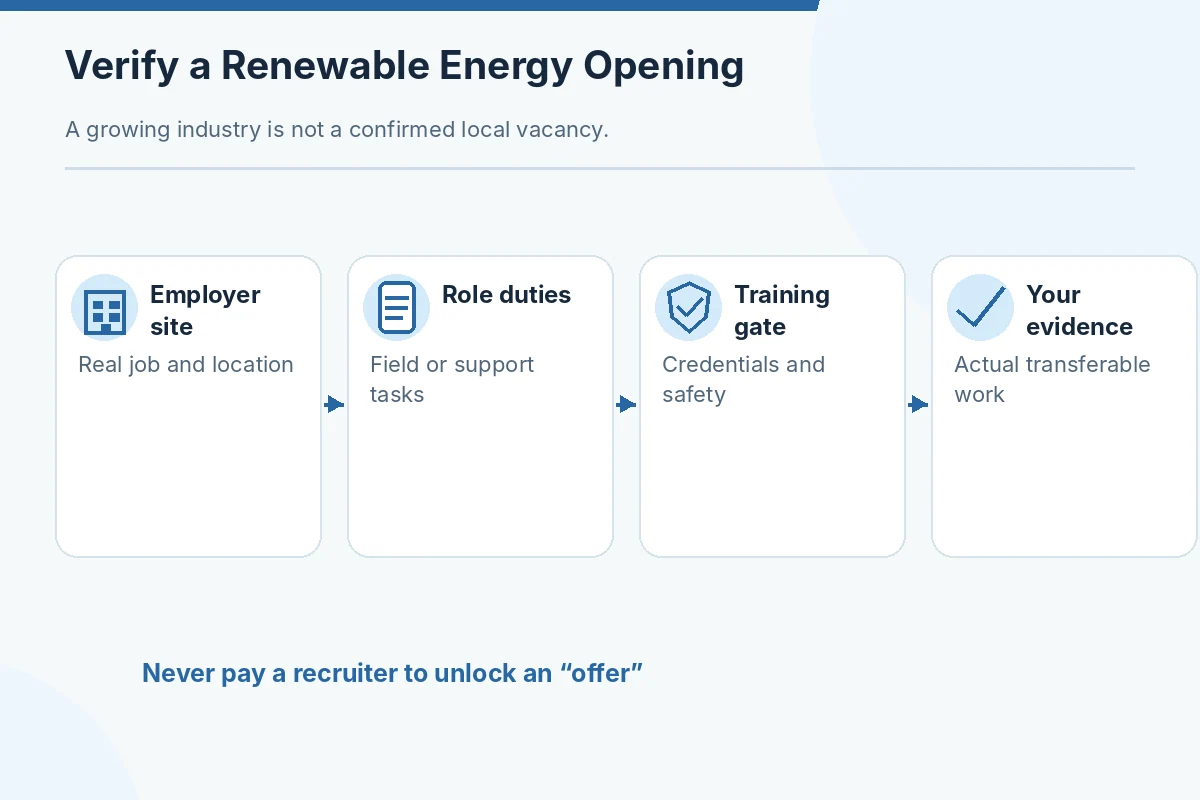
Verify real renewable-energy job offers
Growth-related hype makes broad “green jobs” advertisements attractive to scammers. The FTC warns about fake recruiters, requests to pay for equipment, and early demands for bank or identity information. Confirm a vacancy on the company’s independently located careers page. Compare job title, location, and listed duties before entering personal details. If someone guarantees placement after a large payment or avoids explaining the position, treat that as a serious warning sign. A recognizable solar panel photo or an environmental mission statement does not authenticate a hiring process.
Choose a role family and make a grounded first application
After comparing the work environments and training gates, select one field or support role family, then investigate several actual openings. Match two credible past-work examples to each job’s duties and identify one missing qualification to research. If the role requires a formal credential, do not invent it. If training is described as available, ask when and under whose supervision it occurs. The result should be a small evidence-backed application list, not a generic promise that renewable energy is an easy career for anyone at any career stage.
How We Research Career-Change Job Searches
We consulted federal and other publicly accessible primary career, workplace, and occupational resources. We distinguished typical occupational requirements from the qualifications of an individual employer vacancy and marked all illustrative scenarios as hypothetical. This research was checked on November 16, 2026. Sources cannot establish that a particular vacancy is open or that one applicant is eligible. Verify current job postings and any professional requirements independently.
Sources consulted: BLS wind turbine technician profile; BLS solar PV installer profile; BLS occupation finder; FTC job scam guidance.
For affiliate and editorial relationships, see the JobAsk affiliate disclosure.
Related Job Search Guides
No. BLS profiles describe different tasks, training, and work settings. Check each occupation and employer separately.
It may be relevant to employer-defined scheduling, records or purchasing support roles. Confirm actual openings and the specific industry and software knowledge requested.
Not necessarily. Verify applicable licensing, employer oversight and job-site safety rules; do not perform restricted work without authorization.
No. Growth projections describe broad labor trends. Search actual employer sites for current locations, qualifications and schedules.
Verify the position independently through the real employer, and reject upfront fees or premature requests for sensitive financial information.