
Career change job application email: A career-change job application email should make one clear connection between work you have actually done and a requirement of the new job. State the new role, identify the relevant task from your previous field, and briefly explain any real training or project work that closes a gap. Do not rename your old position or borrow the achievements of your team. A short, accurate bridge is more persuasive than a long explanation of why you want to leave your former career.
Choose one job requirement you can truly support
Read the new posting and mark its core duties separately from preferences. An operations coordinator listing may ask for calendar management, communication among teams and records accuracy. A former teacher could legitimately describe managing classroom calendars or organizing shared work, but cannot claim to have run an employer’s logistics system. A retail lead may have experience with shift handoffs, yet no history approving vendor contracts. The email must be built around what was actually practiced.
Write a three-part evidence statement: the actual task, its relevance, and any limit. For example, “I prepared weekly schedules for a school program, which relates to coordinating deadlines and availability; I would need training in your project software.” The last clause may be unnecessary in the first message unless a critical requirement is missing. The discipline is to keep your private working notes honest before turning them into one or two polished sentences.
Explain the transition without apologizing for your history
A career change is not an employment gap to conceal. Use one direct sentence: “I am applying for the project coordinator role after working in school administration, where I maintained schedules and handoff notes.” If you completed relevant coursework, a certificate, a small portfolio project or approved volunteer duties, mention the part you can show. Avoid implying that a course automatically qualifies you for a regulated job or that a portfolio proves professional experience that you never had.
You do not need to narrate dissatisfaction with a previous manager or a disappointing industry. Recruiters reading a hiring inbox often need the role and evidence quickly. Keep the motivation forward-looking: the work you seek and the specific ability you bring. If the new role requires licensing, clearance or a nonnegotiable credential, verify it before applying; an enthusiastic email cannot substitute for an eligibility requirement.
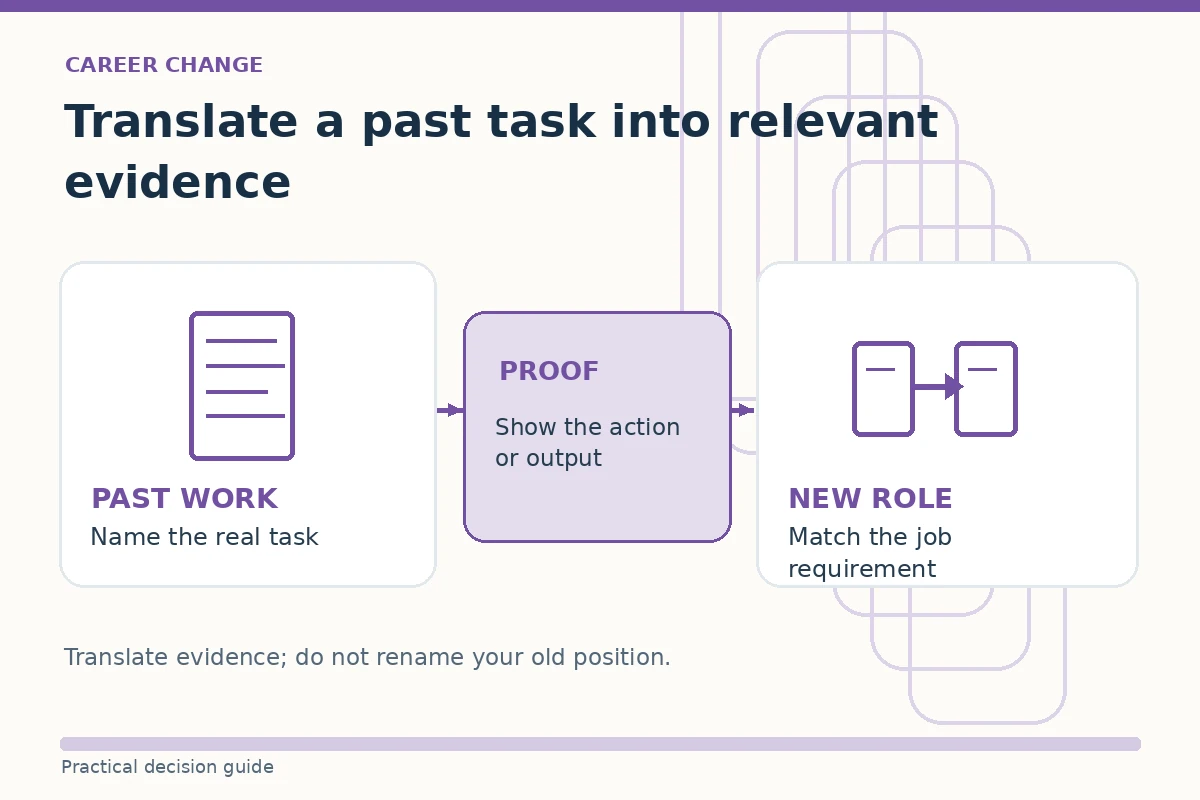
Translate evidence rather than invent metrics
Career changers sometimes feel pressured to use impressive numbers. Only use a measure when you can explain its source and your contribution. “Prepared a schedule for 12 volunteers” may be appropriate if you can confirm it. “Reduced operating costs by 40%” is not appropriate when the figure belongs to a department-wide report and you did not own that outcome. Concrete tasks, clean documentation and consistent follow-up provide useful evidence even without any performance percentage.
Compare two lines before sending: “I independently directed complex enterprise operations” and “I maintained shift notes and escalated unresolved requests to the supervisor.” The second is narrower but testable. Do not change “assisted” to “led” just because the target job is senior. Use ordinary language over industry jargon, especially when you are still learning the new field’s conventions.
Adapt a complete career-change email example
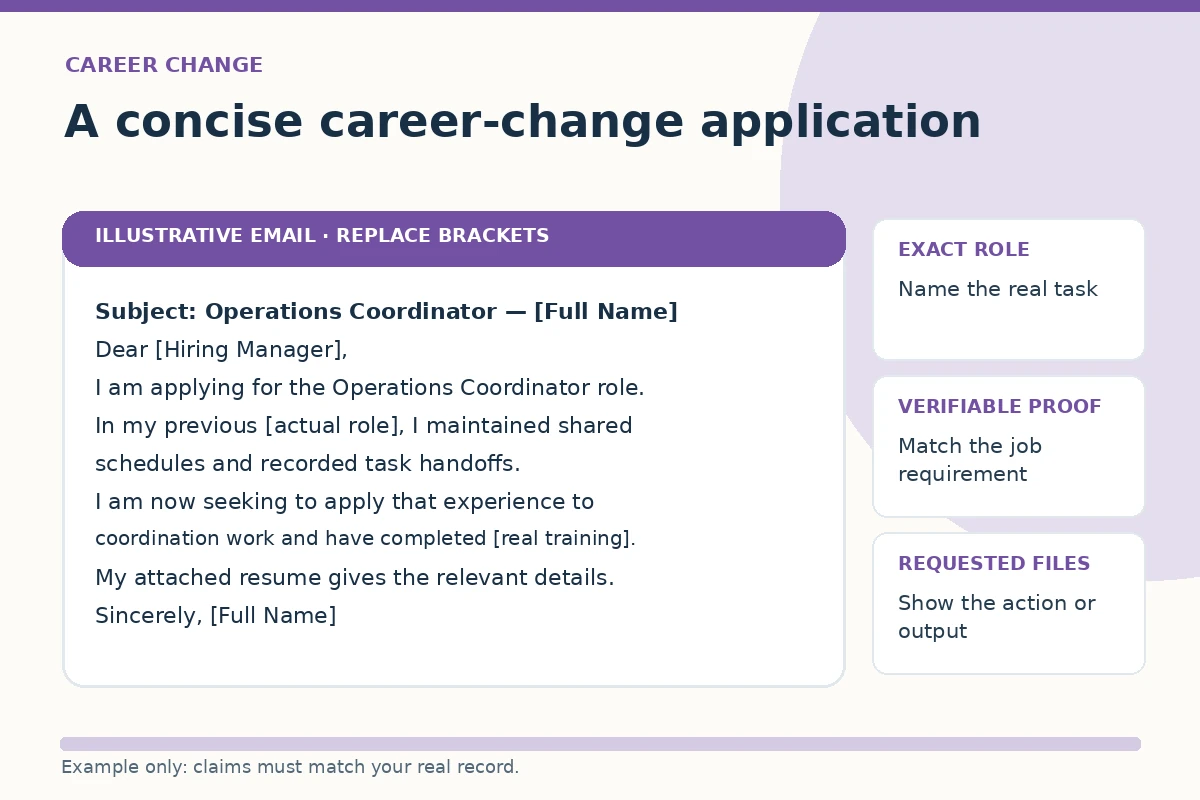
This is a fictional example with placeholders, not a claim about a real applicant. Subject: Operations Coordinator Application — [Full Name]. Message: Dear [Hiring Manager], I am applying for the Operations Coordinator position. In my [actual former position], I maintained schedules, recorded updates and communicated changes to [authorized team]. I am moving toward coordination roles and recently completed [verified course or project, if applicable]. My resume highlights the related work and the areas I am continuing to develop. Thank you for your consideration. Sincerely, [Full Name].
For a shift from hospitality to customer support, replace the evidence with actual guest-request records or approved issue handoffs. For a shift from accounting to IT support, describe record reconciliation and user communication, but do not call it troubleshooting unless you performed technical troubleshooting. A tailored email is not a universal template: its one central proof sentence must change with the candidate and the posting.
Decide when to explain missing qualifications
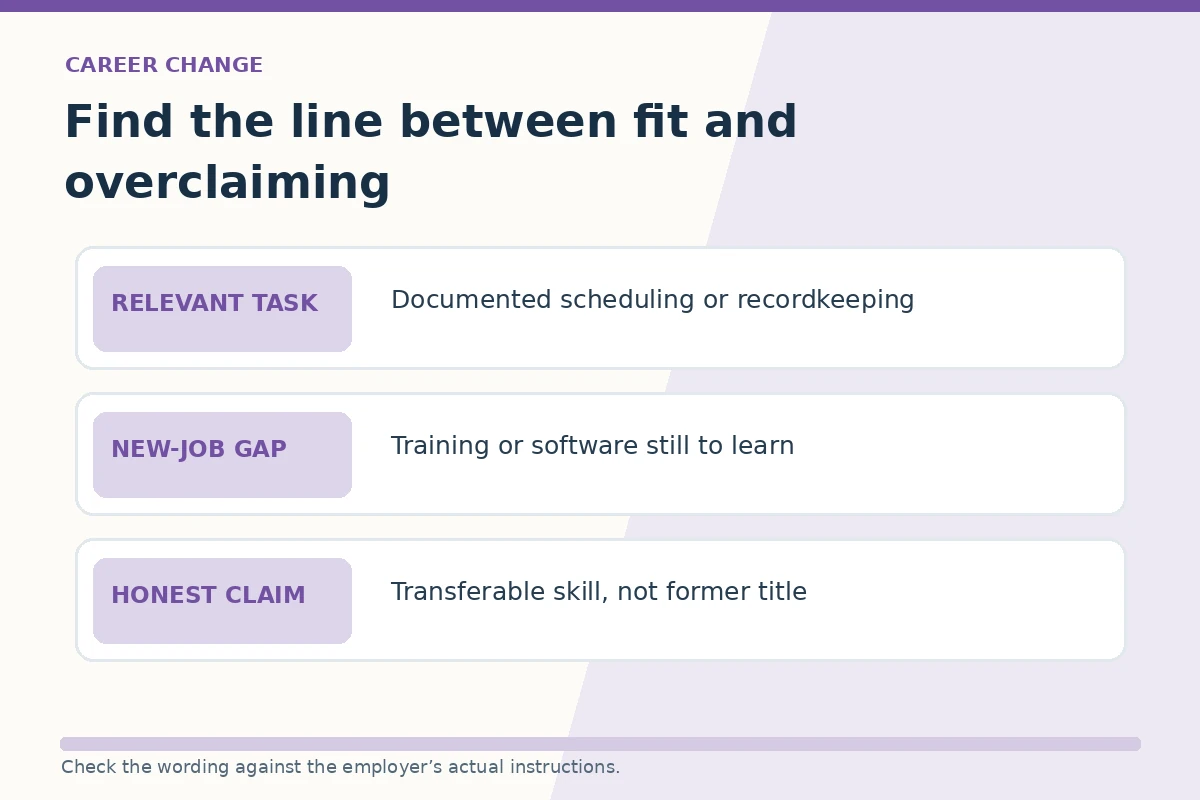
If a requirement is genuinely mandatory, do not imply that transferable experience automatically meets it. Consider another related vacancy or ask a permitted question about accepted equivalents. If a listing asks for familiarity with a tool but offers training, focus on proven learning habits and name the relevant course or project only when real. You can express interest in learning a new software package without pretending to be proficient in it.
Keep the application email itself positive and concise. A list of every gap can obscure the match you do have; a blanket “I meet all requirements” can be equally misleading. The resume holds the full chronology of titles and dates. A cover letter, if requested, can provide more room for the transition story. Do not send redundant long documents when the employer asks for only a brief message and resume.
Check names, documents and a credible next step
Use the exact target job title and the official application method. A short email subject containing your name and role is useful unless the posting prescribes another. Make sure the attached resume keeps past job titles true and labels coursework and freelance work accurately. A mismatch between the email’s “operations lead” and the resume’s “volunteer scheduler” will trigger unnecessary questions about the scope of work.
Close with a simple expression of interest, not pressure for an immediate interview. Save a copy of the version you sent. If you receive an interview invitation, prepare to explain precisely which parts of the old role transfer, which parts do not, and how you plan to learn the missing tasks. That follow-through completes the bridge that the email begins.
How We Research Job Application Emails
We reviewed University of Minnesota guidance on sending job applications by email and University of San Francisco career-service guidance for submission instructions, concise subjects and attachments. For this scenario, we also checked the relevant occupation, verification, or employment-safety material listed in the article sources. All email examples are fictional and illustrative: they do not confirm a real vacancy, a candidate’s qualifications, or employer acceptance.
Employers and licensing bodies may set additional rules that a sample cannot replace. Review the exact posting and current official requirements. No referral, employer partnership or affiliate arrangement is implied. See our affiliate disclosure for the site’s policy.
Related Job Search Guides
Yes, if it clarifies the connection. One sentence is usually enough; follow it with a task relevant to the vacancy.
No. Keep past titles accurate and use the email to explain the transferable work.
Describe it as coursework or training and note what you practiced. Do not present it as a professional credential or paid experience.
Only if accurate and attributable. A verifiable task and output can be more useful than an unsupported percentage.
Follow the posting. Usually a short email and the requested resume or cover letter are enough; do not send extra materials without a reason.