
To decline a summer camp counselor offer, contact the camp director or hiring coordinator named on the offer, say clearly that you will not accept the position, and give a timely response before staff schedules, training, or housing plans are finalized. If you already accepted or signed an agreement, review those documents and ask the camp for its formal process rather than assuming a simple refusal email ends every obligation. Keep your message focused on the exact camp, session, and role, not a judgment about the children or the program.
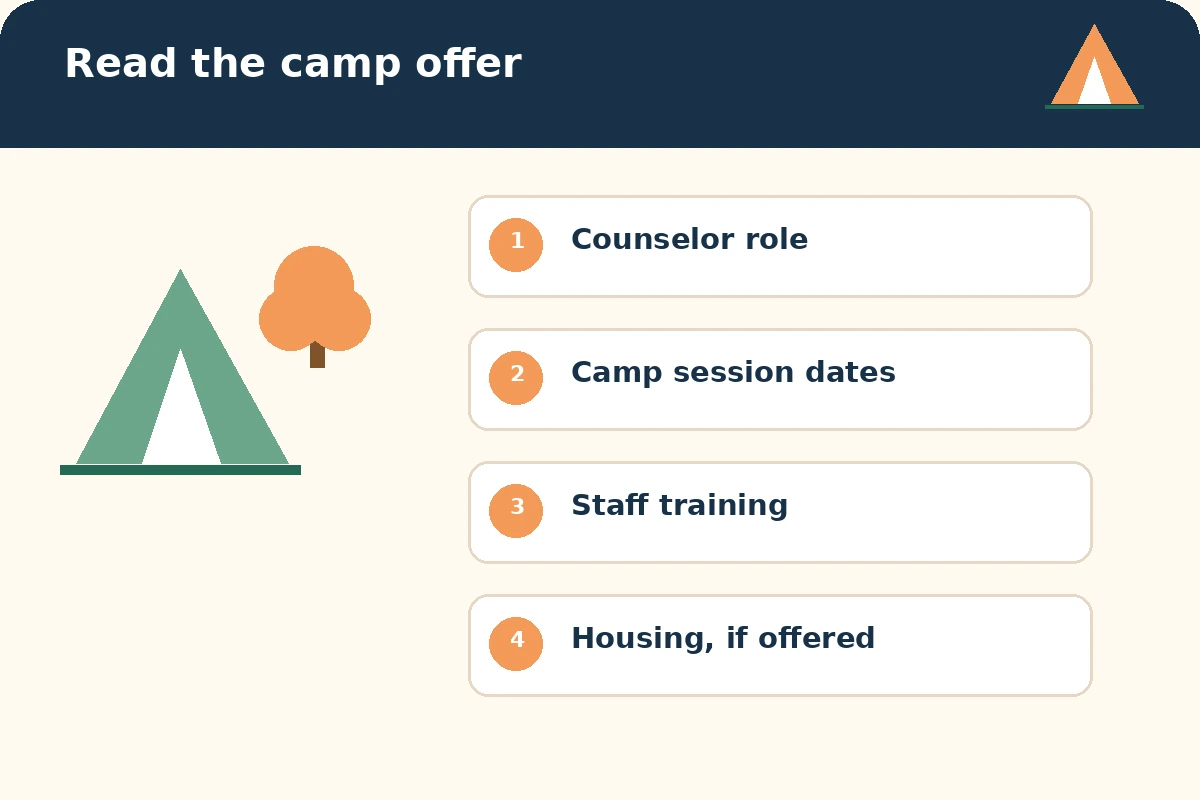
Identify the counselor role and the sessions in the offer
Camp counselors may be hired for day programs, overnight cabins, specialty activities, or a particular session. Offer documents can list different arrival dates for staff training and for campers, time-off arrangements, and seasonal end dates. Before you decline, write down the exact role title, campus or camp location, beginning and ending dates, and the hiring contact. These details help the director determine which staffing plan the decision affects. The American Camp Association describes written staff agreements that address duties, employment duration, and expectations, which explains why specificity matters.
If an offer includes several sessions or different sites, clarify whether you are declining the entire seasonal appointment or only an optional assignment. Do not assume there is a universal ‘camp contract’ format. A full-time residential counselor, a day-camp activity leader, and a returning specialty instructor may have different reporting contacts and practical logistics. Start with the document you received rather than borrowing terms from a previous camp’s paperwork.
Make the decision before the camp builds around your availability
Summer camps need to organize supervision, training, activity coverage, and often cabins or transportation before children arrive. Once you know you will not take the role, communicate promptly. Holding the offer until the last moment because the answer feels awkward can leave the camp trying to adjust a seasonal roster. At the same time, do not invent a decision deadline: follow the date given in your real offer, and ask for an extension if you genuinely need one before deciding.
A practical review separates deal-breakers from questions. If the training week conflicts with an exam, ask whether the dates are flexible before rejecting, if you would accept a workable alternative. If you cannot commit to the season or the safety responsibilities, do not say yes hoping the problem will disappear. Counselor work involves supervision of children, and you should not misstate your availability, experience, or qualifications. An honest refusal is preferable to an unsupported promise.
Send a concise note to the person staffing the camp
An illustrative email is: ‘Subject: Summer Counselor Offer — Decision. Thank you for offering me the counselor position for the summer session at [Camp Name]. I have decided to decline the offer and will not be available for the proposed dates. I appreciate the time you spent speaking with me and wish the program a successful season. Best, [Your Name].’ Adapt the title, session, and actual name; the bracketed details are placeholders for a personal draft, not facts to send unchanged.
Send the notice through the method listed in the offer rather than a social-media account that may not be monitored by hiring staff. If a central office and a site director were both involved, check who is authorized to receive declines. A short honest reason, such as a schedule conflict, can help explain the decision but is not required. Avoid sharing family circumstances, medical details, or criticism of children, facilities, or staff. The decision itself should be unmistakable.
Check orientation, housing, and travel only where relevant
A residential camp may reserve a bunk or staff room, arrange arrival instructions, or plan a training cohort. A day camp may need only a work schedule and introductory staff meeting. Do not add a housing discussion to a role that never offered housing. If the camp has already booked travel, assigned accommodation, shipped equipment, or asked you to complete onboarding, identify those items privately and request the camp’s instructions for canceling pending arrangements. Do not independently promise reimbursement or waiver of charges.
If you are a participant in a visa-based or third-party placement program, there may be additional sponsor or intermediary contacts. This page is not visa advice. Do not assume that declining the camp automatically changes an immigration, placement, or travel record; seek the relevant sponsor’s official instructions. For any safety-related training or background-check documentation, use authorized channels and avoid sending identity documents again merely to decline.
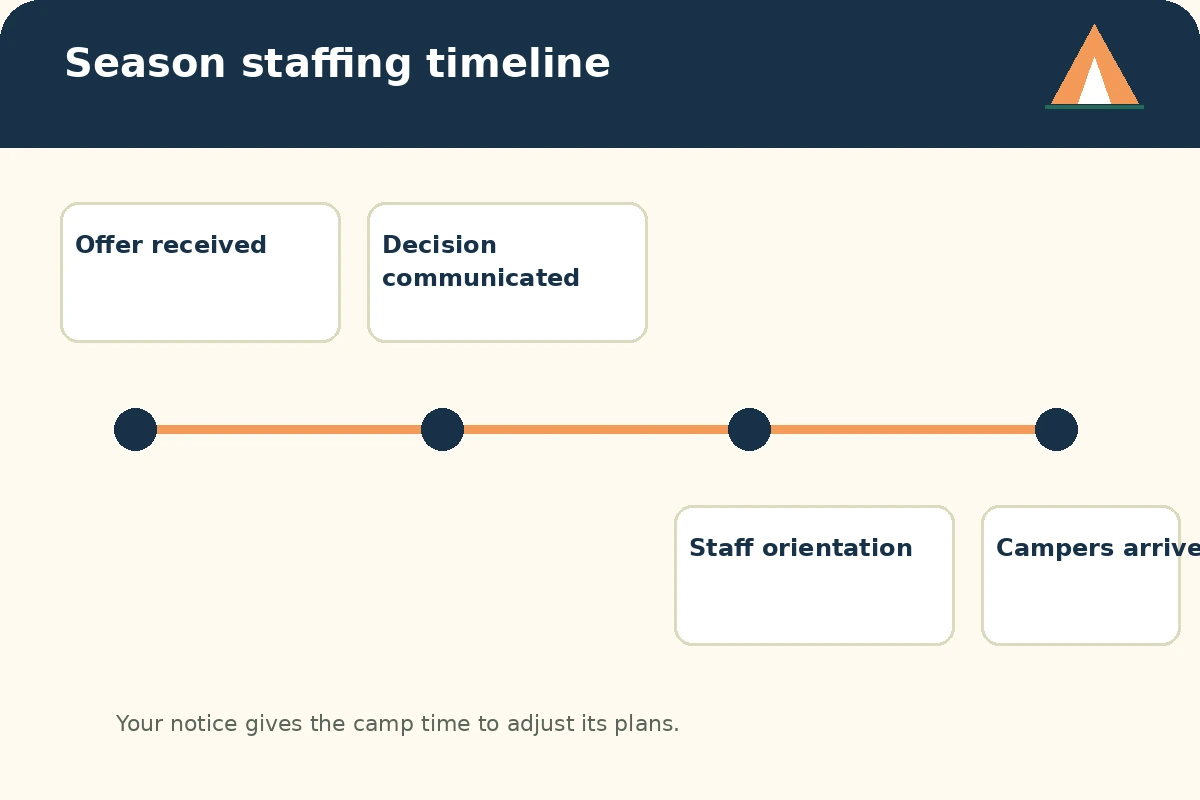
Distinguish an unaccepted offer from a signed commitment
If you have not accepted an offer, a timely refusal generally follows ordinary recruiting etiquette. If you previously accepted, signed a staff agreement, or received advances, the communication is more complicated. Locate the exact agreement and ask the authorized contact what must happen next. State the facts of what you signed or accepted, not what you hope the document means. Employment laws and contract terms vary, so do not assume there are never consequences or that a particular fee is automatically enforceable.
The ACA discussion of staffing emphasizes the importance of written agreements, staff orientation, and clear role duties. It does not decide your individual contractual obligations. If you face a dispute about money, travel arrangements, or a signed agreement, obtain qualified advice appropriate to your location and contract. Do not rely on a general sample to settle those questions. Keep copies of notices and acknowledgments rather than deleting the original offer after replying.
Avoid leaving staff and camper supervision assumptions in limbo
Camp leadership is responsible for staffing decisions and safe activity coverage; a prospective counselor should not try to nominate an unvetted friend as a replacement or promise to train someone before withdrawing. If the director asks for referrals, you can offer a contact only with that person’s permission and only if you truly know they may be interested. The camp still must perform its own screening, training, and assignment process. Your refusal should not minimize supervision requirements or imply that any volunteer can fill the role.
If you applied to more than one camp run by the same organization, specify the site and session. A decline for one location may not close the application at another; confirm before changing additional application statuses. Likewise, if the camp offers a different shift or shorter session, consider it as a new proposal rather than assuming it matches your original decision. If your response remains no, repeat it simply.
Keep the season and your response records aligned
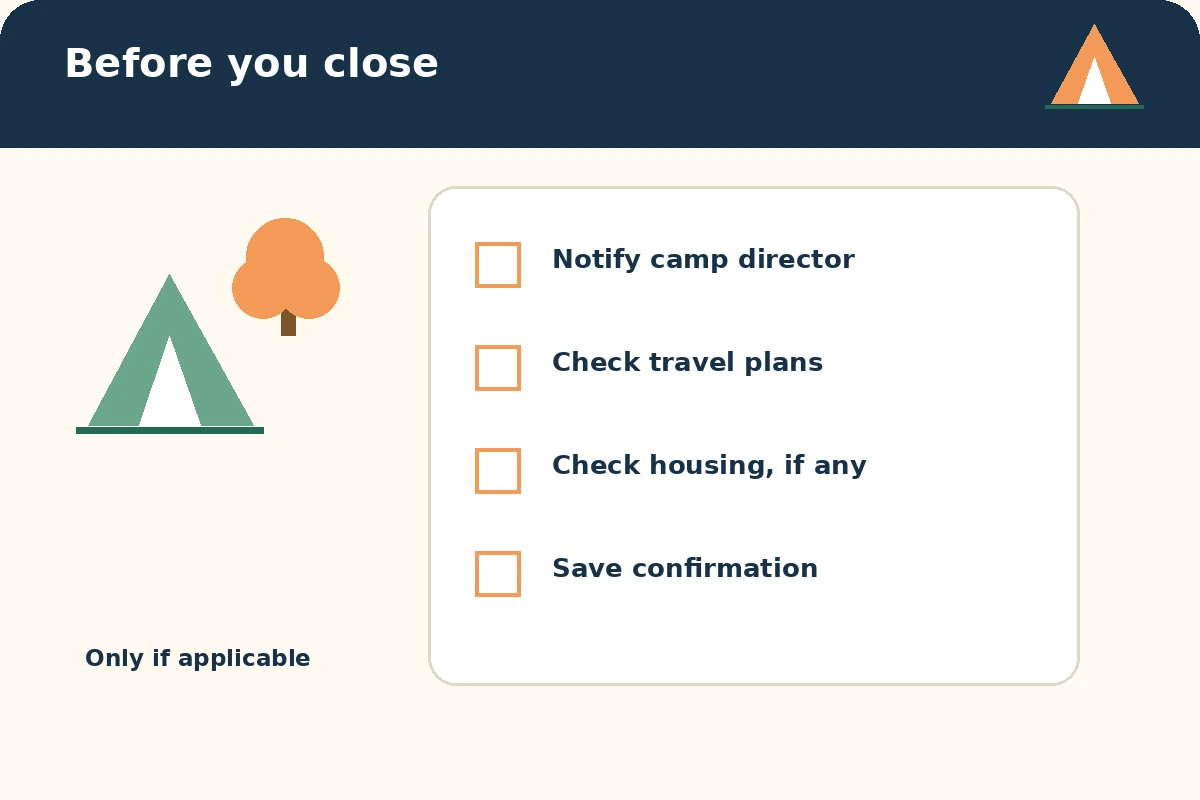
After sending, mark the offer declined in your own job tracker and note the date, channel, position, and camp session. If the camp uses an application system, check whether you must record the decision there. Save any confirmation and practical instructions regarding housing, arrival forms, or returned items when relevant. If the employer does not acknowledge a time-sensitive notice, a single professional follow-up through the designated office may be appropriate.
The final record should tell a future reader exactly what you declined and when. You can express gratitude for the camp mission and the hiring team’s time without promising future employment. A refusal is not a statement about the quality of the camp; it is a decision about this particular commitment. Closing the loop early lets the program manage its season and lets you make the next work or study decision without unresolved assumptions.
How We Research This Guide
This guide draws on these primary professional resources: American Camp Association discusses staff agreements, start and end dates, duties, and training.; ACA staffing guide covers recruiting, onboarding, supervision, and before-camp communication.; UC Berkeley recommends promptly and clearly declining job offers in writing.. We checked the linked resources on November 16, 2026 and compared the topic against the existing JobAsk collection to avoid duplicating a general job-offer refusal guide. The guidance is a decision and communication framework, not individualized legal, academic, or employment advice. Examples are hypothetical, and employer or program instructions may differ. No paid product, commercial link, or affiliate relationship is recommended. Our affiliate disclosure explains the site policy.
Once you decide, notify the camp promptly; follow the actual offer deadline and any agreements you have already accepted.
A short truthful explanation can be useful but is optional. Do not disclose private information to justify a final decision.
Tell the authorized hiring contact and ask about any arrangements or obligations in your actual documents.
Only the camp can make hiring and supervision decisions; do not promise someone a position or bypass screening.
Review it and ask for a formal process; obligations depend on the agreement and applicable rules, not a generic email script.