
A second interview with future teammates is a chance to show how you work alongside people, not just how you describe your achievements to a hiring manager. Prepare one genuine handoff story, one example of useful feedback, and two questions about the team’s daily workflow. You do not need to act as if everyone is already a close friend. You need to explain what you owned, what other people needed from you, and what changed because you communicated clearly.
The invitation may describe a “meet the team” conversation, a peer panel, or an informal discussion. None of those labels guarantees a job or tells you who makes the decision. Ask the recruiter who will attend, whether there is a work exercise, and how much time is planned. Use the job description to choose relevant examples instead of inventing a story that happens to sound collaborative.
Prepare a Handoff Story Your Coworkers Can Evaluate
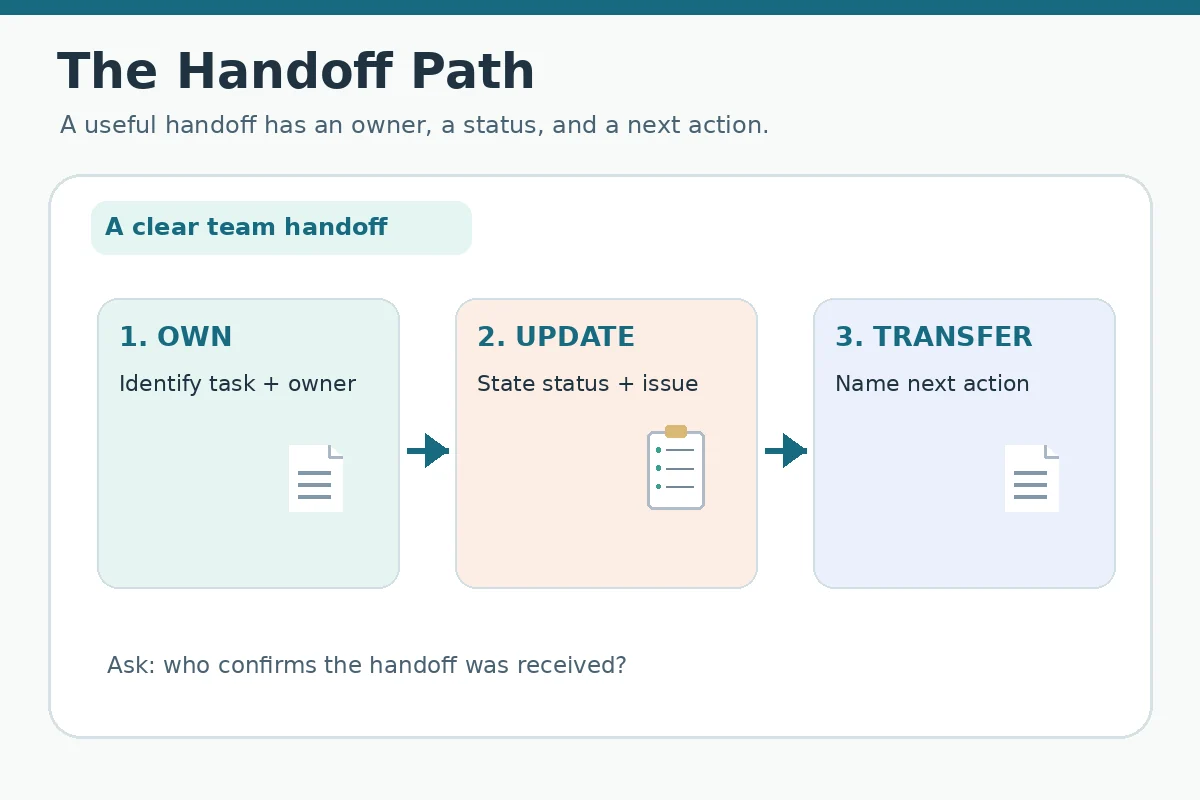
Choose a specific instance when you moved a task from one person or function to another. Explain what the receiving person needed: a clear status, file location, unresolved issue, deadline, or approval. In a hypothetical support-team example, a person finishing a shift summarizes an open customer issue, documents the next action, and identifies an escalation owner. That example is illustrative; use your own verified situation in the interview.
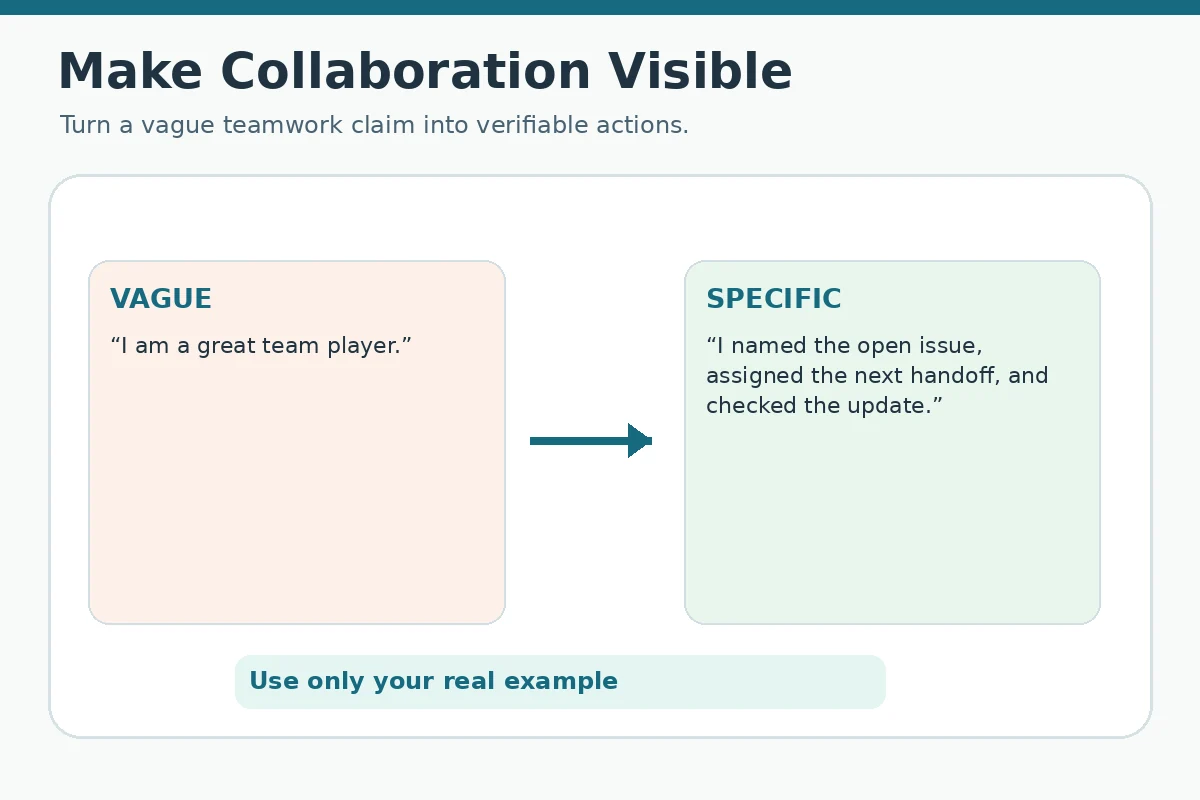
Keep the ownership line visible. Saying “we fixed everything” leaves peers unsure what you did. Saying “I checked the ticket history, flagged the missing information, and asked the shift lead to review the next step” shows both contribution and judgment. If an outcome was not measured, report a process change or a documented handoff rather than a made-up percentage.
Answer Questions About Disagreement and Feedback
A teammate may ask how you handle a coworker who has a different approach. Start with how you learned the other person’s concern, describe what evidence or standard guided your decision, and finish with the agreed next action. Avoid claiming you always get along with everyone. A realistic answer can include a respectful disagreement that required clarification or help from the appropriate lead.
Feedback answers need the same specificity. Identify feedback you actually received, the adjustment you made, and how you checked whether the work improved. Do not share private performance notes or name a coworker who did not consent to being discussed. Your objective is to demonstrate the NACE competencies of communication and teamwork through behavior, not by repeating the words “team player.”
| Peer question | Evidence to prepare | Boundary to keep |
|---|---|---|
| A missed handoff | What information was missing, your part in fixing it, and who reviewed the update | Do not claim the team-wide outcome if you did not verify it |
| A disagreement | What you heard, what standard mattered, and how a decision was reached | Do not blame or expose a named coworker |
| Receiving feedback | Specific adjustment and what you observed afterward | Do not invent a performance score |
Ask Peers About Real Working Routines
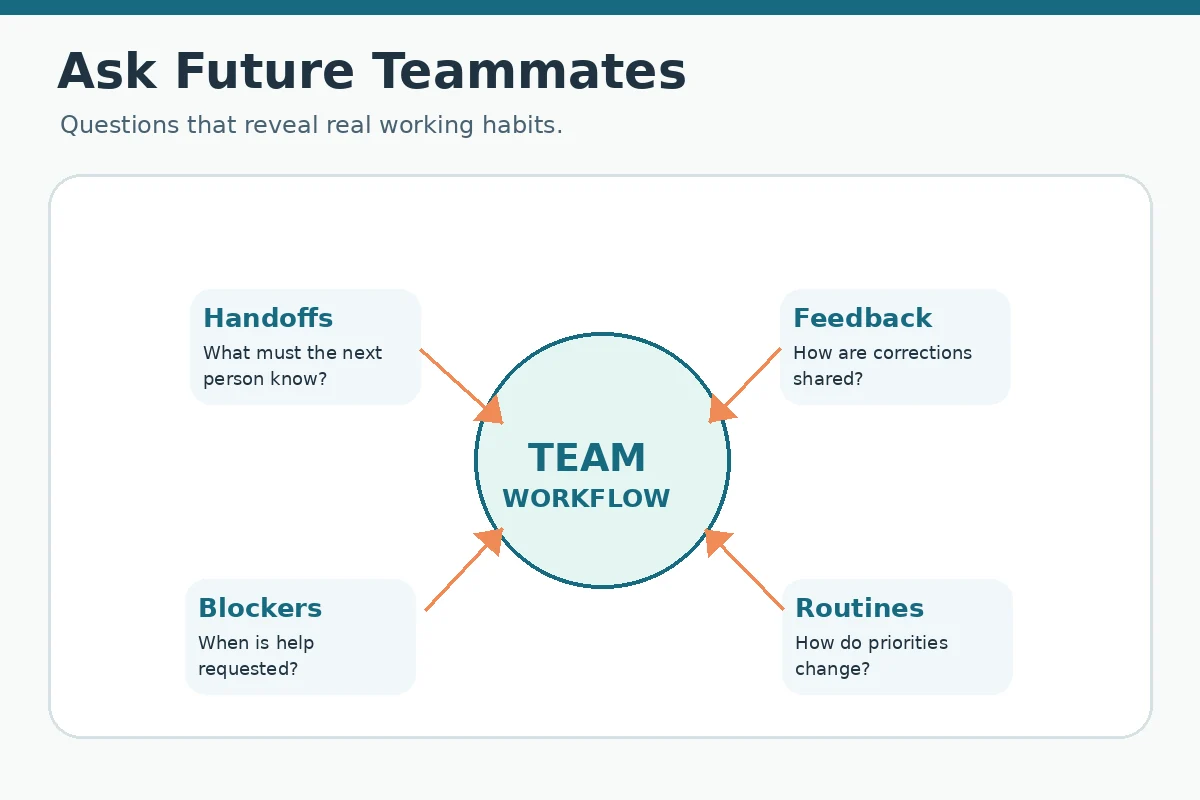
Questions for peers should be ones they can genuinely answer. Try “What information makes a handoff useful on this team?” or “When priorities change midweek, who helps decide what moves first?” You can also ask how new people learn a shared process and what the team does when a blocking dependency has no clear owner. These questions tell you more than asking whether the culture is “good.”
Listen for concrete operating practices: regular reviews, issue trackers, approvals, meeting rhythms, documentation habits, and escalation paths. Different teams may use different tools and still work well. If an answer is vague, ask for one example rather than treating a positive adjective as proof. Keep sensitive customer or personnel details out of the conversation.
Adapt the Evidence to the Job
For an administrative role, the strong example may be calendar coordination with a decision log. For a technical role, it may be handing over a tested change with known limitations and rollback information. For a service role, it may be a shift update that protected a customer from repeating a request. The relevant unit is the job task, not the prestige of the project or software used.
The U.S. Office of Personnel Management describes structured interviews as assessments of work-related competencies; some employers follow that format, and others do not. Prepare short situation, action, result answers that a new teammate can follow. Do not assume the interviewer knows your previous stories or that a friendly chat is outside the hiring process.
Notice Red Flags Without Judging Personalities
You are evaluating the work environment too. Ask what happens when a task arrives without required information, how teams resolve conflicts over priorities, and whether someone reviews high-risk actions. You are not entitled to confidential internal records, and a teammate may reasonably say they cannot discuss a particular incident. Look for a sensible process rather than private stories.
Avoid overinterpreting smiles, interruptions, or the number of people in the room. A brief conversation might reflect scheduling, not a hidden verdict. If a teammate mentions a concern, invite clarification: “What would you want a new hire to learn first?” A thoughtful response is more useful than trying to guess whether you have already been selected.
Close With a Clear, Honest Next Step
Before the session ends, restate one work priority you heard and connect it to a real example you can provide. Ask the recruiting contact for the remaining process rather than pressuring peers for a hiring decision. If you promised a nonconfidential sample or factual detail, send it through the channel the recruiter approves. Never attach an employer’s restricted materials just to demonstrate credibility.
Afterward, jot down the actual handoff expectations, unresolved role questions, and names or roles of contacts. A brief follow-up can thank the host and mention a specific work topic; avoid a mass email describing every interviewer as a future colleague. A peer conversation is a chance for better mutual understanding, not a promise of an offer.
How We Research Interview Guidance
We reviewed the linked career and public-interest guidance on 2026-11-14: National Association of Colleges and Employers (NACE defines and illustrates communication, teamwork, professionalism and leadership competencies.); U.S. Office of Personnel Management (The U.S. Office of Personnel Management explains that structured interviews assess job-related competencies through behavior and hypothetical situations.); OPM interview question guidance (OPM recommends job-relevant, open-ended questions and a situation, action and result structure.). We also compared candidate topics with the WordPress title inventory supplied by the site owner, the preceding local package and the original JobAsk content plan. Interview formats and employer procedures differ; all sample scenarios here are hypothetical, not verified employment histories, interview transcripts, promises of hiring outcomes or a substitute for employer policy. For transparency, see the JobAsk affiliate disclosure; this article does not claim an endorsement or paid partnership.
They may contribute feedback, but the decision process varies. Ask your recruiter about stages rather than assuming how votes are counted.
Ask how they coordinate handoffs, give feedback, prioritize urgent tasks, and help new hires learn everyday workflows.
Yes if it is relevant, but provide the context again for new people and add detail about your own decisions and collaboration.
Only with explicit authorization and appropriate removal of sensitive information; a fictional example may be safer.
Keep the same professional standards: honest examples, respectful questions, and no assumption that the conversation is not evaluative.