
An entry dental front desk is an office job first
You may qualify for a dental receptionist opening without having worked in a dental practice. The first question is whether the employer seeks a receptionist who can learn its scheduling system or a hybrid employee expected to perform clinical procedures. The Bureau of Labor Statistics describes receptionists as greeting visitors, answering calls, keeping calendars and maintaining records, with typical short-term job training. Dentistry adds specialized appointment types, insurance workflows and patient privacy. Focus your search on postings offering supervised front-desk training, not on advertisements that combine reception with hands-on treatment for which you lack applicable preparation.
Distinguish the reception area from patient treatment
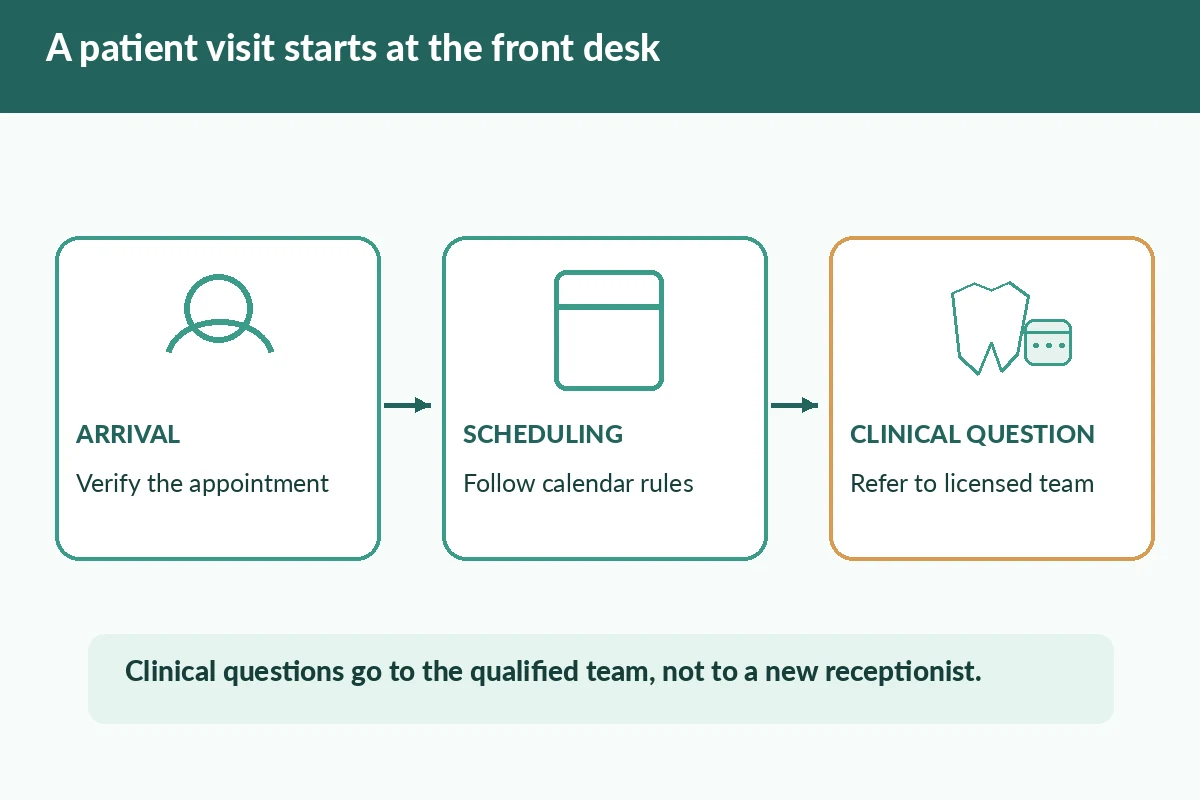
Typical administrative duties may include greeting patients, confirming visits, routing questions to qualified staff and documenting information according to office policy. A dental assistant or clinician may have different duties, including regulated procedures depending on state law and training. Do not interpret ‘willing to train’ as permission to take X-rays, assist with treatment or give clinical advice immediately. When a listing combines receptionist and assistant in one title, ask the employer which tasks are administrative, which require credential verification and which can only occur under an authorized professional’s supervision. Your application should reflect that distinction.
Search for the precise front-office title
Try job titles such as dental receptionist, patient scheduling coordinator, front desk associate or dental office assistant, then read each description rather than filtering solely by title. Check the appointment software requirement, phone volume, patient check-in, insurance-verification tasks, hours, weekend coverage and whether multilingual communication is listed. A requirement marked preferred is different from a mandatory certification or a minimum number of years. If the employer asks for prior software experience but offers training, explain your real experience learning another calendar or records system. Never claim dental-specific skills that you have not practiced.
Map everyday service experience to the vacancy
A former retail worker may be able to explain how they responded to customer questions accurately and involved a supervisor when a return exceeded their authority. A school office volunteer might have organized sign-in records and transferred phone messages. A student could describe a project that involved keeping dates or files consistent. List the actual action, the system used when appropriate and the result you can verify. Do not manufacture patient experience or suggest that ordinary scheduling work amounts to healthcare training. Employers need evidence of careful communication and consistent records more than buzzwords about being passionate.
Learn the scheduling and privacy boundary
A patient may tell the front desk sensitive information during booking or check-in. The practice should train workers in its privacy policies; HHS says covered providers must protect identifiable records and train employees. Ask how messages are verified, who may view patient details, and how to avoid discussing private information in a public waiting area. If someone asks for a diagnosis, treatment change or clinical interpretation, route that question to authorized clinical staff. A new receptionist should follow approved scripts and procedures instead of improvising medical guidance or sharing details with someone merely claiming to be a relative.
Check an office training offer carefully
Useful training is concrete: a named supervisor, scheduling-system practice, policies for confirming identity, a process for insurance questions and a known escalation route. Ask whether shadowing is scheduled before you handle phones alone and how errors are reviewed. Insurance verification and collecting payments are not the same as diagnosing coverage; staff should explain the practice’s actual workflow without guaranteeing benefits or clinical necessity. If the job advertisement emphasizes ‘no experience required’ but gives no training details, request clarification before you accept. Avoid any promise of immediate authority over private records without appropriate orientation.
| Role or task | Realistic entry evidence | Boundary to verify |
|---|---|---|
| Check-in and scheduling | May be taught through office onboarding | Follow practice rules and verify information |
| Insurance and payments | Ask what authority is delegated | Do not promise coverage or approve exceptions |
| Chairside treatment | Different clinical role and scope | Verify training, licenses, and supervision |
Build a simple, truthful first-office resume
Consider this illustrative profile: ‘Customer-service associate with scheduling and records experience seeking a dental front-desk role with structured training.’ Use it only if it matches your history. Strong bullet evidence might describe appointment confirmations, accurate message routing, confidential handling of school documents or successful learning of a new software tool. Do not include fictional patient counts, insurance approvals, certifications or practice systems. Put your availability and relevant language skills where a busy practice can see them. If you have never worked, label coursework, volunteering and community activities accurately rather than disguising them as paid clinical work.
Prepare for realistic patient-flow questions
Practice explaining how you would respond if two patients arrive while the phone rings and a dentist requests a scheduling update. A sensible approach is to acknowledge people, follow the office’s priority system, document messages correctly and ask for assistance when patient safety or a sensitive question is involved. Do not say you would independently resolve a medical emergency, disclose another patient’s visit or decide which treatment is necessary. An interview answer that names your boundary and the handoff to a supervisor demonstrates readiness for controlled responsibility. It is fine to say you would need training on practice software.

Notice when the posting is not truly entry level
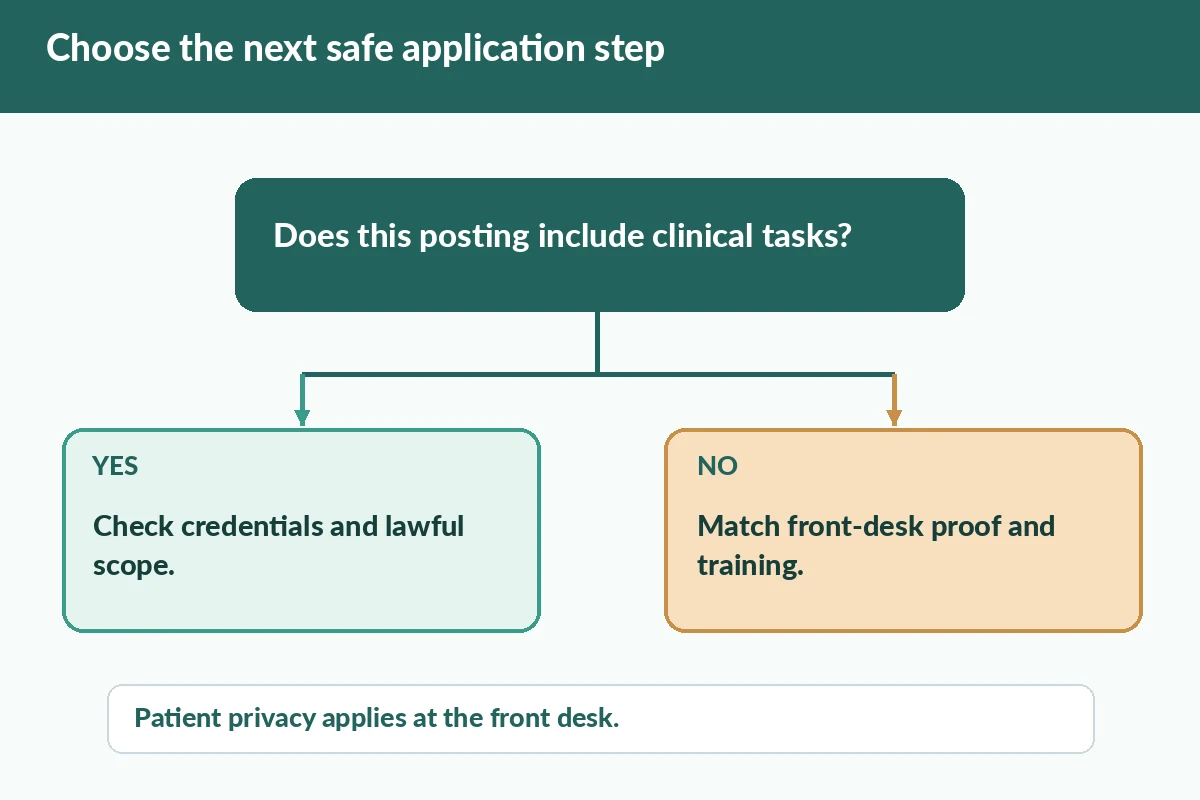
An advertisement may say ‘receptionist’ while requiring advanced coding, treatment coordination, radiography or dental assisting. Those requirements are not automatically reasonable for a newcomer. Mark which duties you can handle now, which require office training and which may need formal credentials. If the employer’s expectations remain unclear after a question, do not embellish your resume to fit them. You can apply to a clearer front-desk vacancy and develop legitimate office experience. A mismatched title is not evidence that you are unqualified for all dental reception work.
Ask these questions before committing to a schedule
Confirm opening hours, lunch coverage, Saturday shifts, onboarding time, break arrangements, training pay and who covers reception when you are away. Ask how the team handles cancellations, late patients, copay questions and difficult phone calls. Determine whether the job expects someone to close the office alone or manage the cash drawer. For an applicant new to healthcare, a clear escalation contact is especially valuable. These details affect the feasibility of a first position more than a polished title. Do not assume every dental practice has the same staffing or after-hours expectations.
Guard against shortcuts involving patient records
You should never practice using a real patient chart without authorization or take sample screenshots of actual names and appointments for a portfolio. A hypothetical calendar with fictional patients is a better way to practice accuracy. Respect the practice’s approved systems and avoid emailing patient information to personal accounts. HHS guidance makes clear that health organizations need workforce privacy procedures and safeguards. If an interviewer asks how you protect privacy, describe verification, limited access and escalation; do not invent a certification. A patient-friendly demeanor matters, but reliable boundaries matter just as much.
Apply with one realistic front-desk example
Select a vacancy whose primary duties are scheduling, phones and administrative records. Tailor a short resume to those tasks, and prepare one concise story about record accuracy or customer communication. Ask which system you would learn first, how patient questions are routed and whether clinical duties are part of the job. Keep a list of applications and follow-ups, and compare offers on training clarity and shift fit. Even if a practice does not hire you, your goal is to learn whether it was a front-desk match or a clinical-hybrid role and revise your next search accordingly.
How We Research and Verify These Entry Routes
We reviewed authoritative occupation, employer, and safety guidance on November 16, 2026. BLS describes receptionist duties, typical entry education, and short-term on-the-job training. HHS states that covered healthcare organizations train workforce members and protect patient records. HHS summarizes privacy-rule safeguards, workforce training, and appropriate access to patient information. The comparisons and sample statements are educational, not real offers or an assurance of hiring. We checked the supplied JobAsk WordPress title export (published and draft entries) and previous local batches for overlapping search intent; specific requirements change by employer and location. Read our affiliate disclosure.
Related Job Search Guides
Some practices hire and train people with strong office and service skills. Read each job description because not all hybrid front-desk positions are beginner roles.
No. Reception is primarily administrative; assisting may involve clinical duties subject to training, supervision, and state-specific rules.
Some employers prefer previous experience; others provide training. Explain the software you have actually used and ask about onboarding for the practice system.
Follow the practice’s privacy rules and identity-verification process. Do not disclose protected information merely because someone claims a relationship.
Truthful examples of scheduling, messages, record accuracy, sensitive information handling, and customer service are useful, even if they came from another setting.