
Work-from-home medical scribe jobs involve preparing or organizing clinical encounter notes under a healthcare professional’s direction, often while an appointment takes place remotely. That is different from transcribing recorded dictation after the visit or independently diagnosing, ordering treatment, or authenticating a clinical record. Before applying, identify the exact workflow, whether the role uses live audio, the approved electronic health record (EHR), the shift schedule, and who reviews and signs the documentation. Never assume that “remote” means access from any personal device or from any location.
Separate live scribing from recorded transcription
A listing may use “scribe,” “virtual scribe,” “medical documentation assistant,” or “transcriptionist” loosely. Ask whether you join encounters in real time, work from audio files, or edit speech-recognition drafts. These workflows have different deadlines and staffing expectations. The BLS profile for medical transcriptionists describes listening to dictation, reviewing generated text, and sending documents back for review; it does not mean every scribe is a transcriptionist. In a live encounter, rapid note capture and immediate clarification may matter more than the number of recordings completed. Do not compare two positions simply by the word “remote.” Map the task, input, output and person who accepts the work.
Read the clinical responsibilities line by line
Look for concrete verbs: document encounter history, structure the note, enter information in an approved system, mark uncertain terms and route the draft for clinician review. Compare these with verbs that imply independent medical decisions, such as diagnose, approve a medication order or select treatment. A support job should not casually assign licensed judgment to an unlicensed applicant. Ask who controls orders, problem lists and record authentication. Different clinical organizations use different workflows, so do not treat one sample job description as universal. When describing prior experience, specify that you prepared documentation under supervision rather than claiming responsibility for clinical conclusions.
Check live coverage, time zones, and escalation
Remote scribe schedules may follow a particular clinician’s appointments rather than a flexible queue of files. Clarify whether a scheduled shift includes pre-visit preparation, documentation during the encounter, end-of-day reconciliation or follow-up corrections. Ask what happens when an appointment runs late, the connection fails or a provider needs clarification while the next visit begins. The posting should describe how to raise an urgent documentation concern without exposing a patient through an unapproved messaging channel. If a shift crosses time zones, record the actual local hours before applying. A work-from-home label alone says nothing reliable about flexible availability.

Treat patient privacy as a condition of the role
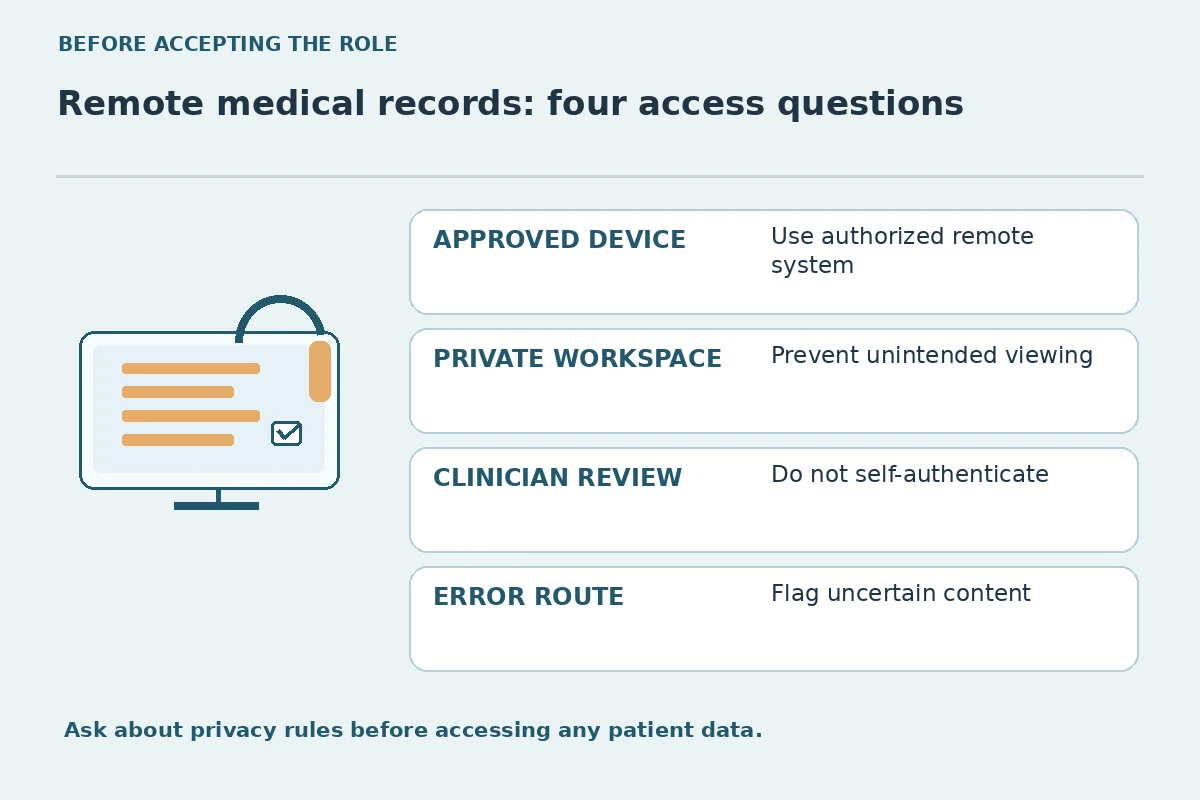
A remote workspace must protect electronic protected health information. HHS explains that appropriate safeguards and authorization standards continue to apply when staff access e-PHI from home. Confirm employer-approved login, multi-factor authentication when required, access limits, screen privacy, locked sessions and procedures for an interrupted connection. Do not save patient notes in personal cloud folders, record encounters on a private phone, or paste data into consumer tools without authorization. Even an impressive clinical-learning portfolio must not show identifying patient records. For a skills sample, use invented sample encounters clearly labeled as hypothetical and never actual protected charts.
Build a targeted application without inventing clinical skills
An entry-level candidate can demonstrate accurate note-taking, medical terminology coursework, typing consistency, privacy awareness and rapid clarification of ambiguous information. If you have real clinical documentation experience, state whether it was live, recorded or supervised. A class exercise is not a signed clinical chart. A useful hypothetical resume bullet might say, “Formatted practice encounter notes from simulated dictation and documented terms needing instructor review.” Replace that with the facts from your own background. Do not list an EHR system you have only seen in a tutorial as production experience. Employers may train applicants in a specific charting system; check the advertisement rather than assuming a universal certificate.
Ask who verifies accuracy and handles corrections
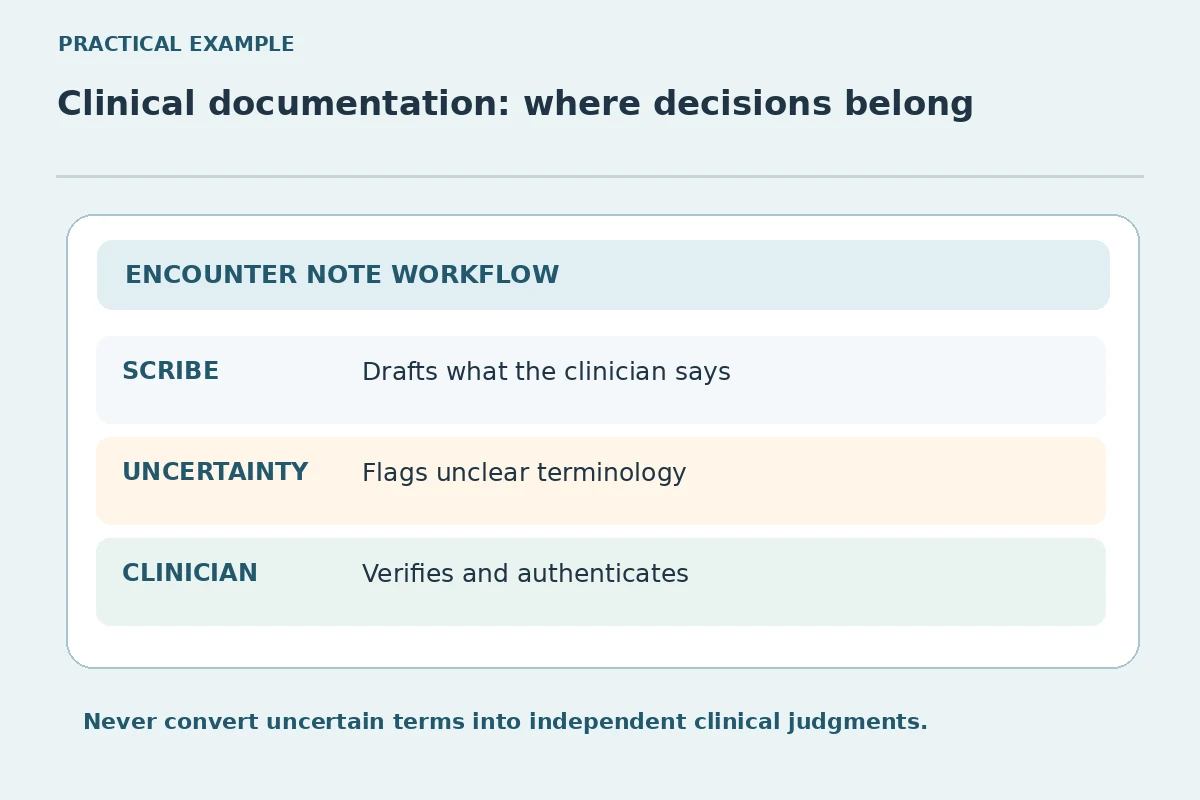
Use a simple workflow: source encounter, documentation draft, clarification request, clinician review and authorized signoff. Determine whether the scribe can edit a draft after the clinician has reviewed it, and how a correction is recorded. Do not silently overwrite an authenticated record. A job can be credible even if it uses quality sampling or team review, but the responsibility boundaries should be clear. If the recruiter promises that scribes independently prescribe, sign diagnoses, or avoid all medical oversight, ask for written clarification through official channels. The illustration below distinguishes draft preparation from the clinician’s decision, rather than pretending that a support worker is the final approver.
| Checkpoint | Evidence to request |
|---|---|
| Encounter format | Live encounter or recorded dictation |
| Drafting scope | History and notes, not diagnosis |
| Clinical control | Provider verifies and signs |
| Remote access | Approved device, network, and space |
Evaluate performance measures without trusting marketing
Ask what counts as accurate work: completeness of required fields, appropriate clarification, consistent terminology, documentation turnaround and compliance with privacy protocols. A recruiter may mention number of encounters covered, but volume alone does not prove safe or reliable work. Avoid listing invented accuracy percentages or promises of better patient outcomes in your application. Ask how the organization trains new staff, reviews errors and supports difficult audio or connectivity conditions. If compensation depends on encounters or output, request the written calculation and whether training, corrections or waiting time is covered. Do not pay a supposed vendor for guaranteed access to patient records.
Verify the employer and protect your application data
Find the organization’s official website independently and locate the vacancy there when possible. Check its listed work location eligibility, state restrictions, training arrangements and data-handling expectations. The FTC warns that fraudulent work-from-home offers often ask for up-front payment or identity information before a legitimate hiring process. Do not provide banking details through an unsolicited chat application, buy gift cards for “equipment activation,” or deposit a check and return part of it. Keep the actual job posting and interview correspondence. If the position is legitimate but its clinical scope seems unclear, ask the employer to specify who supervises and signs notes before accepting.
How We Research Remote Job Roles
We reviewed these primary U.S. government and occupational sources on November 17, 2026: BLS documents medical transcription and record-review tasks and notes home-based transcription is possible; transcription is not automatically the same as live scribing. HHS confirms remote workers with access to e-PHI require appropriate access controls and safeguards. FTC cautions that fake work-from-home offers seek money or identity data, and warns against advance fees and fake equipment checks. The role duties described above reflect typical tasks and professional boundaries, not an assertion that a particular company is hiring now. All illustrated cases, resumes, examples and names are hypothetical. Actual job requirements, employee classifications, geographic eligibility, equipment rules, permissions and work schedules differ by employer. Check any specific vacancy on the employer’s own site and confirm disputed claims with the responsible department. We do not guarantee employment, earnings, employer responses or interview outcomes. For commercial relationships and referral disclosures, see our affiliate disclosure.
Related Job Search Guides
Not necessarily. Live scribes may follow an encounter as it happens, while transcriptionists commonly prepare reports from recordings. Read the actual posting and workflow.
Do not assume so. The clinician or other authorized professional is responsible for review and authentication under the employer’s procedures and applicable rules.
Ask what employer-approved device, remote-access method, headset, and private workspace are required before making any purchases.
Record the uncertainty using the approved workflow and ask the responsible clinician. Do not guess a diagnosis or silently substitute a word.
Find the employer through its official careers page, confirm the recruiter and interview process independently, and never send money to obtain a position.