
To evaluate a medical billing or coding job from home, first identify whether the role processes claims, assigns codes from clinical documentation, or maintains patient records. Check exact credentials, supervision, authorized access, geographic restrictions, and the employer before providing sensitive information.
The decision framework below uses official occupational descriptions and consumer-protection guidance. Any scenarios described as hypothetical are instructional, not verified job listings, placement claims, or promises of earnings.
Medical Billing and Coding Are Not One Job
Online listings often bundle “medical billing and coding,” but a role may focus on claims submission, payment follow-up, code assignment from clinical documentation, or medical record quality. The BLS medical records specialists profile describes workers who verify records, classify information with codes, and follow confidentiality requirements. Read the task verbs in the listing. A person who follows up on a claim is not automatically authorized to assign a diagnosis code.
Create separate columns labeled billing workflow, coding workflow, and records maintenance. Under billing, look for insurance eligibility checks, claim edits, payer correspondence, and accounts receivable tasks. Under coding, look for review of clinical documents and specified code systems. Under records, look for accuracy, retrieval, and restricted access. A posting that expects all three may still be legitimate, but it needs clear training, review responsibilities, and approved systems.

Verify Qualifications Against the Actual Posting
Medical records jobs have varied entry paths. BLS notes that a postsecondary certificate is typical for the occupational group and that some employers prefer or require certification; it does not establish one universal credential for every billing or coding job. Compare the employer’s listed education, experience, coding systems, and credential requirements before paying for a course. If a certificate name appears, verify it with the issuing organization rather than a recruitment advertisement.
Avoid claiming fluency in ICD or procedure code sets because you watched an introductory video. If you completed formal training, list the exact program and what you practiced. If you managed office billing without code assignment, describe that boundary clearly. Remote employers may expect independent handling of difficult exceptions, while other roles include supervised work. Ask who reviews disputed codes, where clinical questions are routed, and how updates to code references are managed.
Inspect the Remote Access and Privacy Workflow
The role may involve sensitive patient information. BLS expressly identifies confidentiality and authorized record access as core responsibilities for medical records specialists. A credible employer should explain how approved personnel access necessary systems and where work materials may be stored. Never download real medical records to a personal device for a job application sample or email them to an unverified recruiter. A portfolio can use invented or publicly released practice data that contains no actual patient identifiers.
Separate three decisions: what data the worker is permitted to view, what changes the worker may make, and who approves unresolved documentation issues. Remote work does not erase workplace security procedures. Do not promise you can use your own cloud folder, share a home computer, or print claims at home without explicit organizational authorization. For training, ask whether access is supervised and how mistakes are reported, not whether you can bypass controls to work faster.
Look for the Whole Revenue-Cycle Handoff
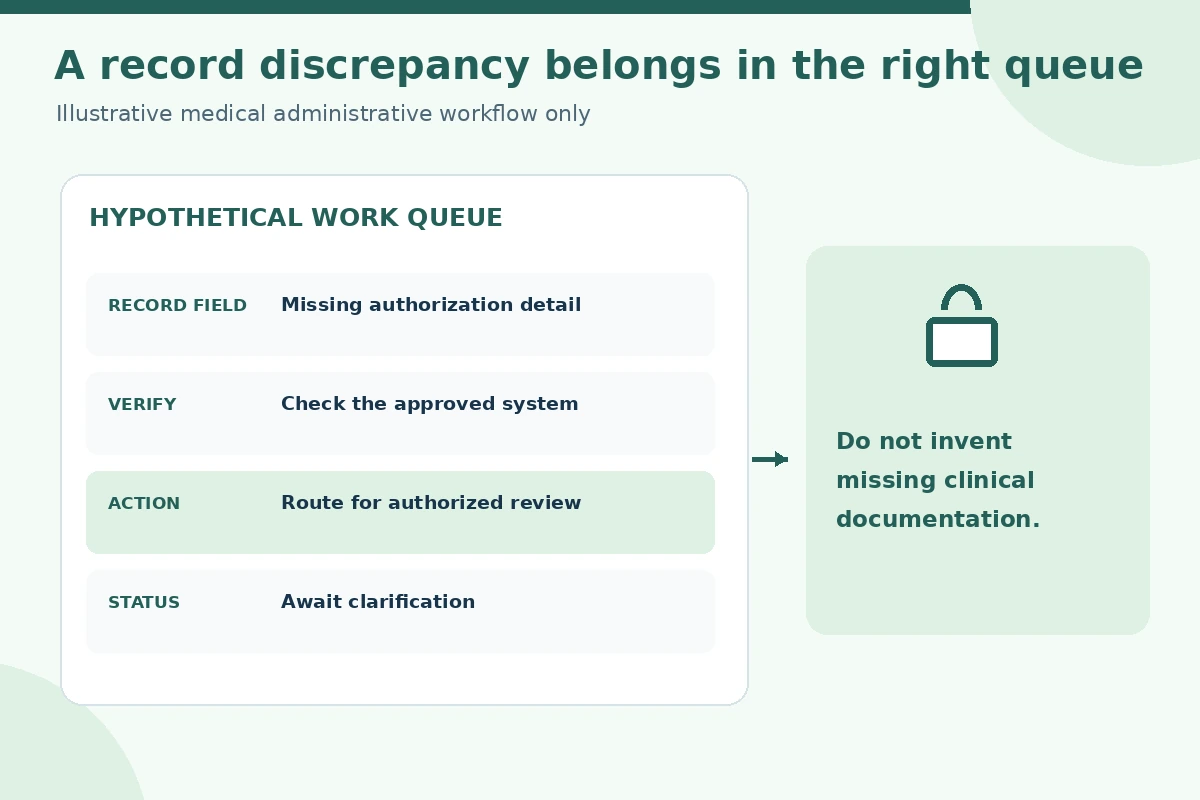
Billing tasks often depend on upstream registration, clinical documentation, and payer responses. A realistic description may identify the point where a worker checks a claim, records an error category, requests documentation through approved channels, and routes the case. If a posting uses “full revenue cycle” without explaining its portion of the work, ask for a typical queue and examples of tasks assigned to the position.
Hypothetical example: “A claim shows a missing authorization detail. I would check the approved work queue, verify what is recorded, and refer the discrepancy under the employer’s rules rather than inventing an authorization.” This demonstrates caution but is not a billing rule for all payers. The correct correction process depends on claim type, system access, plan requirements, and the organization’s compliance policies. Accuracy is preferable to a polished story of unauthorized fixes.
Understand Location, Equipment, and Supervision
Working from home does not mean working independently of a healthcare organization. Ask which state or location the employer can hire in, whether secure equipment is provided, what shift the team covers, and whether initial training occurs at a facility. Some positions described as “remote” may require occasional onsite meetings or a private workspace. These conditions are employer-specific; verify them instead of assuming that every coding role can be done abroad.
Check how mentoring and quality review work for newer candidates. A person new to healthcare claims may find a supervised billing support route more realistic than a position requiring independent complex coding. If the employer expects credentials, ask at which step they must be active. When comparing opportunities, prefer explicit duties and a transparent manager or team contact over listings that simply promise easy medical work.
Avoid Paid Access and Certification Traps
The FTC’s work-from-home scam guidance cautions against upfront fees for the promise of employment. An advertisement for “instant certified coding work” coupled with a mandatory payment link deserves careful examination. Training may be a legitimate separate purchase in the world, but paying a recruiter to unlock a purported job is a different proposition. Confirm any course provider and job opportunity independently; a certificate does not guarantee placement.
The FTC’s 2026 side-hustle alert also warns about remote job offers designed to obtain banking or identity information. Do not send an SSN, patient records, or banking details through an unverified personal chat. Look for the opening through the organization’s actual careers site and check the application channel. If someone sends a check to buy equipment and asks for part of the funds back, stop the transaction and independently verify the arrangement.

Build a Credible Healthcare Records Application
Tailor the first resume lines to tasks you can substantiate: careful records, authorized access, accurate case notes, claim follow-up, or documented coursework. Describe tools as used, studied, or unfamiliar; do not merge those categories. If you have no healthcare experience, use an honest transferable example, such as matching source files and recording discrepancies while following privacy instructions. A hobby spreadsheet is not proof of knowing a clinical coding system.
Before submitting, cross-check the job requirements, location, credential names, shift and training format, and employer identity. Prepare questions about coding review, billing escalation, and secure access. A realistic first step may be a medical records support or claims clerk role if you do not qualify for independent coding. This is a role-fit distinction, not a promise that any particular employer is currently hiring.
How We Research These Remote Work Choices
We checked BLS, FTC, FTC on October 27, 2026 to distinguish occupational duties, qualifications, remote-work limitations, and job-scam warnings. The illustrations are original explanatory diagrams; sample tasks are hypothetical, not actual employer policies or reported client outcomes. Requirements may change, so verify the current job listing and the organization’s official instructions.
JobAsk does not claim an employer affiliation, an available vacancy, or a guaranteed hiring result from this information. If you follow commercial links elsewhere on the site, read our affiliate disclosure; no paid referral or affiliate relationship is asserted in this guide.
Related Job Search Guides
- Online Proofreading Jobs From Home: Build Samples and Check the Assignment
- Remote Dispatcher Jobs From Home: Check Routing and Coverage Duties
- Remote Medical Billing Jobs: Compare Claim Tasks, Records, and Privacy Rules
- Online Jobs From Home: How to Verify Real Work Before You Apply
- Bilingual Work-From-Home Jobs: Compare Interpretation and Translation Roles
No. Remote eligibility, training, technology, and location restrictions depend on the employer and assignment.
No. Billing addresses claims and reimbursement workflow; coding classifies documented medical information.
No universal requirement applies to all listings. Check the exact employer requirements for the role.
Do not use identifiable patient information without explicit authorization; use safe hypothetical practice material.
Do not pay to obtain a promised job. Verify the employer and process independently.