
Quick answer. A first-job layout decision guide that puts the most relevant education, activities, and independently completed tasks ahead of empty work-history sections. The practical goal is an accurate, easy-to-read US resume, not a visual trick or a promise that a particular employer will accept it. Follow any instructions in the actual application before adopting a general layout recommendation.
This page provides a decision method, original hypothetical examples, and a final document review. Replace every example with your own verifiable history. Do not invent employers, projects, work results, credentials, or screening outcomes to make a format look stronger. Our two-page resume format guide covers when extra space makes your case stronger.
Build the Layout Around Real Evidence, Not Missing Jobs
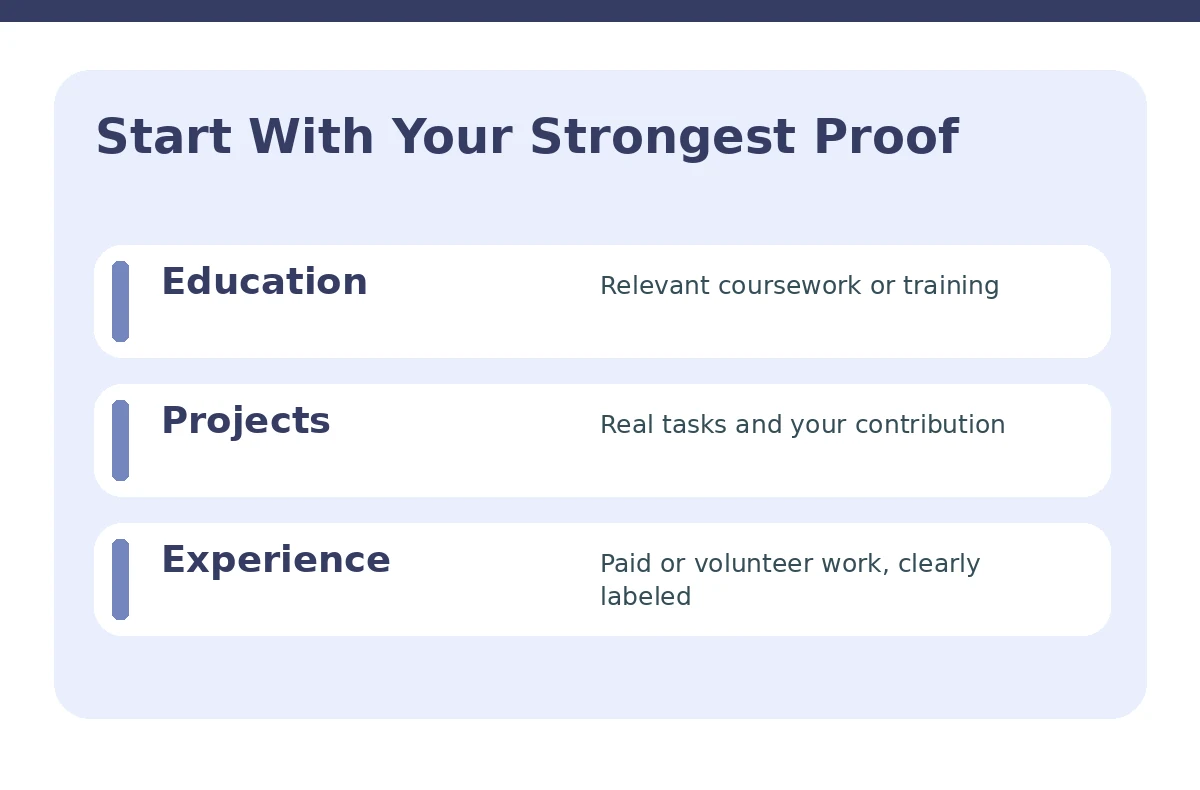
A first-job resume does not need to begin with an empty Professional Experience heading. Start with name and contact details, then choose sections based on the evidence you actually possess: education, relevant coursework, a school project, volunteering, community activities, and paid part-time work if any. The purpose is to help a reader find useful qualifications quickly, not to imitate the resume of someone with years of employment.
CareerOneStop says recent graduates or people with relevant training may place Education before Work Experience. This is a flexible decision based on the target position. If a part-time job already proves the most important skill, lead with that role instead. If the job mainly calls for equipment, software, or basic administrative competence, a real project may deserve early placement.
| Situation | Better option | What to verify |
|---|---|---|
| Recent relevant classwork | Education and projects | Label assignments honestly |
| Part-time work matches role | Experience | Show actual work and dates |
| Volunteer role shows key skills | Volunteer experience | Name the organization and tasks |
Choose a Section Order for This Specific Opening
Scan a genuine job posting for two or three essential tasks. If it emphasizes basic spreadsheet work, a project requiring accurate data entry may be useful. If it emphasizes customer communication, a volunteer role coordinating messages may be closer to the job. Do not fill the resume with every class you have taken or every activity you joined. Select the examples that help answer how you would perform the work.
A practical order is Contact, Education, Relevant Projects or Experience, Skills, and Additional Activities. Change it when evidence suggests a better path. If you are still a student, indicate education status accurately; do not list an unfinished credential as completed. Labels such as School Project, Volunteer Experience, and Part-Time Work communicate the origin of your skills without exaggeration.
Turn Classes and Activities Into Verifiable Examples
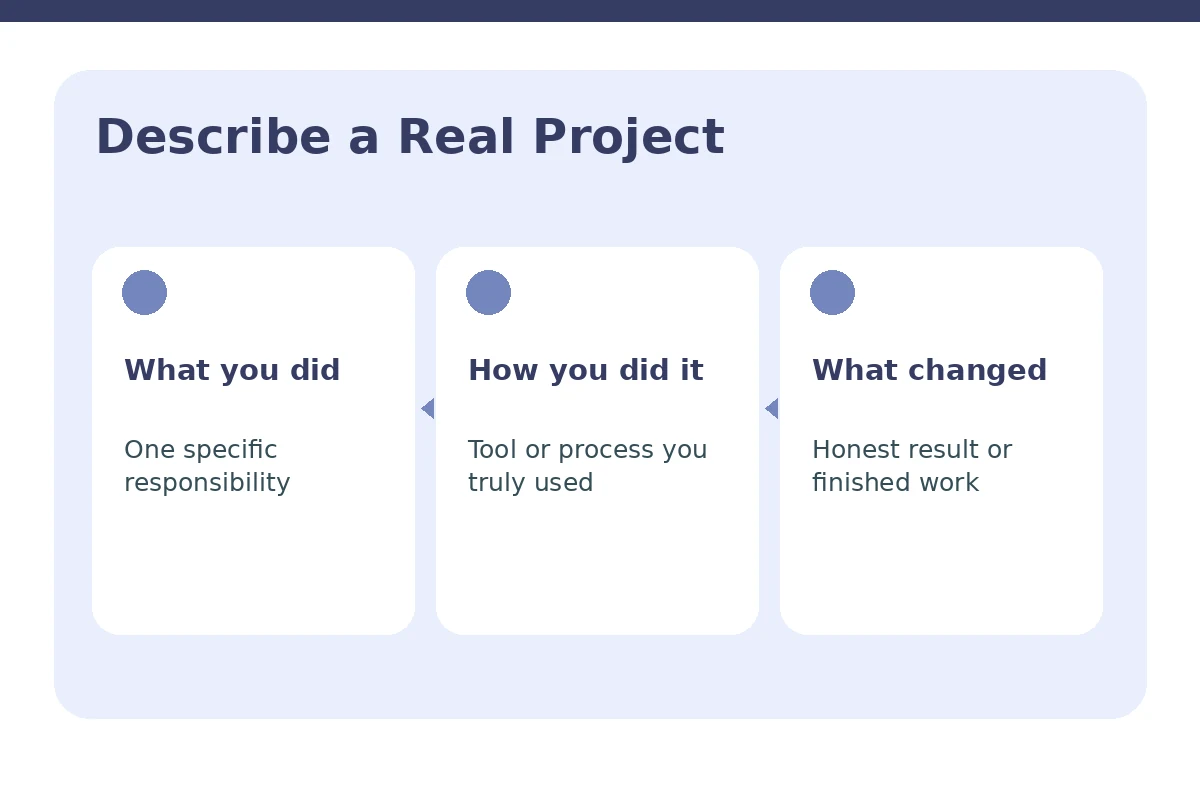
A project can demonstrate planning, communication, basic research, or technical ability when you state exactly what you did. Write the project title and its context, then describe your contribution with an action verb and a concrete output. It is acceptable to name a class assignment as a class assignment. Avoid changing a group project into a solo achievement or calling an exercise paid consulting work.
Hypothetical: for an introductory business course, a student compares several public store websites and summarizes the information in a spreadsheet. A truthful resume line could say, “Prepared a comparison sheet for a class project and checked source links before presenting findings.” This is a fictional practice example. Use the wording structure only if the activity and responsibility resemble your real experience.
Add Skills Only When You Can Explain Them
An entry-level skills section should not be a long list of personality adjectives. If you write “spreadsheet organization,” be ready to explain a workbook you actually used. If you write “customer communication,” identify a service, volunteer, school, or club situation where you practiced it. A limited list backed by examples is more useful than unproven claims of expertise.
Separate familiar tools from formal credentials. Completing one tutorial does not make you a certified specialist. If a posting requires a specific license, document it only if you genuinely hold that credential. Show willingness to learn through completed study, consistent participation, or real practice rather than promising results you have not demonstrated.
Use a Simple One-Page Layout When It Fits
Many student career offices recommend a one-page resume for early applicants. Seton Hall gives one page as the usual starting point for many undergraduate and limited-experience candidates. That is practical guidance rather than a rule for every job. The more important task is to make the evidence readable and relevant without padding the document with generic sentences.
Use a single column, standard section headings, readable type, and enough white space to separate roles or projects. Place actual contact information in normal text. Do not use a photo, decorative skill chart, or crowded sidebar to disguise limited experience. The resume should read like an organized record of learning and activity, not a poster.
Review Honesty, Relevance and Submission Format
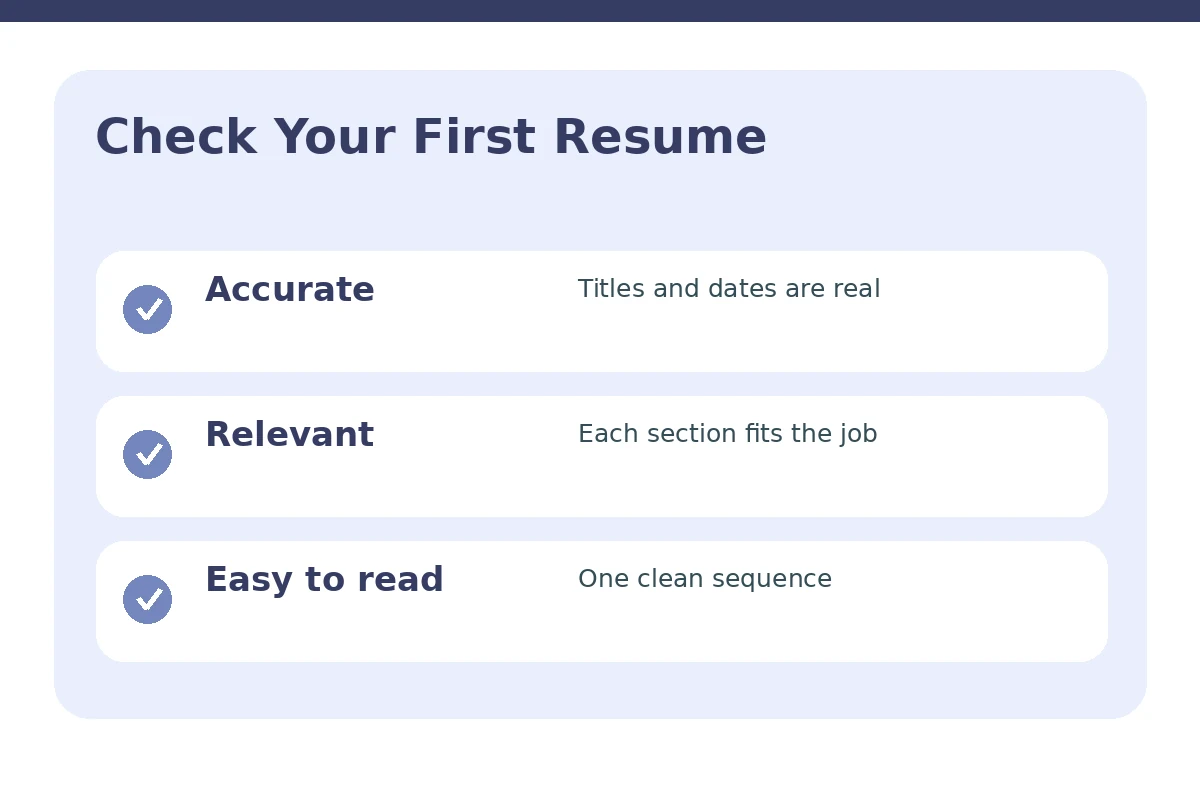
Before sending, mark any line that would be hard to explain in an interview. Does the project title imply employment? Is the tool listed at a level you can demonstrate? Are dates and education status accurate? A first-job resume gains credibility through precision. There is no need to add invented internships, false numbers, or unearned credentials to make a short page appear full.
Finally, follow the employer’s instructions on file type and content. If none are given, inspect a PDF export for broken lines and layout changes. Ask a trusted reader whether they can tell what you have done, where you did it, and why it matters for the role. Use that feedback to clarify the page rather than to make it longer. Our guide “Resume Font Size and Margins” covers how to make the page easy to read.
How We Research and Check This Advice
We checked the current public guidance from the US Department of Labor’s CareerOneStop and university career centers on October 21, 2026. We compared their advice on readability, work-history visibility, section order, and page length against the particular reader decision in this guide. The visual decision aids and hypothetical scenarios were created for this article; they are not employer-tested templates or evidence of any specific applicant-tracking system outcome.
Sources, Limits, and Affiliate Disclosure
Sources checked on October 21, 2026: cloudfront.careeronestop.org — CareerOneStop recommends placing education before experience when recent training is strongest.; www.shu.edu — Seton Hall student resume guidance covers one-page layouts, readability and student experience.; cloudfront.careeronestop.org — CareerOneStop supports readable headings, a single-column design and simple formatting.. These sources offer guidance rather than guarantees, and specific employer instructions override generalized suggestions.
This informational article includes no confirmed affiliate recommendation or paid placement. If JobAsk later uses compensated links, see the site-wide affiliate disclosure. No partner relationship is implied by the ordinary internal links on this page.
More Resume and Cover Letter Guides
- Two-Column Resume Layout: When to Use It and How to Check It
- Continuing Education on a Resume: List Courses, Workshops, and Real Proof
- One-Page Resume Layout: Cut Clutter Without Losing Job-Relevant Proof
- College Student Resume Layout: Order Education, Projects, and Work
- Architecture Resume Layout: Connect Project Roles to Portfolio Proof
Put your strongest relevant evidence first. Education may lead for students; a closely related part-time job may deserve first place instead.
They can show relevant skills when labeled clearly as projects, not invented paid employment.
Not necessarily. A concise education or projects section often provides clearer proof than a generic summary.
Often yes. Keep the page focused and readable rather than adding filler to occupy more space.
No. Choose activities that establish a task or skill requested in the target job and describe your actual contribution.