
Quick answer. A warehouse cover letter works best when it shows how you prevent avoidable mistakes, communicate with coworkers and follow the procedures you were trained to use. The hiring manager does not need a dramatic story. One true example of counting stock, checking an order or reporting a discrepancy is more useful than an unverified claim about perfect productivity.
Keep the letter focused on the site and shift named in the posting. A simple structure works: a specific opening, one or two paragraphs linking reliable work to the site’s needs, and a courteous close. The sample lines below are hypothetical; rewrite them with your own jobs, shifts, and training.
Start With the Work This Role Actually Requires
O*NET describes stockers and order fillers as receiving, storing and issuing items, and lists tasks such as stock counts and order filling. That occupation overlaps many warehouse openings but does not establish that every job involves the same equipment, shifts or certifications. Read whether the posting emphasizes receiving, picking, shipping, inventory or material movement; these words point to different evidence and may involve different training.
Before you write, mark two or three requirements in the posting you can support, such as equipment you have used. The University of Oregon cover-letter guide recommends choosing qualifications from the job description and connecting them to experience. Read the company’s own pages about the site, but avoid vague praise you cannot back up. If a requirement is unclear, describe the floor experience you have rather than claiming a match.
Match Real Experience to the Specific Job
Choose a real workplace, classroom or volunteer task. For receiving, explain how you compared the shipment or list with what arrived. For picking or packing, explain how you checked labels or quantities. If you have never worked in a warehouse, a genuine inventory task from retail or event setup may show transferable organization. Do not call it warehouse experience if it was not. Do not invent a barcode system, forklift certification or productivity figure. Our warehouse worker resume summary guide adds more detail on this.

| What the posting needs | Evidence you can verify | Claim to avoid |
|---|---|---|
| Receiving and counting | An item-count check you completed | Do not invent results or responsibilities |
| Inventory records | A record you corrected | Do not invent results or responsibilities |
| Picking and packing | An order you verified | Do not invent results or responsibilities |
| Safe handoffs | A time you reported a hazard | Do not invent results or responsibilities |
A strong account names both an action and a limit. For example, if a stock count did not match a record, describe checking the source information and reporting the variance, not silently changing numbers. If machinery was involved, identify only equipment you were trained and authorized to operate. “I follow established safety instructions and ask when a task is outside my training” is more credible than “I can operate any warehouse machine.”
Write a Clear Opening That Earns Attention
Your opening should name the position, connect to one need of the site, and preview your reliability. Use the exact job title from the posting, such as “Warehouse Associate.” If you do not know the hiring manager’s name, use a neutral greeting rather than guessing. The University of Virginia career center advises that referral context or a relevant personal connection can be mentioned early when it really exists.

Write one short sentence for each step above. If your opening could go to any warehouse unchanged, add a detail about this site or shift. Describe equipment, certifications, and attendance only as far as you can verify them. The letter should explain your reliability, not repeat every line of your résumé.
Study One Hypothetical Letter and Revise It
Hypothetical sample for adaptation, not a real work history: “Dear Hiring Team, I am interested in your warehouse associate opening, especially the receiving and order-checking responsibilities described in the posting. In a previous retail stockroom assignment, I checked delivered item counts against our receiving list and reported differences to the person responsible for inventory records. I learned to keep labels readable, separate uncertain items from completed checks and communicate before an order moved forward. I would bring the same careful approach to the warehouse team while learning your procedures and equipment requirements. Thank you for reviewing my application. Sincerely, [Your Name].”
This sample names a retail stockroom rather than pretending to be a fulfillment-center job. Use it only if you personally did comparable work; otherwise select a different true example. Remove any equipment, software, metric or schedule availability that is not yours. If the posting requires a credential, the application should reflect what you actually hold, rather than assuming that willingness to learn satisfies a formal prerequisite.
Adapt Your Evidence to Different Application Situations
If you already work in a warehouse: explain your part of the flow instead of saying you “managed operations” when you only handled picking. You might describe a real quality check, an exception you raised or a handoff you coordinated. Measurements can help only if you recorded them and can explain how they were calculated; avoid making up orders per hour or error rates.
If you come from retail or food service: identify overlap honestly. Counting supplies, labeling items and coordinating a restock are relevant skills, but not the same as operating powered industrial equipment. A short letter can say which habits transfer and which systems you would need to learn. No employer-specific safety program should be described without evidence.
If the opening advertises demanding shifts or lifting: avoid claims about physical capacity or availability you cannot support. Confirm the actual expectations through the employer and respond accurately in the application. The cover letter can emphasize dependability and following instructions without making medical, legal or employment guarantees.
Revise for Accuracy Before You Submit
Generic phrases like “hard worker” and “team player” need a specific situation behind them. A list of forklift models you have never used can misrepresent your skills. Promising zero errors forever is also unrealistic; explain how you verify work and address discrepancies. Finally, reread the posting for the actual location, shift and job title so the letter does not sound reused.
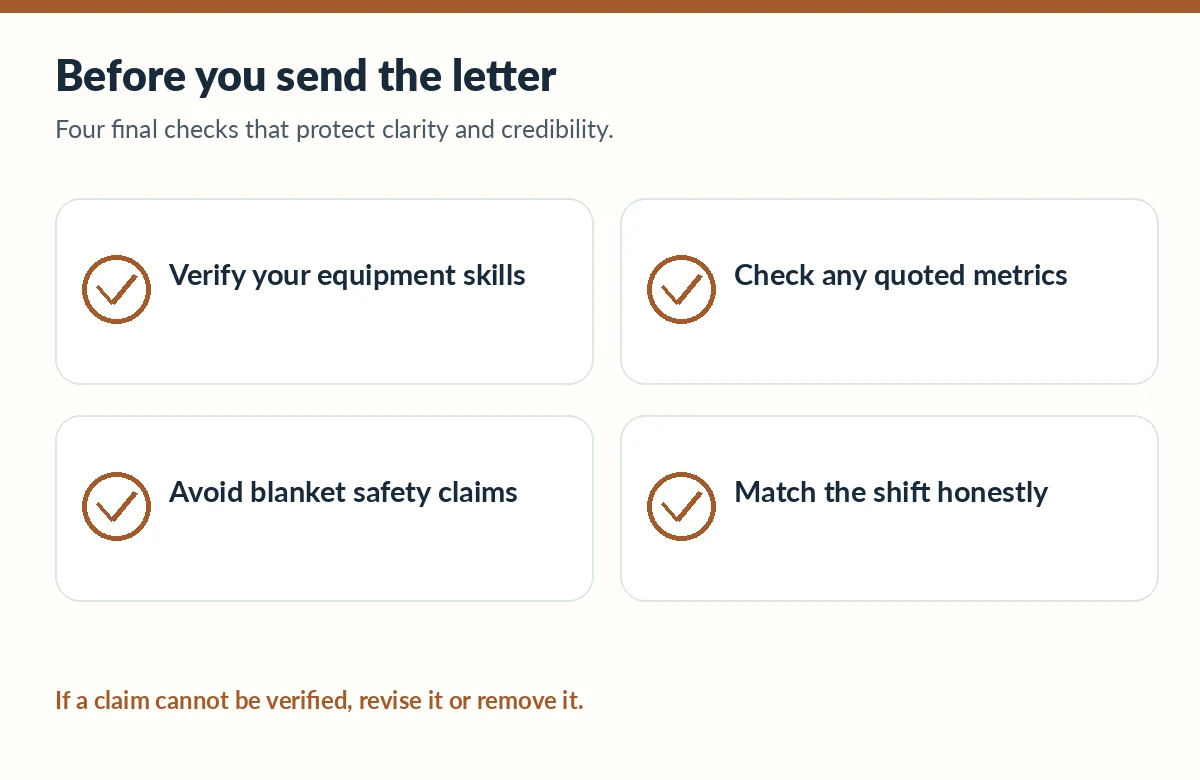
Read the letter aloud once and compare it with the warehouse posting. Does the first paragraph name the right site and shift? Does your main example show a skill the posting asks for, such as accuracy or safety? Have you described training, certifications, and shared tasks precisely? Every employer, date, and certification must be accurate. If the employer uses an online form or short answer box, follow those instructions instead of a template.
Aim for a concise page unless the employer specifically asks for something else; the Santa Clara University career center suggests generally keeping a cover letter to one page and connecting relevant qualifications to the employer. Cut any paragraph that lists traits without showing a real example.
How We Research and Check Cover Letter Advice
This guide draws on university career-center advice and warehouse occupation information. Sources were reviewed on 2026-10-21. The sample letter lines are hypothetical and do not represent a real worker, warehouse, or hiring result.
Source notes: O*NET occupational profile; University career guidance; University career guidance. For disclosures about links and commercial relationships, see the JobAsk affiliate disclosure.
More Resume and Cover Letter Guides
- How to Address a Cover Letter Without a Name: Choose a Respectful Greeting
- Warehouse Worker Cover Letter: Prove Reliable Picking and Handoffs
- Warehouse Associate Cover Letter: Show Safe, Accurate Work
- Research Assistant Cover Letter: Prove Methods and Careful Records
- Career Change Cover Letter: Prove Transferable Skills for a New Role
Yes. Use a real inventory, organization or teamwork task from another setting and clearly identify the setting.
Only if it comes from records you can explain, relates to your work and is appropriate to disclose. Never invent a rate.
No. Mention equipment only when relevant and only if you are genuinely trained or qualified to use it.
Describe a true practice such as reporting uncertainty, following a taught procedure or stopping to ask for guidance.
Choose an example centered on final order checks, documentation or handoffs instead of recycling an unrelated receiving story.