
A data analyst cover letter is strongest when it explains one relevant analysis project from question to decision. Name the problem you investigated, the data you used, the checks you performed, and what you communicated. A list of SQL, Python, and dashboard tools is not enough to show analytical judgment. Do not invent a business result or describe an academic project as a production system.
For this topic, we checked the occupational duties reference and another university career-writing resource.
Read the Posting for Actual Responsibilities
Data analyst titles cover different work. O*NET’s business intelligence analyst profile includes reporting, dashboards, and analyzing information, but it is one related occupation rather than a definition of every data analyst opening. Read the specific posting to see whether the focus is reporting, experimentation, operational analysis, or data preparation.
For this data analyst cover letter, mark the two duties in the posting that matter most. Begin with “problem framing” if the posting actually names it, then check whether your real experience supports “data quality.” Put each task beside an example that you could describe in an interview. If the posting asks for a tool such as SQL or Python that you have not used on real data, note the gap privately instead of covering it.
The applicant should not copy an entire data analyst cover letter posting into a letter. For instance, “explain why the measure matters” is a useful drafting prompt only when the underlying task exists in your history. If the posting stresses reporting over modeling, lead with the reporting work you have actually done.
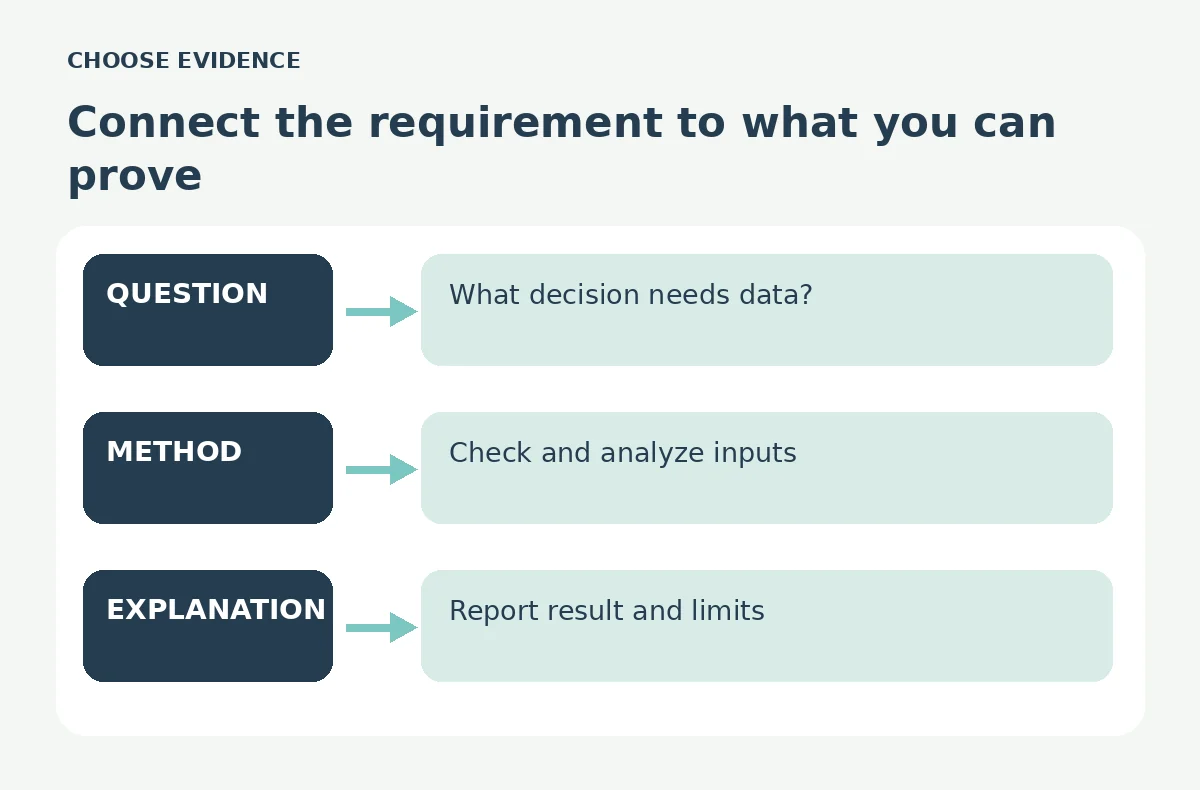
Select One Verifiable Example of Fit
An early-career applicant might discuss a university or personal project analyzing a published dataset. An experienced analyst might explain validating a recurring report or collaborating with stakeholders to define a metric. In either case, the valuable evidence is the process, decision context, and the claims you can defend.
Apply the diagram to a concrete data analyst example. In the first column note “Problem framing”; in the second, record the setting where you actually did it; in the third, outline the step you personally took. Repeat for “Data quality” only if that work is authentic. If you cannot explain the data source, your query, or how you checked it, pick another example rather than inventing a metric.
| What the role may need | Evidence you might possess | What to say in the letter |
|---|---|---|
| Problem framing | A clearly stated business or research question | Explain why the measure matters |
| Data quality | Missing values, duplicates, joins, or definitions | Name one check you actually ran |
| Analysis | A real query, notebook, or dashboard process | Describe your contribution rather than buzzwords |
| Communication | A report, chart, or explanation for an audience | Explain a limitation or decision, not invented impact |
Show the Path From Dataset to Finding
Begin your chosen example with a question rather than a tool: which issue were you trying to understand? Then describe what the dataset represented, how you checked its completeness or definitions, and which method produced the result. A portfolio project might use SQL joins or a spreadsheet pivot table, but the value of the example is the reasoning, not the most impressive software name.
If the underlying dataset was small, public, synthetic, or incomplete, say so. A pattern in a class dataset may suggest a question for further study; it does not prove that a real company will increase revenue or change policy. A careful analyst can explain what the results show, what they do not show, and why another check would matter before a decision.
For a job focused on dashboards, lead with audience needs and metric definitions. For a job focused on data preparation, lead with validation, repeatability, and documentation. As for a job emphasizing stakeholder communication, describe the wording or visualization you used to make an uncertain finding understandable. The same project can support different claims, but only if those tasks were genuinely part of the project.
Build an Opening That Names the Match
A focused opening for this data analyst cover letter should name the advertised position and one relevant capability: problem framing or data quality, depending on the posting. A reader should see why your data work fits the role in two sentences. Replace phrases like “data-driven” with a real dataset you cleaned or analyzed. Our internship cover letter guide covers how to turn coursework and projects into proof.
After the opening, explain one analysis from question to finding, not a list of tools. For data analyst applications, a useful sequence is the setting, your role, the step you performed, and what you verified. If you cannot verify a number, describe the report, dashboard, or decision your work supported. Close by offering to walk through the analysis in more detail, without promising a result.
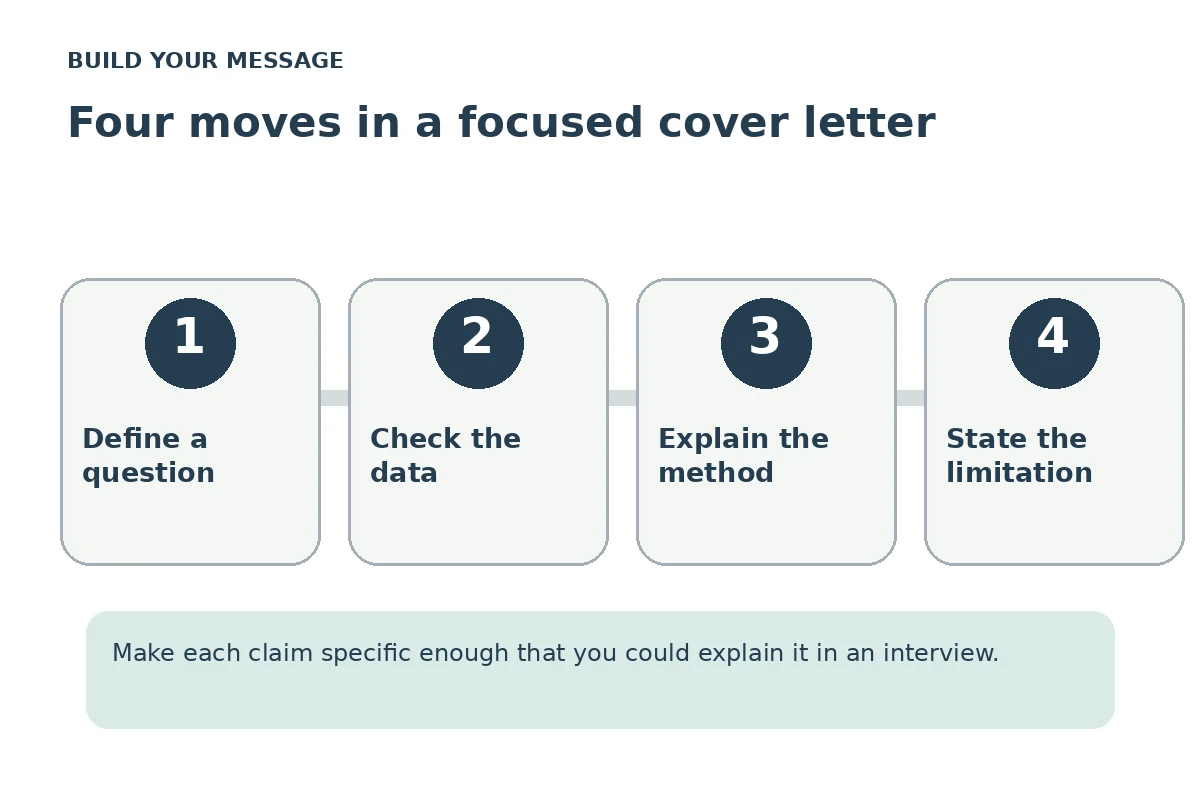
Adapt This Hypothetical Cover Letter
Replace each bracket with a fact from your own data work. Remove any line that implies tools or methods you have not used.
Dear Hiring Team, I am applying for the Data Analyst role because its emphasis on [reporting or analytical responsibility] matches work I have practiced through [truthfully described project or job]. I enjoy explaining how a result was produced, not only presenting the final chart.
In a [course, independent, or professional project], I examined [accurate dataset description] to answer [specific question]. I checked [real data-quality issue], used [tools genuinely used] to [method], and documented [actual finding or deliverable]. I noted [real limitation] so the result would not be interpreted more broadly than the evidence supports.
Your posting mentions [second requirement]. My experience with [verifiable task] would help me contribute to that work, while I continue to learn the team’s definitions, review standards, and reporting process.
Thank you for considering my application. I would welcome the chance to walk through the project, its assumptions, and what I would check before reusing its findings. Sincerely, [Your Name]
Read the hypothetical data analyst cover letter sample with your own posting nearby. The words “problem framing” and “data quality” should remain only when the job calls for them.
Adjust Your Approach for Your Background
First analyst role: Use a reproducible course or independent project, make its setting explicit, and link only to a portfolio you own and have permission to share.
Experienced analyst: Choose a documented data-quality check and a stakeholder explanation; avoid revealing protected employer information.
Your background changes the evidence available for this data analyst cover letter. An analyst with work experience can describe a real report and how it was used. A newer analyst can rely on a course dataset, a public dataset, or a personal project, clearly labeled. If your best analysis is smaller than the role’s scope, say so and explain what you learned.
Avoid Overclaiming Skills or Experience
Many applications name technical tools without a decision trail. A letter that says you built a dashboard can still leave questions: who needed it, what inputs were checked, which measures were defined, and what limitations did you explain? A compact project account can answer those questions.
Be accurate about the data and the tools. If you cleaned a public practice dataset, label it as public or sample data and report only findings that follow from that exercise. If you calculated a result but did not implement a recommendation, do not imply the analysis caused a business improvement.
| Potential mistake | Safer revision |
|---|---|
| Treating tool names as a substitute for evidence | Replace it with a personally verifiable task, precise qualification, or a clear statement of current learning. |
| Calling a public dataset a confidential employer dataset | Replace it with a personally verifiable task, precise qualification, or a clear statement of current learning. |
| Claiming causal business improvement from a descriptive chart | Replace it with a personally verifiable task, precise qualification, or a clear statement of current learning. |
| Omitting data-quality issues or claiming a result you did not validate | Replace it with a personally verifiable task, precise qualification, or a clear statement of current learning. |
Check confidentiality before you link a dashboard, notebook, or sample report. Do not share company data or internal reports without permission. Even when you share a project, use public or anonymized data.
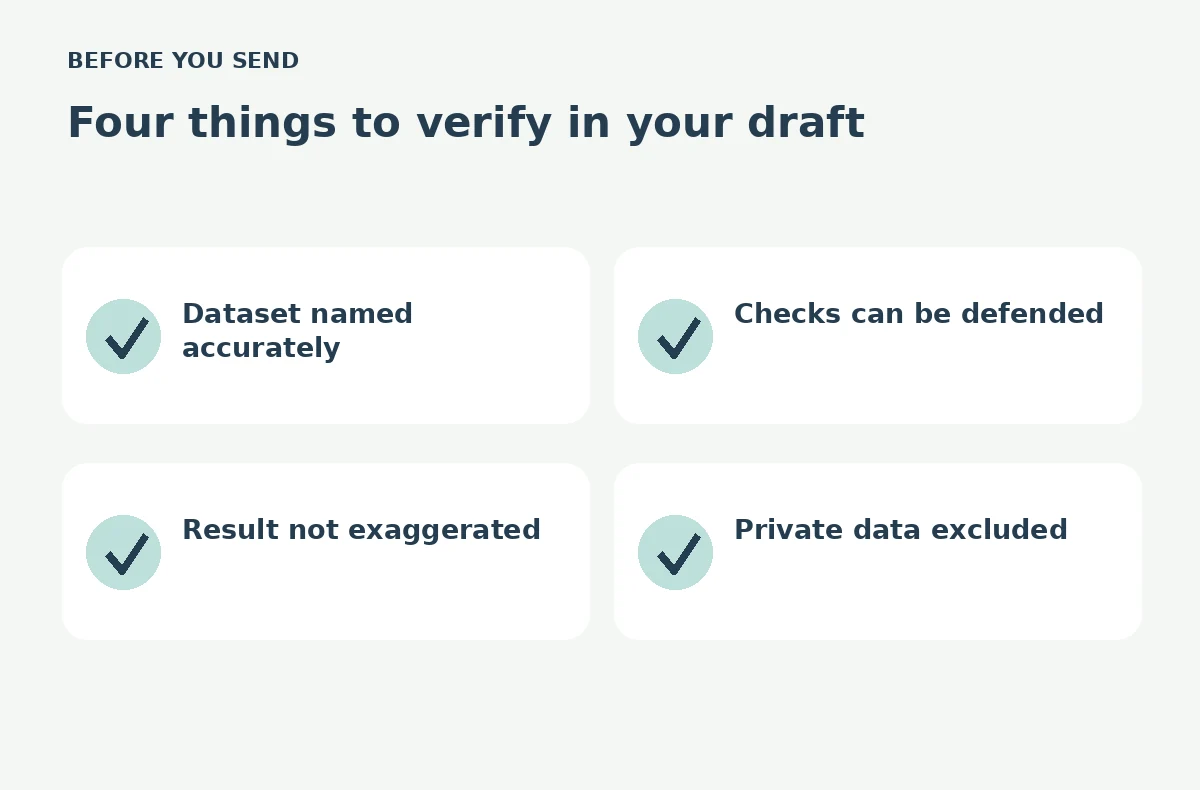
Before adding a chart link, check whether the dataset or report can be shared publicly. Never copy an employer’s internal dashboard, export protected records, or imply that you own a team’s work. If your results are hypothetical or from a practice data source, that label should remain visible in the letter and portfolio. Keep correlation separate from causation.
Proofread Against the Position Description
Proofread your data analyst cover letter against the actual advertisement rather than a generic template. First, confirm the title and the main analysis duties match the posting. Second, check every claim about tools, datasets, and results. Third, verify submission rules, portfolio links, and attachments. Remove guesses about the company’s data stack or hiring decisions.
Use the visual checklist to test the four claims most likely to weaken this letter for a data-analysis role: dataset named accurately, checks can be defended, result not exaggerated, and private data excluded. Where you lack evidence, describe what you are learning or pick another project.
Keep the letter short enough for a hiring manager to skim. About one page is a common guideline, but follow the employer’s instructions first. Use clean formatting, plain language, and the same contact details as your résumé. Ask a reviewer to flag any phrase that overstates your analysis skills.
Read your letter as though an analyst interviewer will question every step. Could you reproduce the query, explain the missing-data decision, and describe why you selected that chart? If not, narrow the claim. A modest reproducible project is preferable to an elaborate success story whose method you cannot defend.
How We Research This Guidance
We separated two kinds of evidence: public occupational or university guidance for typical tasks and writing practices, and the applicant-specific facts that only you can verify.
Sources checked on 2026-10-21: occupational reference (O*NET lists reporting, dashboards, databases, and interpretation among business intelligence analyst tasks; this is a related, not universal, data-analyst profile.) career-center writing guidance (UC Davis Career Center recommends evidence of fit and specific experiences or projects rather than repeating the resume.) career-center writing guidance (UT Austin Career Services offers posting-matched examples including an internship application.) These sources inform the advice but do not validate an individual applicant’s facts or imply endorsement.
For the site-wide policy, read the affiliate disclosure.
Related Guides
- Data Scientist Cover Letter: Show Model Validation and Business Context
- Data Analyst Resume Summary: Highlight Validation, Tools, and Decisions
- Data Analyst Interview Questions: Validate Results and Explain Decisions
- Tell Me About Yourself in a Data Analyst Interview: Project to Decision
- Data Analyst Resume Summary: Connect Methods, Projects, and Findings
Yes. Label it as an independent or academic project, explain the data source and method, and avoid claiming it delivered commercial results.
No. Mention tools you used in the featured project or that are essential to the particular opening, without exaggerating proficiency.
Describe the question, validation steps, limits, and what additional data would be needed. Careful interpretation can itself be relevant evidence.
Only if the work is yours, shareable, accessible, and appropriate to the employer’s application instructions. Never expose private datasets.
Lead with the audience, question, definition of a useful metric, and how you explained results; keep tools supporting that narrative.