
A introductory profile for a data analyst should communicate how you work with information, not simply name every software package you have opened. Begin with actual analysis experience, identify tools you can genuinely use, and show how you checked or explained your findings. It is more useful to say that you validated a reporting dataset than to claim you “turn data into magic.”
O*NET describes business intelligence analyst work including report generation, dashboard maintenance, analysis of trends, and checking information against defined needs. These are descriptions of occupational tasks, not evidence that an applicant has performed them. Your summary must come from your own project or job history.
Start With the Business or Research Question
Look at the role description: is the priority recurring operational reporting, customer analysis, financial dashboards, data quality, or exploratory research? Use one relevant area to anchor the summary. A dashboard-heavy analyst opening needs different evidence than a position focused on survey design or data reconciliation. Our business analyst resume summary guide adds more detail on this.
Ask which question the work was meant to answer. For example, a student project might compare patterns across survey responses, while a finance operations job might reconcile monthly records. State the project purpose without suggesting that a coursework exercise produced a company decision. A summary should accurately reflect the setting and limits of your analysis. To go further, our recent graduate resume summary guide shows how to use coursework and project evidence.
Name Only Tools Used in Real Work
SQL, Python, Excel, Power BI, Tableau, and statistical software are not interchangeable. If you built a pivot table, do not imply you created a production machine-learning model. If you wrote SQL queries for a class database, name that context when appropriate and explain whether you joined tables, filtered records, or aggregated values.
A concise summary might mention one or two tools with a task attached: “used SQL to reconcile reporting fields” is more informative than “SQL, Python, R, Tableau, Excel, Power BI expert.” Reserve a detailed technical inventory for a skills section where the reader can understand your actual working level. Our guide “Excel Skills on a Resume” goes into more detail.
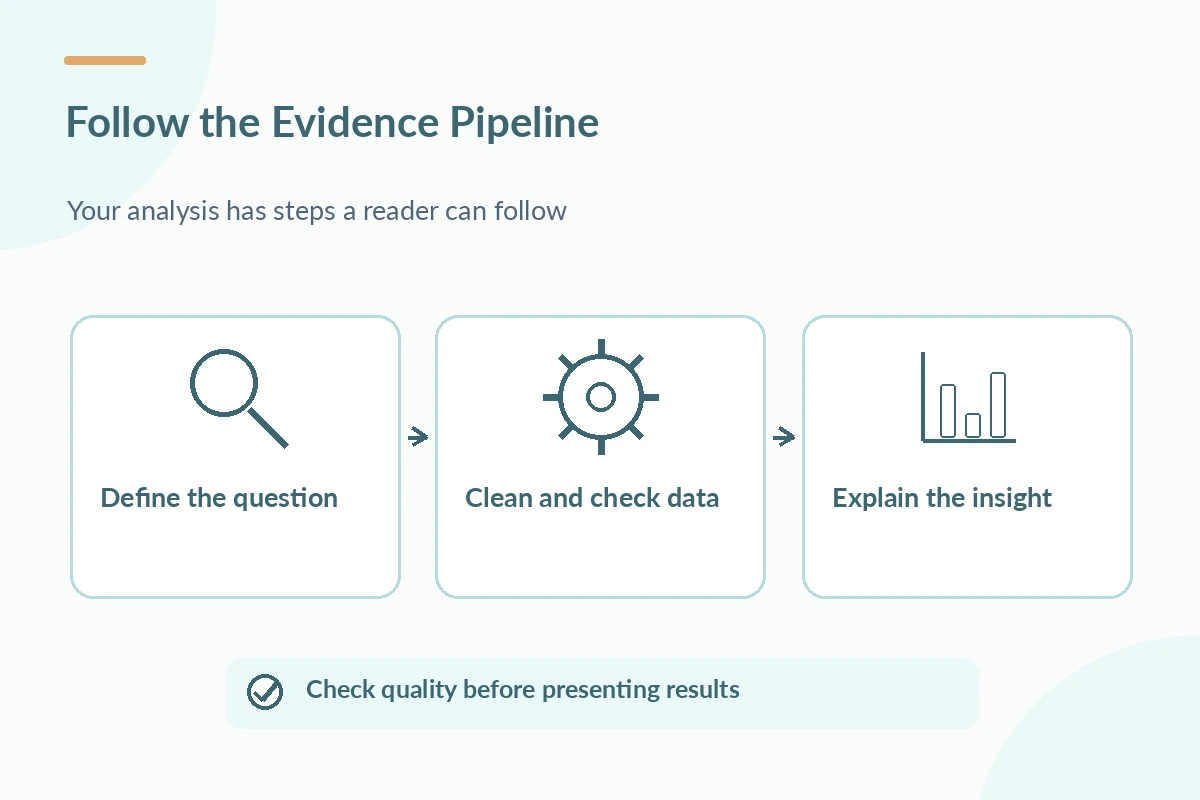
Make Data Validation Visible
Employers need analyses they can trust. A data-focused summary can mention actual validation: checking missing values, comparing totals to source records, verifying join keys, reviewing date ranges, or reconciling repeated calculations. Do not claim every possible quality-control method if you used only one.
O*NET includes testing and maintaining reporting information among related analyst activities. A meaningful summary makes the quality step visible so the reader can distinguish analytical judgment from generating a chart. Write what you checked and why it mattered to the task. If the findings were uncertain, describe that uncertainty rather than converting it into an exaggerated result.
Connect Analysis to a Clear Output
A report, documented query, reproducible notebook, dashboard, or presentation can give the reader a concrete output. It is not necessary to invent a business outcome to make an analytics project useful. “Prepared a weekly exception report for supervisor review” is a legitimate kind of output when true; it does not automatically mean the report improved profits.
Hypothetical sample: “Entry-level data analyst with project experience cleaning survey responses in spreadsheets, checking category totals, and presenting a concise dashboard to classmates. Comfortable explaining data limitations and documenting analysis steps.” This invented candidate example is for writing practice only. Replace the methods, audience, and deliverables with your actual work.

Distinguish Your Contribution From Team Results
A collaborative data project may include database design by one member, cleansing by another, and presentation by a third. Your summary should not claim you designed the entire pipeline if your actual contribution was validating final tables. Use accurate verbs such as prepared, tested, compared, or explained in relation to your contribution.
This is consistent with the UC San Diego resume guide, which emphasizes outcomes and what the individual contributed. If a quantified effect was the team’s reported result, clearly establish which part you owned. If you cannot substantiate the number, omit it and name the practical deliverable instead.
Adapt for Entry-Level and Experienced Analysts
For entry-level work, coursework and completed independent projects may be appropriate if their status is clear. An experienced analyst should usually prioritize actual recurring reports, stakeholder communication, data testing, or systems used at work. Neither group benefits from padding the summary with vague “data-driven” claims.
Do not present a demonstration dashboard as a deployed enterprise report. Likewise, avoid downgrading a substantial professional contribution to an empty list of tools. Use the highest-value evidence appropriate to your career stage. If the job posting lists a technique you have not used, do not add it to the summary just to mirror the employer’s vocabulary. Our career change resume summary guide adds more detail on this.

Audit Any Claim About Business Impact
Phrases such as “saved hundreds of hours” or “grew revenue 30%” require a verifiable calculation and a credible connection to your contribution. If the employer recorded those results and you can explain them, describe the context and attribution. If not, focus on the report, validation, or recommendation that you produced.
Your summary is not the place to imply that a visualization guaranteed improved decisions. Data can inform choices while leaving uncertainty. The University of Montana career guide advises truthful and relevant accomplishments. Apply the same honesty to analysis projects and avoid numerical decoration without a measurable basis.
Run the Analyst Summary Quality Test
Read the opening and ask four questions: What information did the person analyze? What did they actually do? How did they check their work? What did they deliver or communicate? A summary may not answer every question, but it should reveal something more useful than “passionate about insights.”
Then cross-check every claim with the project or experience bullets. Software labels, report types, audiences, and results must agree. Trim irrelevant technologies and replace stock phrases with precise actions. A credible, readable statement is useful; it cannot guarantee a screening result or an interview invitation.
How We Research Resume Summaries
The sources reviewed on 2026-10-22 are O*NET, university career guidance, university career guidance. We compared their actual occupational descriptions or career-center guidance with the limited claims made above. These references do not verify any hypothetical candidate, guarantee a hiring outcome, or establish an applicant tracking system ranking. All examples labeled hypothetical are invented teaching cases.
Earlier generic resume-summary pages cover broad principles; this guide addresses a specific applicant context. No affiliate partnership is asserted; see the affiliate disclosure.
Related Guides
- Data Analyst Cover Letter: Connect Data Quality Checks to Useful Decisions
- Data Analyst Interview Questions: Validate Results and Explain Decisions
- Data Analyst Cover Letter: From Verified Data to a Clear Insight
- Tell Me About Yourself in a Data Analyst Interview: Project to Decision
- Data Analyst Interview Questions About Accuracy and Clear Insights
Only when you actually used the tools and they matter for the vacancy. Describe the task, not merely the software name.
Yes, if you label it as coursework and accurately explain your contribution and output.
No. A documented analysis, data-quality check, or concrete report can be useful without an invented metric.
A specific process, such as validating source totals before preparing a recurring report, is more informative.
Only if you truly led it. Otherwise identify your part in the team’s work.