
Entry-level paralegal jobs may be available as trainee positions, but the title does not always mean an employer will train someone with no legal education. Start by comparing paralegal, legal assistant, and case intake descriptions against your own coursework, credentials, and practical document skills. The Bureau of Labor Statistics describes several routes into paralegal work and notes that education expectations differ by employer. A careful applicant demonstrates accurate research and file handling without claiming attorney responsibilities or giving legal advice.
The professional context in this guide is grounded in the primary occupational source, while the application process follows CareerOneStop job-search advice. The examples below are hypothetical unless they explicitly describe a type of task reported by an official occupational source; they are not live vacancies or employer guarantees.
What Entry-Level Really Means for Paralegal
According to the Bureau of Labor Statistics, paralegals and legal assistants help attorneys with research, case facts, documents, correspondence, and preparation. Many enter through an associate degree or a paralegal studies certificate; some employers prefer bachelor’s degrees, while some hire applicants with other backgrounds and train them. That does not make every law firm willing to waive its listed requirements. Read the actual vacancy before deciding that the word ‘junior’ makes you qualified.
Legal support roles vary widely by practice area. A litigation-focused opening might emphasize exhibits and case schedules, while another organization needs contract records or administrative coordination. The work can involve private client information and deadlines, so accuracy and confidentiality matter. A beginner should be clear about what work they can perform under supervision and should not suggest they can independently practice law or counsel clients.

Compare Three Practical Starting Routes
A paralegal trainee position may explicitly offer supervised research and drafting. A legal assistant opening might prioritize scheduling, filing, proofreading, and correspondence. Case intake support may require patient listening and precise summaries but not legal interpretation. These are related paths rather than interchangeable job titles, and their required education and permissible duties depend on the specific role and relevant jurisdiction.
| Starting route | What to check in the posting |
|---|---|
| Paralegal trainee | Support supervised document and case research with clearly defined responsibilities. |
| Legal assistant | Coordinate files, correspondence, scheduling, and attorney requests. |
| Case intake support | Record client inquiry details under practice policies and escalate legal questions. |
Choose the route using both credentials and work evidence. A candidate with academic research and a paralegal certificate may pursue different openings from an applicant whose best evidence is accurate office coordination. If a posting requires a specific credential, do not substitute enthusiasm for that requirement. If it lists a degree only as preferred, CareerOneStop suggests examining which other required skills you already meet.
Show Evidence Without Inflating Your Experience
Use a publicly available, nonconfidential topic to write a short research memo with a date, sources, and a description of what remains uncertain. State that it is a hypothetical educational example, not legal advice. A second sample could index invented case files with document names, versions, and deadlines. Neither should contain an actual client’s name, private correspondence, or privileged materials from a workplace.
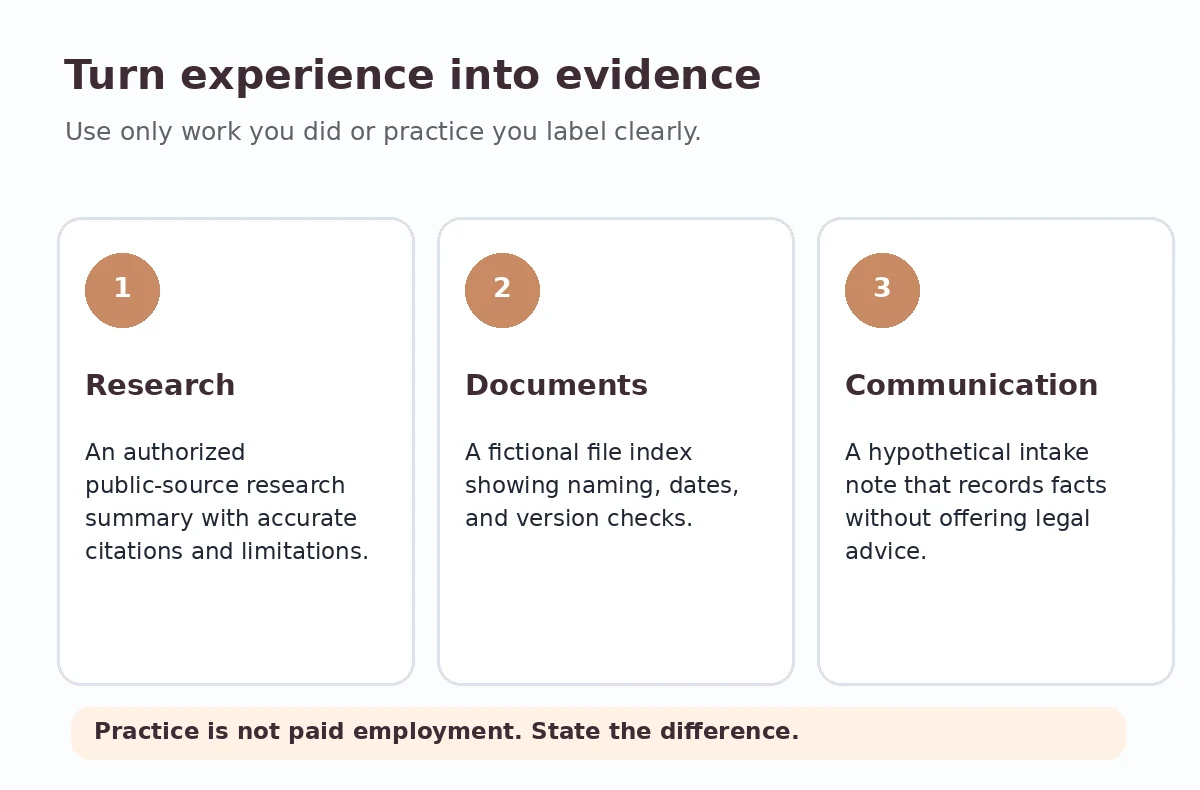
| Evidence area | Honest beginner example |
|---|---|
| Research | An authorized public-source research summary with accurate citations and limitations. |
| Documents | A fictional file index showing naming, dates, and version checks. |
| Communication | A hypothetical intake note that records facts without offering legal advice. |
A strong resume bullet can come from school, volunteer, or unrelated office work: organized hundreds of pages for a real committee, prepared accurate meeting notes, or reviewed references for completeness. Include only records of work you personally performed; do not invent caseload counts. A recruiter can ask about your process, so be ready to explain how you checked a source, corrected an inconsistency, and flagged unresolved questions.
Find Postings That Match Your Actual Background
Search beyond ‘entry-level paralegal’ by trying ‘legal assistant,’ ‘legal administrative assistant,’ ‘case coordinator,’ and ‘paralegal trainee.’ Narrow by location, training requirement, and practice area. Read whether the duties center on research, files, calendaring, billing, or client communication. These distinctions often reveal whether your evidence really aligns with the work. For the fuller picture, see our guide “Entry-Level Cybersecurity Jobs”.
For each potential application, create a short requirement matrix: necessary education, required software, confidentiality expectations, and examples of writing or research. Save the original advertisement and verify the employer’s career page. A firm posting ‘paralegal’ with independent litigation responsibilities may be a poor fit for a complete beginner, even if a job site tags it as junior.
Read Requirements and Protect Your Information
Avoid presenting a hypothetical memo as a real legal assignment. Do not share client files, contract drafts, or legal work product from any employer without permission. If asked for a writing sample, clarify whether an educational or fully sanitized example is acceptable. Keep identifying details and confidential information out of public portfolios and do not claim that your own explanation replaces a lawyer’s judgment.
A second risk is confusing professional training with guaranteed eligibility. Training providers may describe paths into the occupation; hiring criteria remain employer- and role-specific. Check official sources and the actual posting before paying for a program. If a recruiter seeks payment just to place you or asks for unusual financial details, independently verify the arrangement before proceeding. To go further, our guide “Entry-Level Data Entry Jobs” shows how to check skills and avoid fake offers.
Build a Focused Five-Day Application Plan
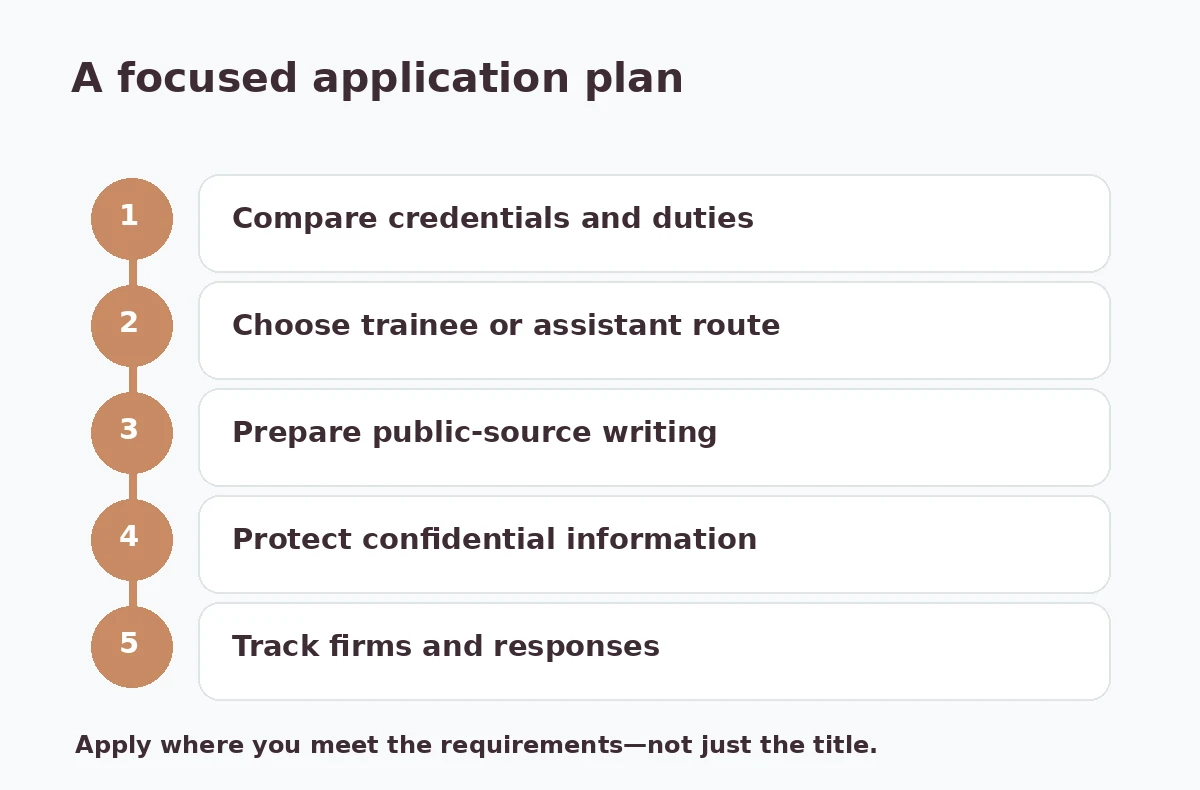
Spend the first day identifying five local legal-support job descriptions. On the second, separate required credentials from preferences. On the third, prepare a short research or document-control sample from entirely fictional or public material. Then, on the fourth, revise your resume to emphasize precision, writing, calendar management, and genuine coursework. On the fifth, apply to roles you can credibly perform and note training questions for interviews.
If the required education is consistently missing, consider a realistic training or administrative route before expecting direct paralegal responsibility. If your experience is mostly office coordination, legal assistant and intake titles may be better search terms. Track why an application fits or does not fit; the objective is an evidence-based choice, not an inflated number of submissions. For the fuller picture, see our guide “Entry-Level Electrician Jobs”.
How We Research Entry-Level Job Routes
We checked the linked sources on 2026-10-21. The route distinctions, application tables, and sample exercises here are editorial tools rather than claims from employers. Educational examples are hypothetical and should be adapted to your genuine qualifications.
Sources checked on 2026-10-21: BLS occupational profile (BLS lists legal research, records, and drafting support, and explains that education paths and employer expectations vary.) official career guidance (CareerOneStop explains how to distinguish required qualifications from preferred requirements.) official career guidance (CareerOneStop describes targeted applications and recording employer contacts.) These sources support the occupational and procedural statements indicated, not a claim that every company uses the same screening standards.
This guide contains no affiliate links. See the JobAsk affiliate disclosure for the site-wide policy. Verify every employer, opening, and program before providing personal information.
Related Job Search Guides
- Entry-Level Legal Assistant Jobs: Organize Files and Protect Deadlines
- Entry-Level Sales Jobs: Compare Positions and Build Proof
- Entry-Level Construction Jobs: Find a Suitable First Site Role
- Legal Job Boards: Separate Attorney Roles From Paralegal Support
- Entry-Level Compliance Jobs: Compare Analyst Support and Officer Roles
Some employers consider alternative education or relevant experience, while many roles expect a certificate or degree. Review exact requirements.
Duties can overlap, but responsibilities and education expectations depend on the employer and role. Read the posting.
Do not disclose client or employer materials without authorization. Use clearly labeled fictional or public examples.
Paralegals generally work in support of attorneys and must respect applicable limits on legal practice. Do not imply you can advise clients independently.
Show real research, writing, organization, source checks, confidentiality habits, and applicable coursework.